
Specialty Pharmacy Management Platforms: A Comprehensive Comparison
Specialty Pharmacy Management Platforms: A Comprehensive Comparison
The Specialty Drug Takeover
Specialty drugs have quietly taken over American healthcare spending. They now account for 55% of all U.S. medication dollars - up from 28% in 2011 - while representing just 2-3% of prescription volume. We're talking about $301 billion in 2021 alone, and the number keeps climbing.
Here's why that matters for pharmacy operations: each specialty prescription demands a gauntlet of administrative work before a patient ever receives their medication. Benefit verification. Prior authorization. Financial assistance enrollment. Patient onboarding. Clinical monitoring. Adherence support. When any of these steps breaks down, patients don't start therapy. BrightInsight and Claritas Rx found that 38% of specialty prescriptions are never filled. That's not a billing problem - it's a patient care crisis.
So the question facing specialty pharmacy leaders isn't whether to invest in technology. It's which platform actually fits your operation.
We looked at 14 platforms across three categories: the established clinical management systems that have been around for years, the digital-first solutions built by startups, and the newer AI-powered platforms focused on automation. What follows is what we found.
What These Platforms Do and Market Trends
Before diving into specific vendors, it helps to understand the five functional areas where these platforms compete.
Clinical workflow management is the foundation - dispensing workflows, clinical assessments, drug utilization review, REMS compliance tracking. This is where the traditional pharmacy platforms have the deepest roots.
Patient access covers benefit verification, prior auth, and financial assistance. This is often where specialty pharmacies burn the most staff hours. A single prescription might require 12-15 discrete administrative tasks before you can dispense.
Operations means inventory, fulfillment, cold chain, shipping, compliance reporting. For high-volume pharmacies, this is where margin lives or dies.
Patient engagement handles onboarding, education, adherence monitoring, refills. Specialty medications often demand lifestyle changes and ongoing monitoring, so this isn't optional.
Payer management covers contracting, outcomes reporting, accreditation compliance. As payers demand more granular data for value-based arrangements, this increasingly drives platform selection.
Market Trends Worth Knowing
Four dynamics are reshaping this market in 2026.
Health systems keep launching their own specialty pharmacies to capture margin on drugs dispensed to their patients. These pharmacies need tight EHR integration and outcomes reporting that feeds quality programs - requirements that favor certain platforms.
The architecture shift from on-premise to cloud continues. Legacy systems built for traditional pharmacy struggle with specialty's documentation and integration demands. Cloud platforms update faster and require less IT overhead.
AI is entering from two directions: established platforms bolting on AI features, and AI-native startups building from scratch. The clearest AI wins right now are prior auth, benefit verification, and patient outreach - high-volume, repetitive tasks.
And regulatory complexity keeps growing. USP 800, expanding REMS programs, 340B compliance - platforms need to track requirements at the medication level and document everything for audits.
Established Clinical Management Systems
These evolved from pharmacy management systems and offer mature clinical workflows. They're the safe choice if you prioritize stability and comprehensive clinical features.
WellSky CareTend has the largest installed base in specialty pharmacy. It came from CareTend (before WellSky acquired it) and has deep roots in home infusion. The clinical depth is real - especially for infusion therapies requiring extensive monitoring. It runs on-premise or hosted. The trade-off: it's not cloud-native, so you're dealing with older architecture even as WellSky modernizes it. If you're a health system pharmacy or independent with high clinical complexity, particularly infusion, CareTend is probably on your shortlist.
McKesson EnterpriseRx Specialty leverages McKesson's position as the largest distributor. The obvious advantage: your pharmacy management and supply chain run through one vendor, with direct visibility into inventory and access to limited distribution drugs. It's cloud-hosted with McKesson handling infrastructure. The dependency cuts both ways - you're deeply tied to McKesson's ecosystem. Makes sense if you're already using McKesson distribution and want to consolidate.
PrimeRx Specialty from Micro Merchant Systems targets independents who want enterprise-level specialty capabilities without enterprise complexity or cost. It handles clinical workflows, PA tracking, adherence monitoring, with built-in POS and inventory. Shorter implementation timelines than the big platforms. The Windows-based interface is functional if not beautiful. Good fit for independent specialty pharmacies and small chains that need robust functionality without the overhead of platforms built for health systems.
Inovalon ScriptMed Cloud pairs specialty pharmacy management with Inovalon's broader data and analytics. The differentiator is access to Inovalon's healthcare data assets—you can benchmark against peers and get payer-specific insights that standalone platforms can't offer. Cloud-native with continuous updates. Works well if you're data-driven and want analytics beyond what pharmacy platforms typically provide.
Omnicell (which acquired EnlivenHealth in 2022) combines pharmacy software with automation hardware. The EnlivenHealth platform handles specialty workflows and patient engagement. The interesting angle is if you need integrated medication management across inpatient and specialty pharmacy settings - Omnicell can connect those worlds.
CPS therigyst takes a different approach: it's built around clinical pharmacist workflows rather than dispensing operations. Heavy emphasis on clinical documentation, therapy management, and outcomes tracking. If your specialty pharmacy's value comes from clinical services rather than volume, therigyst is designed for that model. It interfaces with dispensing systems rather than replacing them.
ScriptPro offers something unique: robotic dispensing plus pharmacy management software. The robots handle high-volume, high-accuracy fills - useful for controlled substances and high-cost specialty medications where precision matters. The trade-off is significant capital investment in hardware. Makes sense for high-volume operations where automation ROI pencils out.
PioneerRx serves independents wanting modern technology without enterprise complexity. It covers both traditional and specialty operations on one platform, with an interface that's notably more usable than legacy systems. Regular updates based on customer input. Good choice for independents expanding into specialty who don't want to run separate platforms.
Digital-First and AI-Powered Platforms
Digital-First Solutions
Built specifically for specialty pharmacy challenges, often with startup funding and modern architectures.
House Rx is focused specifically on medically integrated pharmacy - where specialty pharmacies operate within physician practices. Founded in 2020, they've built AI-powered PA automation into the core platform. Their reported numbers are impressive: 92% first-pass PA approval rate, 3.5-day average fill time versus a 15.5-day industry average, PA documentation generated in 15 seconds. They've processed over $1.2 billion in specialty prescriptions across 80+ clinic sites. (These are self-reported figures—we couldn't independently verify them, but they're directionally interesting.) If you're a provider-owned specialty pharmacy or building a medically integrated model, House Rx is purpose-built for that.
Bayvrio does something different: it's a marketplace connecting specialty pharmacies to pharmaceutical manufacturers and hub programs. Rather than traditional pharmacy management, Bayvrio helps you access limited distribution networks and manufacturer programs without building those relationships yourself. Useful if you're trying to expand into new therapies and don't have the relationships yet.
AI-Powered Platforms
These apply AI as a core capability rather than an add-on. They're focused on automating the administrative work that consumes staff time.
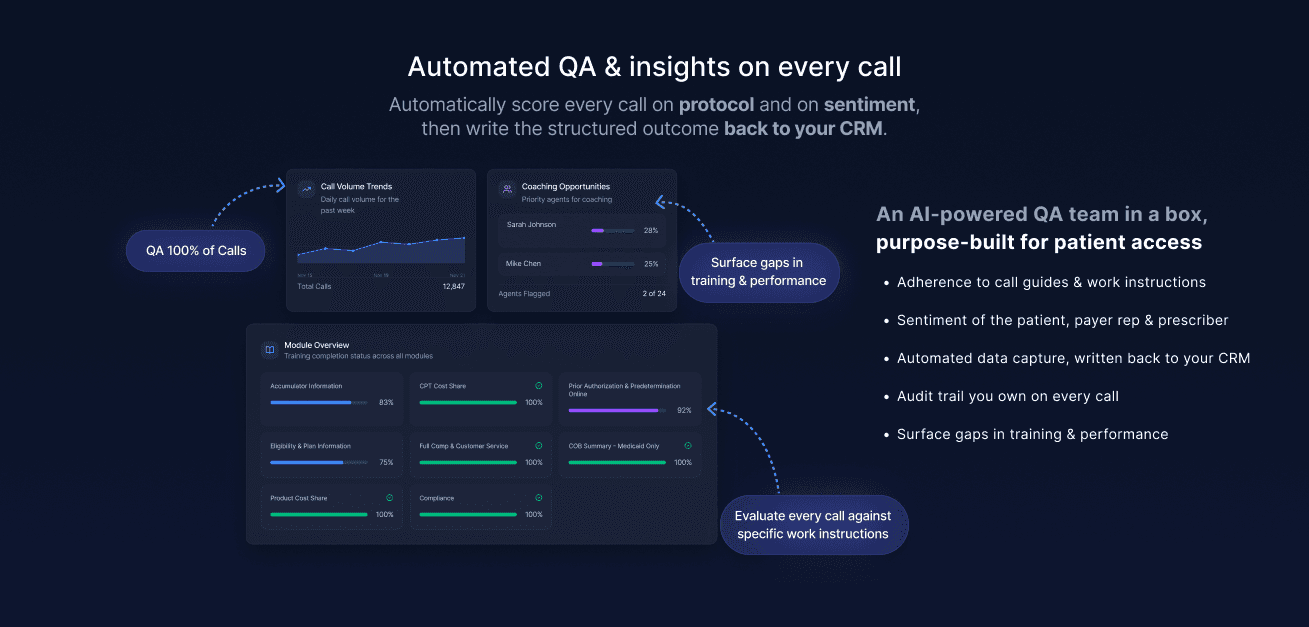
Neon Health provides what they call an "AI workforce" - agents that handle benefit verification, prior auth, financial assistance enrollment, and adherence support. Unlike traditional RPA (which breaks when portals change), Neon's AI adapts to changes and handles exceptions. They report 2x faster time-to-therapy and 80% cost reduction versus manual processes. Raised $6M in September 2025 to expand specialty drug access. HIPAA compliant with HITRUST and SOC 2 certifications. The approach is modular—they integrate with your existing pharmacy systems rather than replacing them. Good fit for specialty pharmacies, pharma hub programs, and health systems where patient access is the bottleneck.
Mandolin focuses specifically on PA automation for specialty medications - submission, tracking, appeals. Deep specialization means concentrated development on that one problem. Makes sense if PA volume is your primary pain point and you want a dedicated solution rather than a broader platform.
Tandem automates the medication access workflow: benefit verification, PA, financial assistance enrollment. Built around the pre-dispense administrative work that delays therapy. Similar to Neon in approach - AI-native, focused on patient access - with their own integration model.
Latent Health takes a clinical AI angle rather than administrative. They focus on clinical decision support and patient monitoring—helping pharmacists with complex therapy management rather than automating paperwork. If your challenge is clinical complexity rather than administrative volume, Latent is built for that.
Feature Comparison and Performance Data
Platform | Clinical | Dispensing | PA Auto | BV Auto | Financial Assist | Adherence | REMS | 340B | Deploy | AI |
|---|---|---|---|---|---|---|---|---|---|---|
WellSky CareTend | Full | Full | Partial | Partial | Partial | Full | Full | Full | On-prem/Hosted | Limited |
McKesson EnterpriseRx | Full | Full | Partial | Partial | Partial | Full | Full | Full | Cloud | Limited |
PrimeRx Specialty | Full | Full | Partial | Partial | Partial | Full | Full | Partial | On-prem/Cloud | Limited |
Inovalon ScriptMed | Full | Full | Partial | Partial | Partial | Full | Full | Full | Cloud | Partial |
Omnicell/EnlivenHealth | Full | Full | Partial | Partial | Partial | Full | Full | Full | Cloud | Partial |
CPS therigyst | Full | Partial | Partial | Partial | Partial | Full | Full | Partial | Cloud | Limited |
ScriptPro | Partial | Full | None | None | None | Partial | Partial | Partial | On-prem | Limited |
PioneerRx | Full | Full | Partial | Partial | Partial | Full | Full | Partial | Cloud | Limited |
House Rx | Full | Full | Full | Full | Full | Full | Full | Partial | Cloud | Full |
Bayvrio | Partial | None | None | None | Partial | None | None | None | Cloud | Limited |
Neon Health | Partial | None | Full | Full | Full | Full | None | None | Cloud | Full |
Mandolin | None | None | Full | Partial | None | None | None | None | Cloud | Full |
Tandem | Partial | None | Full | Full | Full | Partial | None | None | Cloud | Full |
Latent Health | Full | None | None | None | None | Partial | Partial | None | Cloud | Full |
Full = comprehensive native capability. Partial = basic or through integration. None = not available.
Performance Numbers (With Caveats)
Comparing performance across platforms is genuinely difficult. Patient populations differ, therapy mixes differ, and most data is self-reported by vendors.
Time-to-fill: Industry average is roughly 15.5 days from prescription to patient delivery (House Rx cites this figure). House Rx reports 3.5 days. AI platforms generally claim 50-70% reductions through automation. These claims are plausible but hard to verify independently.
PA approval rates: Industry baseline seems to be 60-70% first-pass approval for specialty medications. House Rx reports 92%. AI-assisted platforms generally claim 10-20 percentage point improvements through better documentation. Again - plausible, self-reported.
Cost per prescription: Manual administrative processing seems to run $25-50 per prescription depending on therapy complexity. Automation platforms claim 50-80% reductions. Neon Health specifically cites 80% cost reduction.
A note on this data: Most of it comes from vendor press releases and marketing materials. Independent verification through peer-reviewed studies or organizations like NCPDP or NASP is thin on the ground. When evaluating platforms, ask for customer references with similar patient populations and therapy mixes.
Matching Platforms to Pharmacy Types
Health system specialty pharmacy: You need EHR integration (Epic, Cerner, MEDITECH), clinical documentation that feeds quality measures, outcomes reporting for contracts, and 340B/REMS compliance. Look at WellSky CareTend, Omnicell/EnlivenHealth, Inovalon ScriptMed, or CPS therigyst. Layer in Neon Health or Tandem if patient access automation is a priority.
Independent specialty pharmacy: You need reasonable TCO, multi-payer support, efficient operations, and accreditation compliance without dedicated IT staff. PrimeRx Specialty and PioneerRx fit here. Add Mandolin or Neon Health for PA/patient access automation.
Pharma-partnered specialty pharmacy: You need hub integration, REMS compliance for specific drugs, manufacturer reporting, and financial assistance management. WellSky CareTend, McKesson EnterpriseRx, or Bayvrio for manufacturer access. Neon Health for automated financial assistance enrollment.
PBM/mail-order specialty: High-volume processing, multi-state compliance, automation at scale. McKesson EnterpriseRx or ScriptPro for robotic automation. Layer AI platforms for PA and BV.
Provider-owned medically integrated pharmacy: Tight provider workflow integration, clinical documentation from EHR, rapid PA turnaround. House Rx is purpose-built for this model.
Where AI Helps and The Bottom Line
Where AI Actually Helps (and Where It Doesn't)
AI in specialty pharmacy is real, but the impact varies.
Where AI delivers clear value: Prior authorization works well because it's high-volume, rules-based, and document-intensive. AI can read clinical records, match payer requirements, and submit requests faster than humans doing it manually. Benefit verification similarly involves navigating portals, interpreting coverage, and extracting data - tasks that scale poorly with human labor. Patient outreach for refills, adherence, and scheduling frees clinical staff for complex work. Financial assistance involves matching patients to programs and completing enrollment - repetitive data work.
Where AI falls short: Clinical judgment shouldn't be automated. Complex drug interactions, patient-specific factors, and clinical exceptions need pharmacists. Relationship management with providers, payers, and patients during difficult situations requires humans. And exception handling—AI handles the routine 70-80%, but edge cases still need people.
The hybrid model that works: AI handles routine administrative tasks. Staff focus on exceptions, clinical interventions, and relationships. AI augments clinical decision-making with relevant information. Humans maintain oversight and catch errors.
Pharmacies that view AI as replacing staff are missing the point. The ones getting value view AI as amplifying their team.
What to ask when evaluating AI platforms:
• Does the AI execute complete workflows or just surface information for humans to act on?
• How does it handle payer portal changes and exceptions?
• Can you see how decisions are made and override them?
• Does it layer into existing systems or require platform replacement?
• What certifications does the vendor have for handling PHI?
The Bottom Line
The market is bifurcating. Established vendors are adding AI. AI-native vendors are expanding clinical features. Both paths can work - your choice depends on where you're starting.
If patient access delays, PA backlogs, or administrative costs are your constraint, AI-powered automation is the clearest path forward. If clinical complexity and therapy management drive your value, you need platforms with deep clinical functionality.
The specialty drug market will keep growing. Platforms that help pharmacies scale without proportionally scaling headcount - while getting patients on therapy faster - will win. That's where the technology is heading, even if we're still early.
The Specialty Drug Takeover
Specialty drugs have quietly taken over American healthcare spending. They now account for 55% of all U.S. medication dollars - up from 28% in 2011 - while representing just 2-3% of prescription volume. We're talking about $301 billion in 2021 alone, and the number keeps climbing.
Here's why that matters for pharmacy operations: each specialty prescription demands a gauntlet of administrative work before a patient ever receives their medication. Benefit verification. Prior authorization. Financial assistance enrollment. Patient onboarding. Clinical monitoring. Adherence support. When any of these steps breaks down, patients don't start therapy. BrightInsight and Claritas Rx found that 38% of specialty prescriptions are never filled. That's not a billing problem - it's a patient care crisis.
So the question facing specialty pharmacy leaders isn't whether to invest in technology. It's which platform actually fits your operation.
We looked at 14 platforms across three categories: the established clinical management systems that have been around for years, the digital-first solutions built by startups, and the newer AI-powered platforms focused on automation. What follows is what we found.
What These Platforms Do and Market Trends
Before diving into specific vendors, it helps to understand the five functional areas where these platforms compete.
Clinical workflow management is the foundation - dispensing workflows, clinical assessments, drug utilization review, REMS compliance tracking. This is where the traditional pharmacy platforms have the deepest roots.
Patient access covers benefit verification, prior auth, and financial assistance. This is often where specialty pharmacies burn the most staff hours. A single prescription might require 12-15 discrete administrative tasks before you can dispense.
Operations means inventory, fulfillment, cold chain, shipping, compliance reporting. For high-volume pharmacies, this is where margin lives or dies.
Patient engagement handles onboarding, education, adherence monitoring, refills. Specialty medications often demand lifestyle changes and ongoing monitoring, so this isn't optional.
Payer management covers contracting, outcomes reporting, accreditation compliance. As payers demand more granular data for value-based arrangements, this increasingly drives platform selection.
Market Trends Worth Knowing
Four dynamics are reshaping this market in 2026.
Health systems keep launching their own specialty pharmacies to capture margin on drugs dispensed to their patients. These pharmacies need tight EHR integration and outcomes reporting that feeds quality programs - requirements that favor certain platforms.
The architecture shift from on-premise to cloud continues. Legacy systems built for traditional pharmacy struggle with specialty's documentation and integration demands. Cloud platforms update faster and require less IT overhead.
AI is entering from two directions: established platforms bolting on AI features, and AI-native startups building from scratch. The clearest AI wins right now are prior auth, benefit verification, and patient outreach - high-volume, repetitive tasks.
And regulatory complexity keeps growing. USP 800, expanding REMS programs, 340B compliance - platforms need to track requirements at the medication level and document everything for audits.
Established Clinical Management Systems
These evolved from pharmacy management systems and offer mature clinical workflows. They're the safe choice if you prioritize stability and comprehensive clinical features.
WellSky CareTend has the largest installed base in specialty pharmacy. It came from CareTend (before WellSky acquired it) and has deep roots in home infusion. The clinical depth is real - especially for infusion therapies requiring extensive monitoring. It runs on-premise or hosted. The trade-off: it's not cloud-native, so you're dealing with older architecture even as WellSky modernizes it. If you're a health system pharmacy or independent with high clinical complexity, particularly infusion, CareTend is probably on your shortlist.
McKesson EnterpriseRx Specialty leverages McKesson's position as the largest distributor. The obvious advantage: your pharmacy management and supply chain run through one vendor, with direct visibility into inventory and access to limited distribution drugs. It's cloud-hosted with McKesson handling infrastructure. The dependency cuts both ways - you're deeply tied to McKesson's ecosystem. Makes sense if you're already using McKesson distribution and want to consolidate.
PrimeRx Specialty from Micro Merchant Systems targets independents who want enterprise-level specialty capabilities without enterprise complexity or cost. It handles clinical workflows, PA tracking, adherence monitoring, with built-in POS and inventory. Shorter implementation timelines than the big platforms. The Windows-based interface is functional if not beautiful. Good fit for independent specialty pharmacies and small chains that need robust functionality without the overhead of platforms built for health systems.
Inovalon ScriptMed Cloud pairs specialty pharmacy management with Inovalon's broader data and analytics. The differentiator is access to Inovalon's healthcare data assets—you can benchmark against peers and get payer-specific insights that standalone platforms can't offer. Cloud-native with continuous updates. Works well if you're data-driven and want analytics beyond what pharmacy platforms typically provide.
Omnicell (which acquired EnlivenHealth in 2022) combines pharmacy software with automation hardware. The EnlivenHealth platform handles specialty workflows and patient engagement. The interesting angle is if you need integrated medication management across inpatient and specialty pharmacy settings - Omnicell can connect those worlds.
CPS therigyst takes a different approach: it's built around clinical pharmacist workflows rather than dispensing operations. Heavy emphasis on clinical documentation, therapy management, and outcomes tracking. If your specialty pharmacy's value comes from clinical services rather than volume, therigyst is designed for that model. It interfaces with dispensing systems rather than replacing them.
ScriptPro offers something unique: robotic dispensing plus pharmacy management software. The robots handle high-volume, high-accuracy fills - useful for controlled substances and high-cost specialty medications where precision matters. The trade-off is significant capital investment in hardware. Makes sense for high-volume operations where automation ROI pencils out.
PioneerRx serves independents wanting modern technology without enterprise complexity. It covers both traditional and specialty operations on one platform, with an interface that's notably more usable than legacy systems. Regular updates based on customer input. Good choice for independents expanding into specialty who don't want to run separate platforms.
Digital-First and AI-Powered Platforms
Digital-First Solutions
Built specifically for specialty pharmacy challenges, often with startup funding and modern architectures.
House Rx is focused specifically on medically integrated pharmacy - where specialty pharmacies operate within physician practices. Founded in 2020, they've built AI-powered PA automation into the core platform. Their reported numbers are impressive: 92% first-pass PA approval rate, 3.5-day average fill time versus a 15.5-day industry average, PA documentation generated in 15 seconds. They've processed over $1.2 billion in specialty prescriptions across 80+ clinic sites. (These are self-reported figures—we couldn't independently verify them, but they're directionally interesting.) If you're a provider-owned specialty pharmacy or building a medically integrated model, House Rx is purpose-built for that.
Bayvrio does something different: it's a marketplace connecting specialty pharmacies to pharmaceutical manufacturers and hub programs. Rather than traditional pharmacy management, Bayvrio helps you access limited distribution networks and manufacturer programs without building those relationships yourself. Useful if you're trying to expand into new therapies and don't have the relationships yet.
AI-Powered Platforms
These apply AI as a core capability rather than an add-on. They're focused on automating the administrative work that consumes staff time.
Neon Health provides what they call an "AI workforce" - agents that handle benefit verification, prior auth, financial assistance enrollment, and adherence support. Unlike traditional RPA (which breaks when portals change), Neon's AI adapts to changes and handles exceptions. They report 2x faster time-to-therapy and 80% cost reduction versus manual processes. Raised $6M in September 2025 to expand specialty drug access. HIPAA compliant with HITRUST and SOC 2 certifications. The approach is modular—they integrate with your existing pharmacy systems rather than replacing them. Good fit for specialty pharmacies, pharma hub programs, and health systems where patient access is the bottleneck.
Mandolin focuses specifically on PA automation for specialty medications - submission, tracking, appeals. Deep specialization means concentrated development on that one problem. Makes sense if PA volume is your primary pain point and you want a dedicated solution rather than a broader platform.
Tandem automates the medication access workflow: benefit verification, PA, financial assistance enrollment. Built around the pre-dispense administrative work that delays therapy. Similar to Neon in approach - AI-native, focused on patient access - with their own integration model.
Latent Health takes a clinical AI angle rather than administrative. They focus on clinical decision support and patient monitoring—helping pharmacists with complex therapy management rather than automating paperwork. If your challenge is clinical complexity rather than administrative volume, Latent is built for that.
Feature Comparison and Performance Data
Platform | Clinical | Dispensing | PA Auto | BV Auto | Financial Assist | Adherence | REMS | 340B | Deploy | AI |
|---|---|---|---|---|---|---|---|---|---|---|
WellSky CareTend | Full | Full | Partial | Partial | Partial | Full | Full | Full | On-prem/Hosted | Limited |
McKesson EnterpriseRx | Full | Full | Partial | Partial | Partial | Full | Full | Full | Cloud | Limited |
PrimeRx Specialty | Full | Full | Partial | Partial | Partial | Full | Full | Partial | On-prem/Cloud | Limited |
Inovalon ScriptMed | Full | Full | Partial | Partial | Partial | Full | Full | Full | Cloud | Partial |
Omnicell/EnlivenHealth | Full | Full | Partial | Partial | Partial | Full | Full | Full | Cloud | Partial |
CPS therigyst | Full | Partial | Partial | Partial | Partial | Full | Full | Partial | Cloud | Limited |
ScriptPro | Partial | Full | None | None | None | Partial | Partial | Partial | On-prem | Limited |
PioneerRx | Full | Full | Partial | Partial | Partial | Full | Full | Partial | Cloud | Limited |
House Rx | Full | Full | Full | Full | Full | Full | Full | Partial | Cloud | Full |
Bayvrio | Partial | None | None | None | Partial | None | None | None | Cloud | Limited |
Neon Health | Partial | None | Full | Full | Full | Full | None | None | Cloud | Full |
Mandolin | None | None | Full | Partial | None | None | None | None | Cloud | Full |
Tandem | Partial | None | Full | Full | Full | Partial | None | None | Cloud | Full |
Latent Health | Full | None | None | None | None | Partial | Partial | None | Cloud | Full |
Full = comprehensive native capability. Partial = basic or through integration. None = not available.
Performance Numbers (With Caveats)
Comparing performance across platforms is genuinely difficult. Patient populations differ, therapy mixes differ, and most data is self-reported by vendors.
Time-to-fill: Industry average is roughly 15.5 days from prescription to patient delivery (House Rx cites this figure). House Rx reports 3.5 days. AI platforms generally claim 50-70% reductions through automation. These claims are plausible but hard to verify independently.
PA approval rates: Industry baseline seems to be 60-70% first-pass approval for specialty medications. House Rx reports 92%. AI-assisted platforms generally claim 10-20 percentage point improvements through better documentation. Again - plausible, self-reported.
Cost per prescription: Manual administrative processing seems to run $25-50 per prescription depending on therapy complexity. Automation platforms claim 50-80% reductions. Neon Health specifically cites 80% cost reduction.
A note on this data: Most of it comes from vendor press releases and marketing materials. Independent verification through peer-reviewed studies or organizations like NCPDP or NASP is thin on the ground. When evaluating platforms, ask for customer references with similar patient populations and therapy mixes.
Matching Platforms to Pharmacy Types
Health system specialty pharmacy: You need EHR integration (Epic, Cerner, MEDITECH), clinical documentation that feeds quality measures, outcomes reporting for contracts, and 340B/REMS compliance. Look at WellSky CareTend, Omnicell/EnlivenHealth, Inovalon ScriptMed, or CPS therigyst. Layer in Neon Health or Tandem if patient access automation is a priority.
Independent specialty pharmacy: You need reasonable TCO, multi-payer support, efficient operations, and accreditation compliance without dedicated IT staff. PrimeRx Specialty and PioneerRx fit here. Add Mandolin or Neon Health for PA/patient access automation.
Pharma-partnered specialty pharmacy: You need hub integration, REMS compliance for specific drugs, manufacturer reporting, and financial assistance management. WellSky CareTend, McKesson EnterpriseRx, or Bayvrio for manufacturer access. Neon Health for automated financial assistance enrollment.
PBM/mail-order specialty: High-volume processing, multi-state compliance, automation at scale. McKesson EnterpriseRx or ScriptPro for robotic automation. Layer AI platforms for PA and BV.
Provider-owned medically integrated pharmacy: Tight provider workflow integration, clinical documentation from EHR, rapid PA turnaround. House Rx is purpose-built for this model.
Where AI Helps and The Bottom Line
Where AI Actually Helps (and Where It Doesn't)
AI in specialty pharmacy is real, but the impact varies.
Where AI delivers clear value: Prior authorization works well because it's high-volume, rules-based, and document-intensive. AI can read clinical records, match payer requirements, and submit requests faster than humans doing it manually. Benefit verification similarly involves navigating portals, interpreting coverage, and extracting data - tasks that scale poorly with human labor. Patient outreach for refills, adherence, and scheduling frees clinical staff for complex work. Financial assistance involves matching patients to programs and completing enrollment - repetitive data work.
Where AI falls short: Clinical judgment shouldn't be automated. Complex drug interactions, patient-specific factors, and clinical exceptions need pharmacists. Relationship management with providers, payers, and patients during difficult situations requires humans. And exception handling—AI handles the routine 70-80%, but edge cases still need people.
The hybrid model that works: AI handles routine administrative tasks. Staff focus on exceptions, clinical interventions, and relationships. AI augments clinical decision-making with relevant information. Humans maintain oversight and catch errors.
Pharmacies that view AI as replacing staff are missing the point. The ones getting value view AI as amplifying their team.
What to ask when evaluating AI platforms:
• Does the AI execute complete workflows or just surface information for humans to act on?
• How does it handle payer portal changes and exceptions?
• Can you see how decisions are made and override them?
• Does it layer into existing systems or require platform replacement?
• What certifications does the vendor have for handling PHI?
The Bottom Line
The market is bifurcating. Established vendors are adding AI. AI-native vendors are expanding clinical features. Both paths can work - your choice depends on where you're starting.
If patient access delays, PA backlogs, or administrative costs are your constraint, AI-powered automation is the clearest path forward. If clinical complexity and therapy management drive your value, you need platforms with deep clinical functionality.
The specialty drug market will keep growing. Platforms that help pharmacies scale without proportionally scaling headcount - while getting patients on therapy faster - will win. That's where the technology is heading, even if we're still early.
Related articles
Related articles

Ready to transform Patient Access?
Ready to transform Patient Access?
NEWSLETTER
@ 2026 Neon Health (Belay, Inc).
AI-powered patient access automation
for leading pharma enterprises.
NEWSLETTER
@ 2026 Neon Health (Belay, Inc).
AI-powered patient access automation for leading pharma enterprises.
NEWSLETTER
@ 2026 Neon Health (Belay, Inc).
AI-powered patient access automation
for leading pharma enterprises.