Quality Engine – AI-powered “QA team in a box”
Quality Engine – AI-powered “QA team in a box”
Automated QA & insights on every call
Automated QA & insights on every call
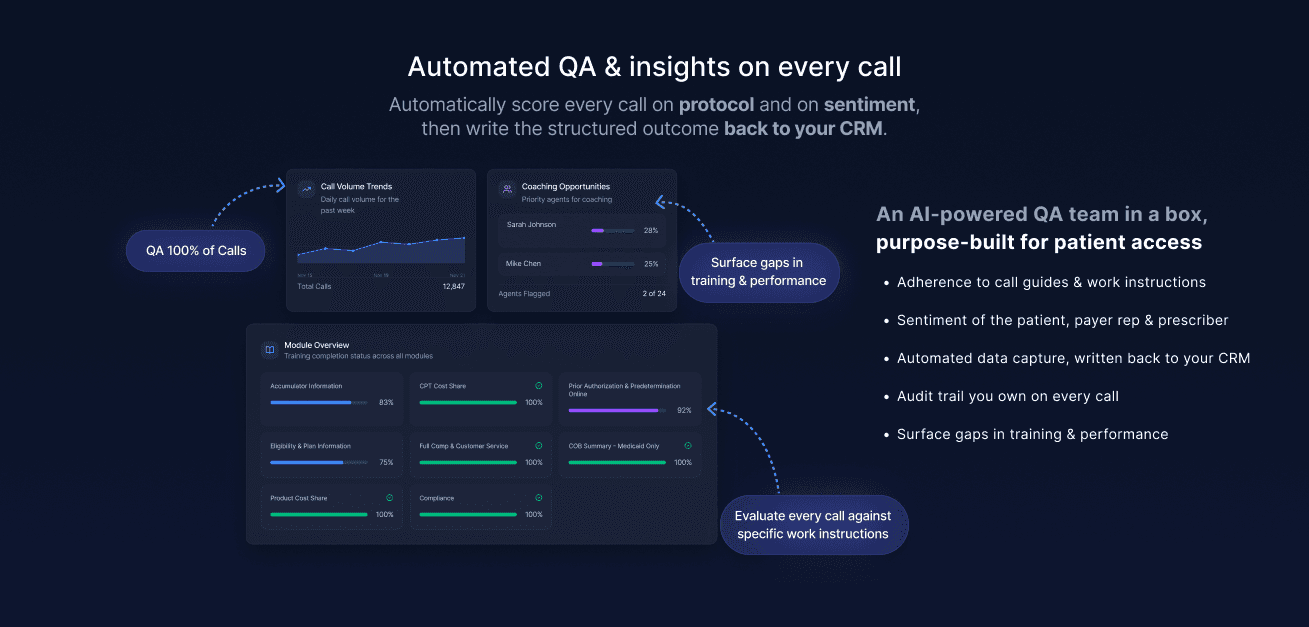
Today we’re launching the Neon Quality Engine – an AI-powered “QA team in a box”.
The Quality Engine gives you automated QA & Insights on every call:
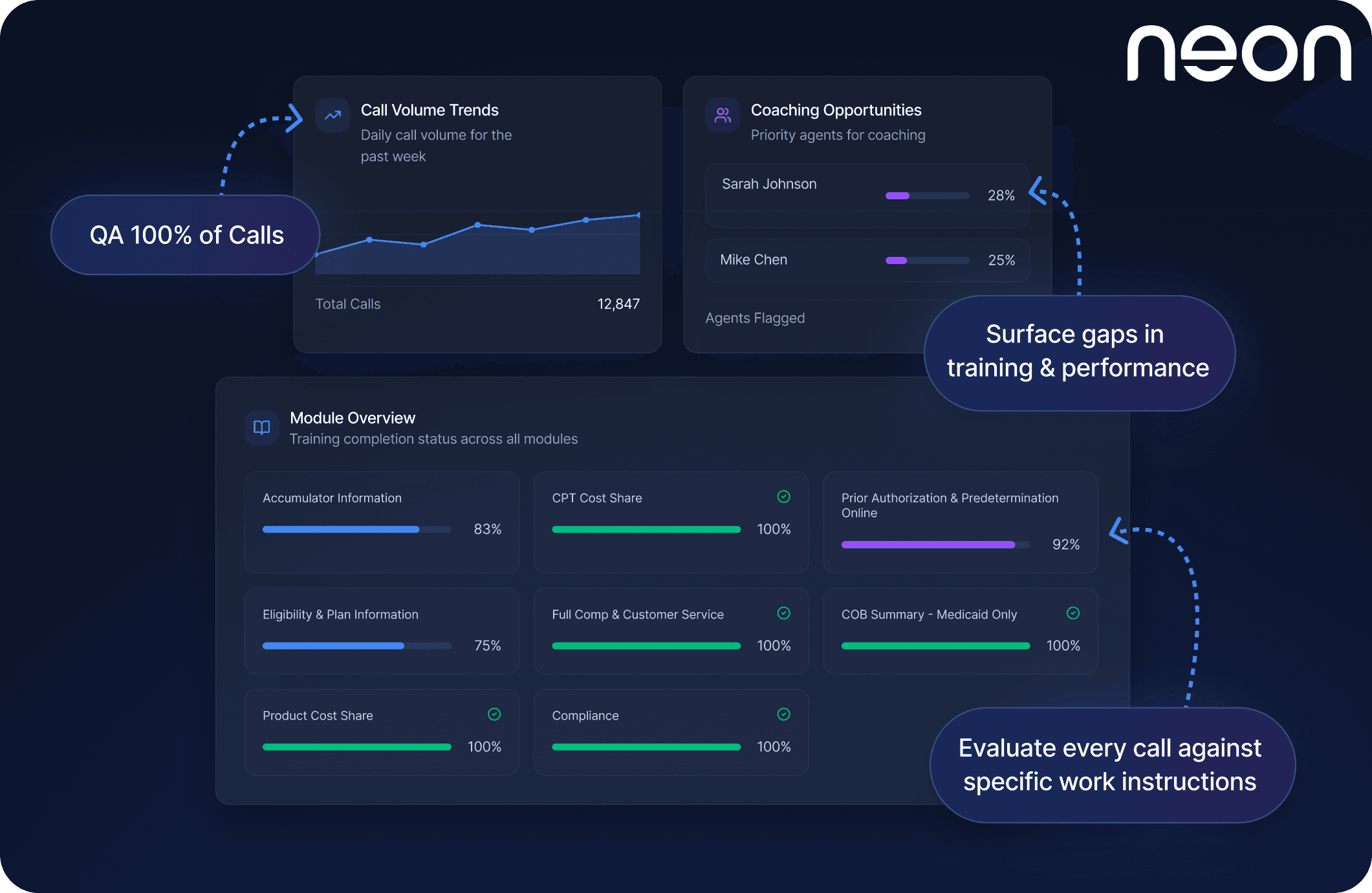
Evaluate every call against your program-specific work instructions
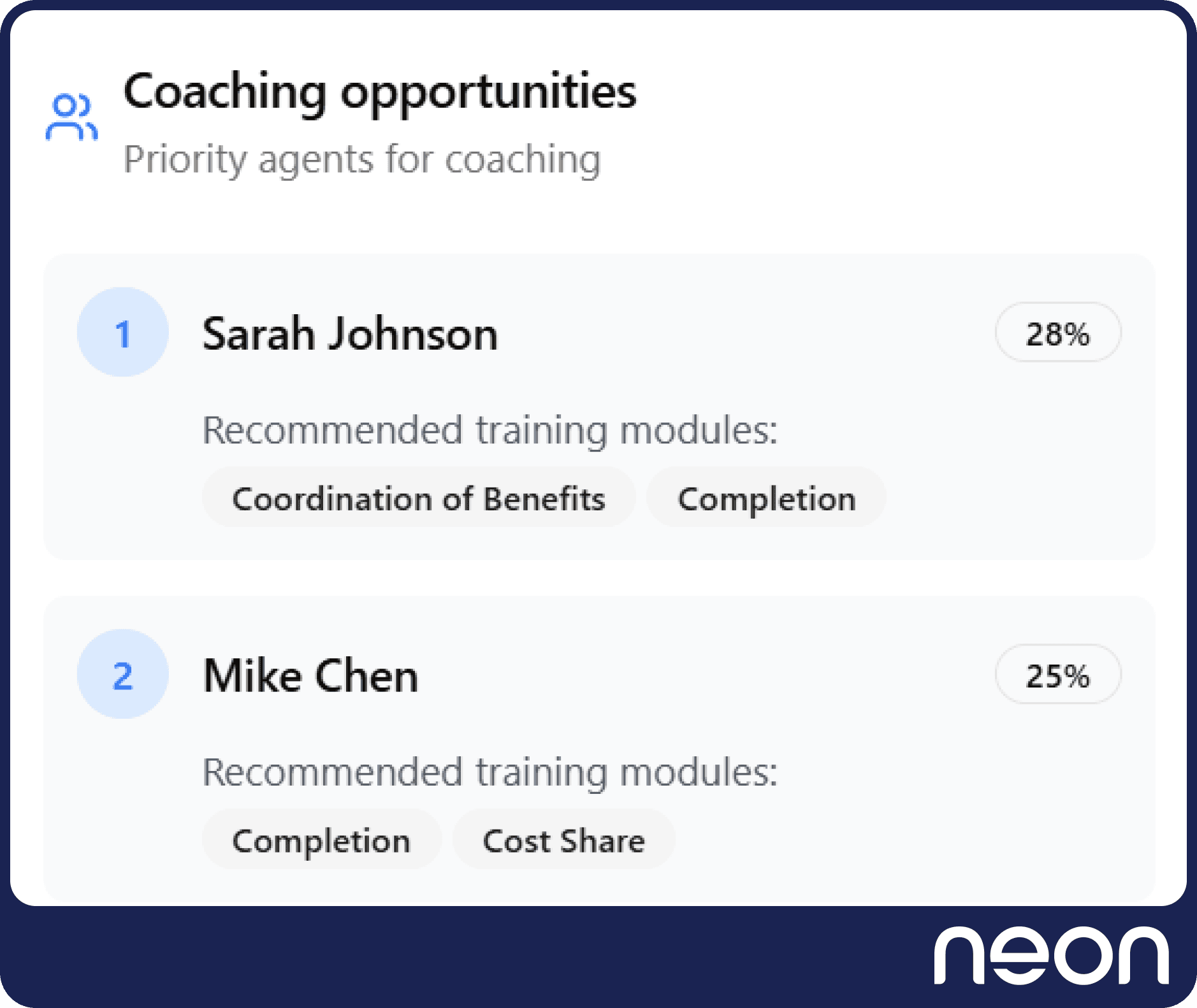
Prioritize coaching for your agents with recommended training modules
Track call quality trends and compliance metrics in real-time
Why did we build this specifically for patient access teams?
Neon Health is the market-leading AI automation partner for patient access teams.
Whereas large call center tools like Genesys and Five9 offer QA and sentiment analysis, they’re far too generic to be trusted to evaluate your call center operations with the level of detail and precision that you demand.
By contrast, Neon’s Quality Engine is purpose-built for patient access leaders – to deliver a level of observability and oversight that has never before been possible without costly human review.
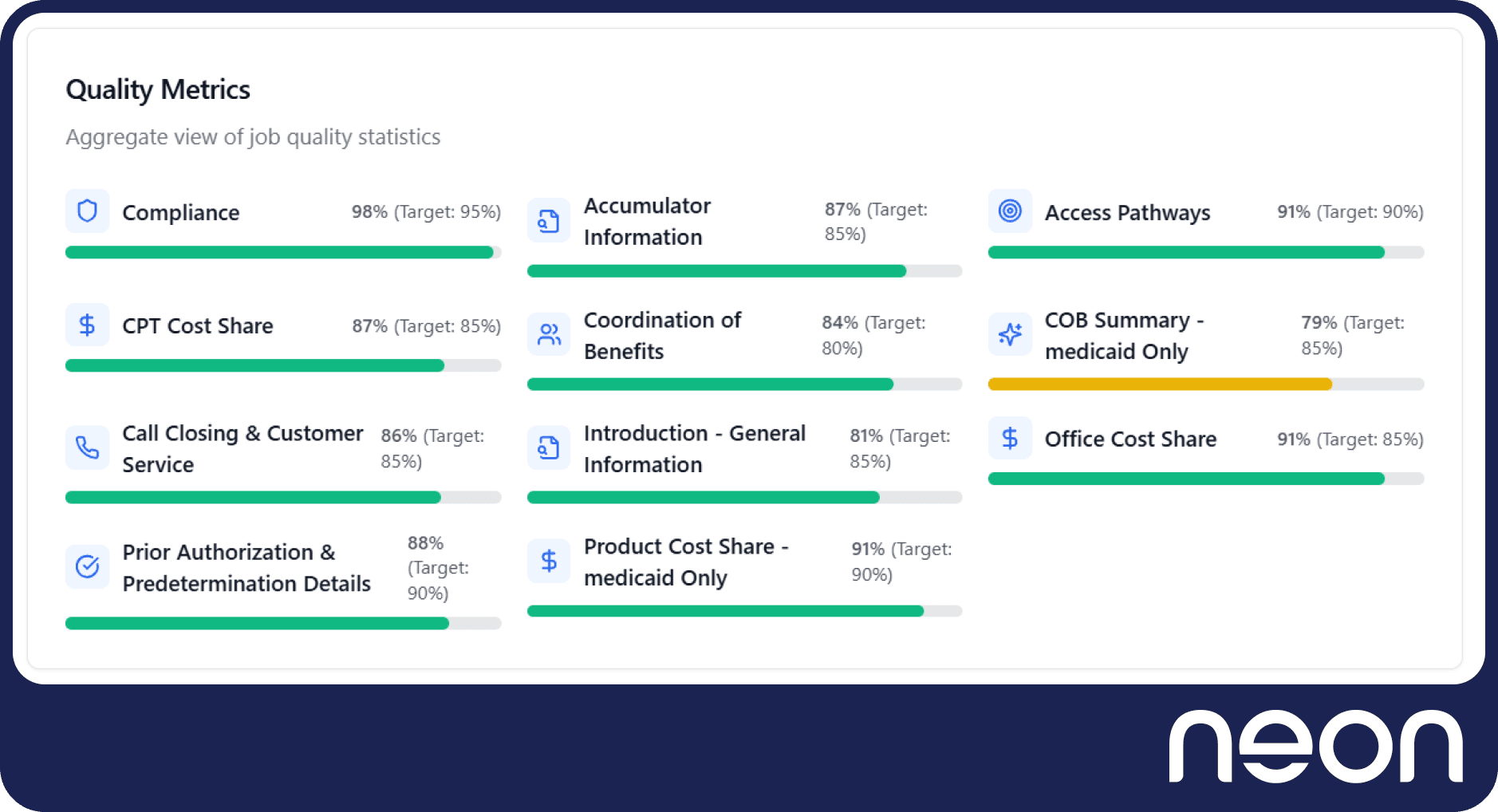
The Neon Quality Engine: an AI-powered "QA team in a box" purpose-built for patient access.
Today, we're giving patient access leaders command-and-control visibility into call center operations that used to require costly human review. Neon Quality Engine
scores every interaction against your program-specific work instructions;
monitors for the dynamic sentiment of the patient, payer rep, or prescriber;
and turns the substance of each interaction into structured case data that flows automatically back into your system of record.
100% call coverage, automated case data capture, accelerated agent credentialing, and command-and-control visibility for hubs, specialty pharmacies, and manufacturer patient services programs.
With the Neon Quality Engine, leaders see how teams are performing at any point in time. Supervisors can coach off evidence, not memory. And when your manager asks a question about your call center operations, your answer is based on comprehensive insights, not a sampled guess.
We built this because the quality tools currently on the market force a tradeoff that patient access leaders should not have to make.
The problem: quality that can't keep up
Most patient access QA programs today review a sample of five calls per agent per month. Roughly 5 to 10% coverage. That's the industry norm. It's also the source of most QA pain: persistent issues only surface after they've already cost the brand revenue or delayed a patient's access to therapy.
One QA lead at a major patient services hub told us: "If we could do quality without listening to the calls, we would obliterate the time it takes to do quality."
The tools that exist today force two tradeoffs at the same time.
1. Measuring sentiment vs following work instructions
The first is sentiment vs. work instructions. Generic contact-center QA platforms can tell you how the call sounded. They can tell you whether the payer rep was cooperative, whether the prescriber's staff felt heard, whether the patient walked away satisfied. They are too generic to be trusted with the level of detail patient access programs demand. They cannot tell you whether your agent actually ran your program, asked the required questions, or captured the right information. A call can score an A+ on tone and still be wrong.
2. Call coverage vs. depth of review
The second is coverage vs. depth. Manual review goes deep, but only on the 5 to 10% of calls a QA analyst can physically listen to. Persistent and potentially dangerous issues hide in the long tail of complications. Credentialing new agents requires QA analysts to listen to training calls one by one. During AR season, QA teams hire 10 to 40 temporary QA analysts just to keep up, and even then, they still review less than 10% of the spiked caseload. At scale, this breaks down. Small misses on even one call can create downstream rework that delays patient access and time to therapy. Traditional human QA simply can't keep up, not at the coverage levels that matter.
And for many teams, there's a problem the two tradeoffs don't capture: the QA tool often belongs to someone else. The people doing the work get measured by a system they can't see, tune, or defend against. A flag comes down, and the team is on the hook to explain a call no one on their side ever got to review.
Why patient services needs the Neon Quality Engine
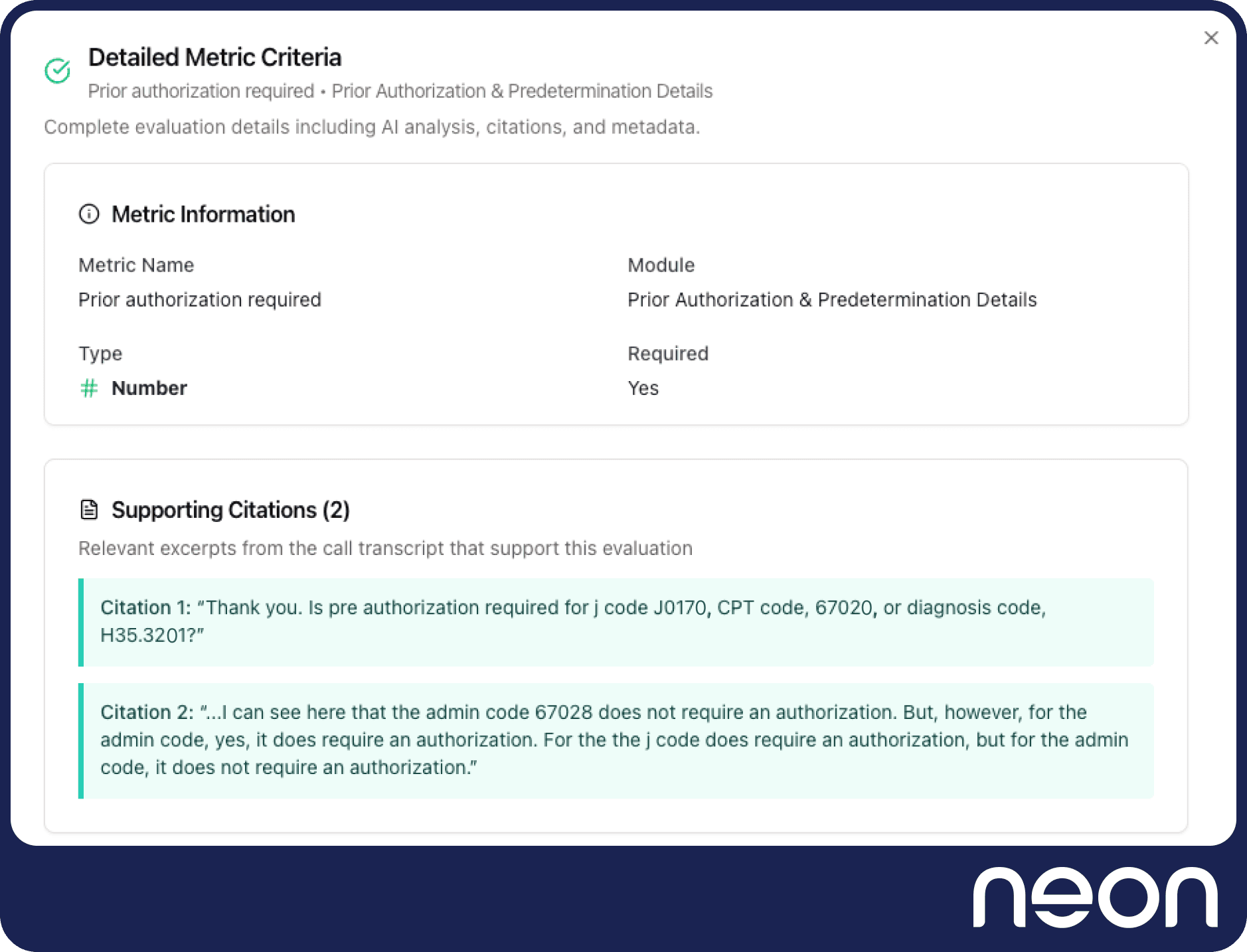
The Neon Quality Engine brings rapid, evidence-linked quality to every call. Instead of reviewing a fraction of interactions, quality teams get fast, AI-generated scorecards on every call, complete with traceable evidence for each insight. Agents get credentialed in a fraction of the time, with Neon evaluating whether they consistently ask required questions, follow program-specific workflows, and document cases accurately, before they're deployed into live programs. And the structured outcome of every call gets written back into your system of record automatically, so the documented case matches what was actually said and your team spends the saved time on helping more patients.
Designed for patient services hubs, specialty pharmacies, and manufacturer patient services programs, the engine replaces manual QA cycles with continuous, system-level oversight.
Every agent, every program, every call.
Key capabilities
Rapid AI scoring against your program-specific work instructions and call guides, with complete consistency call to call.
Automated case data capture that closes the gap between what was said on the call and what gets entered into your system of record.
Accelerated agent credentialing based on objective evaluation of required questions, workflows, and documentation accuracy, before agents go live, then precise per-agent coaching signals once they are.
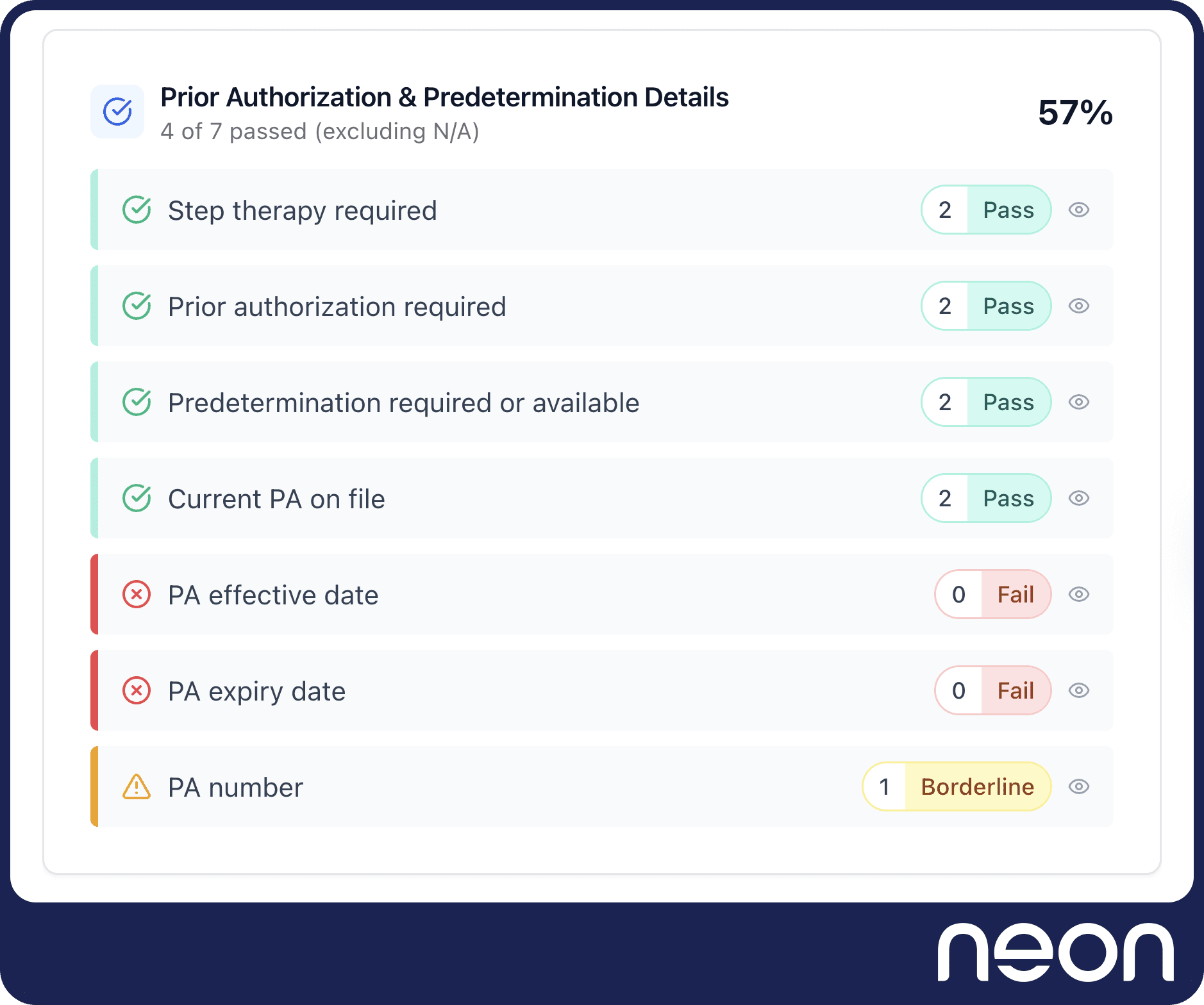
Evidence-linked scoring that ties every evaluation back to the exact transcript snippet where it happened.
Supervisor dashboards that surface patterns, improvement areas, and program-level oversight, with filters for specific agents, time frames, programs, and brands.
You configure the rubrics. You hold the audit trail. The report you send to your team is a comprehensive view you can defend, not a sample you have to apologize for.
Be right and be nice
The question a patient access QA leader is actually being asked by their manager is not "how did the calls sound?" or "did the agents follow the SOP?" It's both, at the same time, on every call.
Did the agent run the program: ask the required questions, capture the required information, handle the branching paths, hit the right outcome? That's the right axis.
And did the patient, payer rep, or prescriber walk away feeling supported: tone, clarity, empathy, no rough edges that show up in tomorrow's escalation queue? That's the nice axis.
Neon Quality Engine scores both so you get total visibility:
Not nice (negative sentiment) | Be nice (positive sentiment) | |
|---|---|---|
Right (on protocol) | Hard call handled well: agent ran the program under pressure | Ideal: agent ran the program, caller felt supported |
Not right (off protocol) | Obvious problem: rough call, missed steps | The silent failure mode: pleasant call, missed required steps |
The lower-right cell is what most QA programs cannot see today. Sentiment-led tools miss it because the call sounded fine. Sample-based review misses it because it's not in the 5 to 10% sampled. Neon surfaces it on day one because every call is scored on both axes.
The upper-left cell matters too. It's where agents and QA teams get punished by sentiment-only tools for supporting hard cases correctly. The Neon Quality Engine sees the protocol layer that earns the agent credit, even when the call sounded rough.
Three operational scenarios this changes
Defensible response to manager feedback in minutes, not days
Your manager emails: "Your agents sound dismissive on Brand X this quarter. We need an answer by the end of the week."
Today that's two QA analysts, three days, hand-pulled audio, a hedged response, and a sample your manager knows is a sample.
With Neon, you open the dashboard and filter to the brand, period, and agent cohort. The 100% coverage view surfaces sentiment and protocol following with transcript-linked examples. The response goes back the same business day, anchored on exhaustive analysis.
Quality you can defend on every call.
Rapid protocol monitoring, not a monthly post-mortem
It's Tuesday morning. The supervisor opens the dashboard, sorts the agent leaderboard by negative impact (high call volume + low protocol following), drills into the two or three agents or issue types that need attention this week, exports a one-page coaching artifact for each 1:1, and ends the round in 15 minutes. Same surface every week. The data is already in front of them.
And because the observability layer is generic by design, the same loop is how you'll diagnose your AI and automated agents (third-party voice agents, chatbots, and any other interaction channel) when they come online. The supervisor's surface doesn't change. The agent does.
After-call work done automatically, not from memory
The last call of the day went perfectly: a complex benefit verification, a secondary coverage question, a patient with concerns, and a confirmed plan of action.
Then came the after-call work. Four screens, six fields, dropdowns, and notes typed from memory. Somehow, the secondary payer name was entered wrong, the deductible information didn't make sense, and a flawless call produced a CRM entry that told the wrong story.
With Neon, the structured outcome is captured and written back automatically. No separate after-call work session. No transcription from memory. The agent ends the call, and the downstream case already reflects what was actually said.
Quality does not stop when the call ends. It stops when the case is right.
Impact for leaders and teams
Leaders: The Neon Quality Engine gives call center, program, and enterprise leaders a level of visibility and oversight that wasn't previously attainable. 100% QA coverage. Rapid operational performance across agents, programs, and workflows. Confidence that teams are executing exactly as intended on every call, with evidence to defend the answer.
Teams: The Neon Quality Engine gives access teams the consistency and reliability they've been missing. Calls are handled more accurately. Credentialing is faster. Supervisors resolve issues before they become rework. Downstream teams inherit cleaner documentation, leading to fewer callbacks, higher first-call resolution, and lower cost per case. Agents feel confident they're performing the correct steps in each workflow, leading to higher productivity and retention.
Now available
Neon's Quality Engine is now live and ready for teams across hubs, specialty pharmacies, and manufacturer patient services programs. It supports full inbound and outbound call coverage from day one, accelerates agent credentialing, automatically inputs data into CRMs, and adapts to the rules and processes of every program.
If you're reviewing less than 10% of calls, the risk/reward calculation has changed. Book a demo to see what 100% coverage looks like for your program.
Be right. Be nice. On every call.
Today we’re launching the Neon Quality Engine – an AI-powered “QA team in a box”.
The Quality Engine gives you automated QA & Insights on every call:
Evaluate every call against your program-specific work instructions
Prioritize coaching for your agents with recommended training modules
Track call quality trends and compliance metrics in real-time
Why did we build this specifically for patient access teams?
Neon Health is the market-leading AI automation partner for patient access teams.
Whereas large call center tools like Genesys and Five9 offer QA and sentiment analysis, they’re far too generic to be trusted to evaluate your call center operations with the level of detail and precision that you demand.
By contrast, Neon’s Quality Engine is purpose-built for patient access leaders – to deliver a level of observability and oversight that has never before been possible without costly human review.
The Neon Quality Engine: an AI-powered "QA team in a box" purpose-built for patient access.
Today, we're giving patient access leaders command-and-control visibility into call center operations that used to require costly human review. Neon Quality Engine
scores every interaction against your program-specific work instructions;
monitors for the dynamic sentiment of the patient, payer rep, or prescriber;
and turns the substance of each interaction into structured case data that flows automatically back into your system of record.
100% call coverage, automated case data capture, accelerated agent credentialing, and command-and-control visibility for hubs, specialty pharmacies, and manufacturer patient services programs.
With the Neon Quality Engine, leaders see how teams are performing at any point in time. Supervisors can coach off evidence, not memory. And when your manager asks a question about your call center operations, your answer is based on comprehensive insights, not a sampled guess.
We built this because the quality tools currently on the market force a tradeoff that patient access leaders should not have to make.
The problem: quality that can't keep up
Most patient access QA programs today review a sample of five calls per agent per month. Roughly 5 to 10% coverage. That's the industry norm. It's also the source of most QA pain: persistent issues only surface after they've already cost the brand revenue or delayed a patient's access to therapy.
One QA lead at a major patient services hub told us: "If we could do quality without listening to the calls, we would obliterate the time it takes to do quality."
The tools that exist today force two tradeoffs at the same time.
1. Measuring sentiment vs following work instructions
The first is sentiment vs. work instructions. Generic contact-center QA platforms can tell you how the call sounded. They can tell you whether the payer rep was cooperative, whether the prescriber's staff felt heard, whether the patient walked away satisfied. They are too generic to be trusted with the level of detail patient access programs demand. They cannot tell you whether your agent actually ran your program, asked the required questions, or captured the right information. A call can score an A+ on tone and still be wrong.
2. Call coverage vs. depth of review
The second is coverage vs. depth. Manual review goes deep, but only on the 5 to 10% of calls a QA analyst can physically listen to. Persistent and potentially dangerous issues hide in the long tail of complications. Credentialing new agents requires QA analysts to listen to training calls one by one. During AR season, QA teams hire 10 to 40 temporary QA analysts just to keep up, and even then, they still review less than 10% of the spiked caseload. At scale, this breaks down. Small misses on even one call can create downstream rework that delays patient access and time to therapy. Traditional human QA simply can't keep up, not at the coverage levels that matter.
And for many teams, there's a problem the two tradeoffs don't capture: the QA tool often belongs to someone else. The people doing the work get measured by a system they can't see, tune, or defend against. A flag comes down, and the team is on the hook to explain a call no one on their side ever got to review.
Why patient services needs the Neon Quality Engine
The Neon Quality Engine brings rapid, evidence-linked quality to every call. Instead of reviewing a fraction of interactions, quality teams get fast, AI-generated scorecards on every call, complete with traceable evidence for each insight. Agents get credentialed in a fraction of the time, with Neon evaluating whether they consistently ask required questions, follow program-specific workflows, and document cases accurately, before they're deployed into live programs. And the structured outcome of every call gets written back into your system of record automatically, so the documented case matches what was actually said and your team spends the saved time on helping more patients.
Designed for patient services hubs, specialty pharmacies, and manufacturer patient services programs, the engine replaces manual QA cycles with continuous, system-level oversight.
Every agent, every program, every call.
Key capabilities
Rapid AI scoring against your program-specific work instructions and call guides, with complete consistency call to call.
Automated case data capture that closes the gap between what was said on the call and what gets entered into your system of record.
Accelerated agent credentialing based on objective evaluation of required questions, workflows, and documentation accuracy, before agents go live, then precise per-agent coaching signals once they are.
Evidence-linked scoring that ties every evaluation back to the exact transcript snippet where it happened.
Supervisor dashboards that surface patterns, improvement areas, and program-level oversight, with filters for specific agents, time frames, programs, and brands.
You configure the rubrics. You hold the audit trail. The report you send to your team is a comprehensive view you can defend, not a sample you have to apologize for.
Be right and be nice
The question a patient access QA leader is actually being asked by their manager is not "how did the calls sound?" or "did the agents follow the SOP?" It's both, at the same time, on every call.
Did the agent run the program: ask the required questions, capture the required information, handle the branching paths, hit the right outcome? That's the right axis.
And did the patient, payer rep, or prescriber walk away feeling supported: tone, clarity, empathy, no rough edges that show up in tomorrow's escalation queue? That's the nice axis.
Neon Quality Engine scores both so you get total visibility:
Not nice (negative sentiment) | Be nice (positive sentiment) | |
|---|---|---|
Right (on protocol) | Hard call handled well: agent ran the program under pressure | Ideal: agent ran the program, caller felt supported |
Not right (off protocol) | Obvious problem: rough call, missed steps | The silent failure mode: pleasant call, missed required steps |
The lower-right cell is what most QA programs cannot see today. Sentiment-led tools miss it because the call sounded fine. Sample-based review misses it because it's not in the 5 to 10% sampled. Neon surfaces it on day one because every call is scored on both axes.
The upper-left cell matters too. It's where agents and QA teams get punished by sentiment-only tools for supporting hard cases correctly. The Neon Quality Engine sees the protocol layer that earns the agent credit, even when the call sounded rough.
Three operational scenarios this changes
Defensible response to manager feedback in minutes, not days
Your manager emails: "Your agents sound dismissive on Brand X this quarter. We need an answer by the end of the week."
Today that's two QA analysts, three days, hand-pulled audio, a hedged response, and a sample your manager knows is a sample.
With Neon, you open the dashboard and filter to the brand, period, and agent cohort. The 100% coverage view surfaces sentiment and protocol following with transcript-linked examples. The response goes back the same business day, anchored on exhaustive analysis.
Quality you can defend on every call.
Rapid protocol monitoring, not a monthly post-mortem
It's Tuesday morning. The supervisor opens the dashboard, sorts the agent leaderboard by negative impact (high call volume + low protocol following), drills into the two or three agents or issue types that need attention this week, exports a one-page coaching artifact for each 1:1, and ends the round in 15 minutes. Same surface every week. The data is already in front of them.
And because the observability layer is generic by design, the same loop is how you'll diagnose your AI and automated agents (third-party voice agents, chatbots, and any other interaction channel) when they come online. The supervisor's surface doesn't change. The agent does.
After-call work done automatically, not from memory
The last call of the day went perfectly: a complex benefit verification, a secondary coverage question, a patient with concerns, and a confirmed plan of action.
Then came the after-call work. Four screens, six fields, dropdowns, and notes typed from memory. Somehow, the secondary payer name was entered wrong, the deductible information didn't make sense, and a flawless call produced a CRM entry that told the wrong story.
With Neon, the structured outcome is captured and written back automatically. No separate after-call work session. No transcription from memory. The agent ends the call, and the downstream case already reflects what was actually said.
Quality does not stop when the call ends. It stops when the case is right.
Impact for leaders and teams
Leaders: The Neon Quality Engine gives call center, program, and enterprise leaders a level of visibility and oversight that wasn't previously attainable. 100% QA coverage. Rapid operational performance across agents, programs, and workflows. Confidence that teams are executing exactly as intended on every call, with evidence to defend the answer.
Teams: The Neon Quality Engine gives access teams the consistency and reliability they've been missing. Calls are handled more accurately. Credentialing is faster. Supervisors resolve issues before they become rework. Downstream teams inherit cleaner documentation, leading to fewer callbacks, higher first-call resolution, and lower cost per case. Agents feel confident they're performing the correct steps in each workflow, leading to higher productivity and retention.
Now available
Neon's Quality Engine is now live and ready for teams across hubs, specialty pharmacies, and manufacturer patient services programs. It supports full inbound and outbound call coverage from day one, accelerates agent credentialing, automatically inputs data into CRMs, and adapts to the rules and processes of every program.
If you're reviewing less than 10% of calls, the risk/reward calculation has changed. Book a demo to see what 100% coverage looks like for your program.
Be right. Be nice. On every call.
Related articles
Related articles

Ready to transform Patient Access?
Ready to transform Patient Access?
NEWSLETTER
@ 2026 Neon Health (Belay, Inc).
AI-powered patient access automation
for leading pharma enterprises.
NEWSLETTER
@ 2026 Neon Health (Belay, Inc).
AI-powered patient access automation for leading pharma enterprises.
NEWSLETTER
@ 2026 Neon Health (Belay, Inc).
AI-powered patient access automation
for leading pharma enterprises.