Pharma Patient Services Enrollment: From Fax to AI [2026]
Pharma Patient Services Enrollment: From Fax to AI [2026]
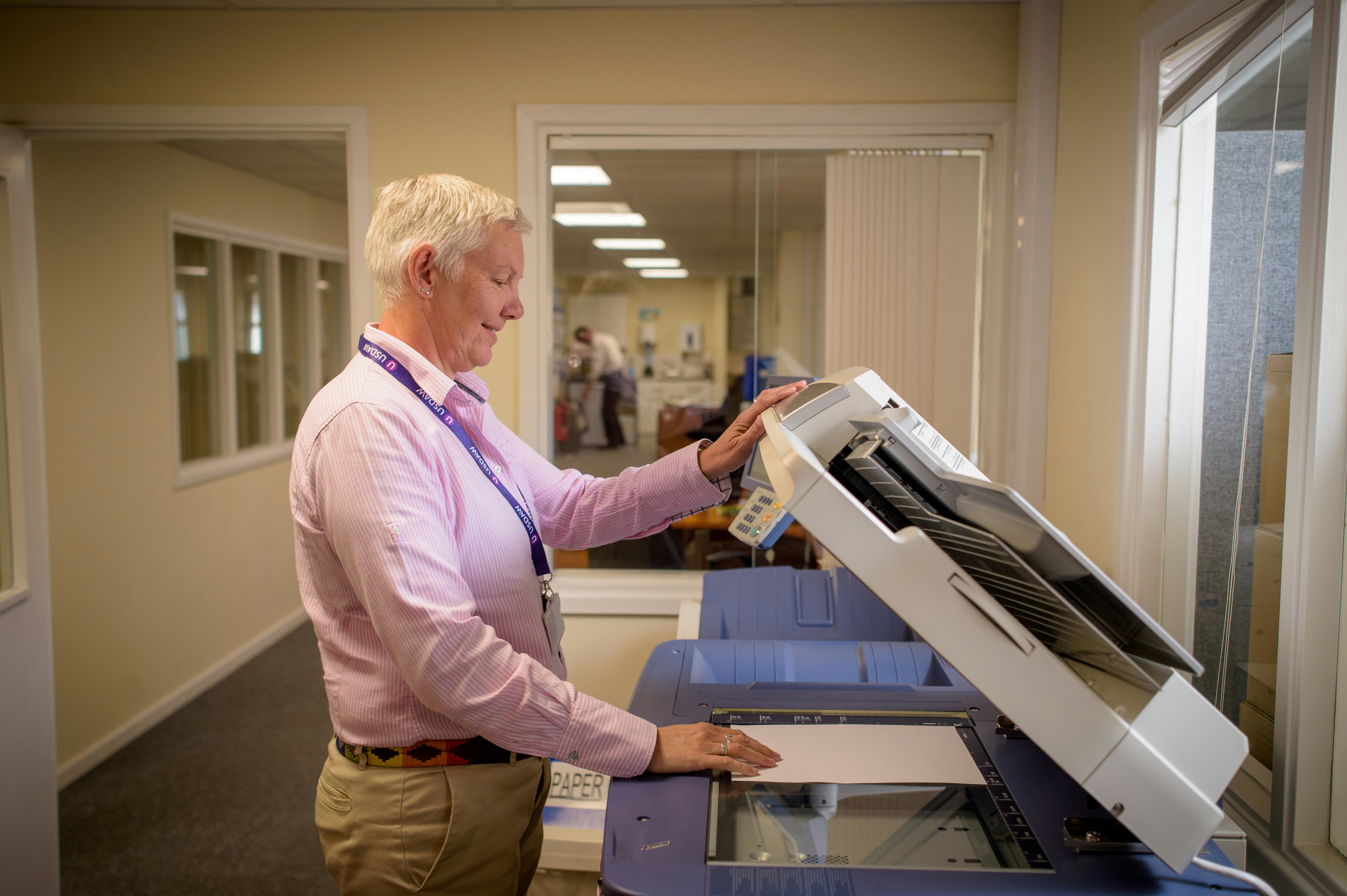
Less than 10% of specialty medication enrollments are completed electronically, according to data from an AMP pilot study covered in Pharmaceutical Commerce. The other 90% arrive the way they arrived in 1995: as a multi-page fax, often hand-completed, frequently incomplete. More than 40% of those faxed specialty prescriptions require a provider callback before they can be processed.
The industry talks about AI in patient services as if the workflow already starts in a database. It does not. It starts on a piece of paper that someone scanned and routed through a fax-to-email bridge. Until that paper becomes a validated, structured record, nothing else in the patient access stack can run. Benefit verification cannot start without a verified insurance ID. Prior authorization cannot start without an ICD-10 code. Financial assistance cannot start without consent.
At Neon Health, our AI workforce sits at this seam. Voice agents call payers and prescribers, portal automations navigate manufacturer hubs and EHRs, and document intake parses what arrives by fax and validates it before it touches a downstream system. We have spent the past few years rebuilding this primitive for pharma manufacturer and hub deployments, and the takeaway is consistent: most teams are several layers short of what AI can actually do here.
This guide walks through the enrollment intake pipeline end to end. What OCR and validation actually accomplish at each layer. Where AI agents replace human callbacks, and where they do not. How to evaluate a vendor without being sold a demo.
Why Patient Services Enrollment Still Runs on Fax
Patient services enrollment still runs on fax because payer credentialing, manufacturer hub contracts, and provider EHRs all assume fax as the lowest-common-denominator transport, leaving structured electronic intake as the exception, not the rule.
More than 85% of providers surveyed in the AMP pilot reported no digital access to specialty pharmacy data inside their EHR systems (Pharmaceutical Commerce). When a prescriber starts a patient on a specialty therapy, the path of least resistance is to print or generate the manufacturer's enrollment form, complete it by hand or in a PDF, and fax it to the hub. The hub receives it through a HIPAA-compliant fax gateway, drops it in an inbound queue, and a coordinator opens each file to triage.
Prior authorization is no different. AHIP's 2024 survey found that 45% of medical prior authorizations and 47% of prescription drug prior authorizations are still submitted manually by phone, fax, or mail (covered in Fierce Healthcare). Fax is not a legacy edge case in specialty pharma. It is the dominant transport across an entire category of upstream documents.
The cost compounds at scale. A peer-reviewed study published in JAMA Health Forum put the US administrative bill at roughly $1 trillion per year, with administrative staff outnumbering physicians and nurses by about two to one. The CAQH Index 2024 identified a $20 billion savings opportunity from shifting still-manual transactions to electronic, with $90 billion spent annually on routine tasks like insurance verification. The 2025 CAQH Index reported $258 billion already avoided through automation in 2024 and another $21 billion remaining on the table.
The operational picture inside a hub is familiar to anyone who has worked one. A coordinator opens the morning fax queue, manually keys data into the case management system, sets aside incomplete forms for outbound callbacks, and rotates through this loop until the queue is clear. The next morning it refills.
What's Actually on a Specialty Enrollment Form
The form is doing more work than it looks like. Each field gates a downstream automation, and the failure modes are predictable.
A typical specialty enrollment form carries patient demographics, the patient's medical and pharmacy benefit IDs and group numbers, an ICD-10 diagnosis, the prescriber's name and NPI, the drug with NDC, dose, and frequency, prior therapies tried, allergies and contraindications, patient signature and consent, and an attestation for any financial assistance program.
Field | Downstream workflow it gates |
|---|---|
Medical and pharmacy benefit IDs | Benefit verification (eligibility + coverage) |
ICD-10 diagnosis | Prior authorization (medical necessity criteria) |
NDC, dose, frequency | Pharmacy benefit verification + PA dosing rules |
Prescriber NPI | Provider validation, claim routing |
Prior therapies tried | Step-therapy override determination |
Patient signature and consent | Copay assistance enrollment, data sharing |
Financial attestation | Foundation and free-drug program eligibility |
Two issues recur. The prescriber portion is frequently handwritten, and handwriting errors cluster around drug dosing (10 mg versus 100 mg), NDCs (single digit transpositions), and frequency (BID versus QID). The patient portion is frequently incomplete, especially around the secondary insurance line and the consent checkboxes for copay and data sharing.
What looks like a clerical artifact is actually the upstream determinant of how long the rest of the workflow takes. A clean intake feeds clean BV and PA queues. An incomplete intake creates a callback loop that adds days before any real automation can run.
From Fax to AI: The Five-Layer Intake Pipeline
The intake pipeline is the architectural backbone underneath every claim about "AI in patient services." Each layer is a separate operational decision and, often, a separate vendor category.
Layer 1: HIPAA-Compliant Fax Ingestion
The first layer is transport. HIPAA-compliant fax services provide a Business Associate Agreement, encryption in transit, role-based access, and audit logs. Most hubs already operate here. This layer is necessary, but it solves only the compliance question. The payload arriving at Layer 2 is still an unstructured scanned image.
Layer 2: OCR and Document Classification
The second layer converts a scanned image into machine-readable text. Modern OCR on structured forms reaches 99% or better accuracy on standardized templates, and 95% or better on semi-structured documents like Explanation of Benefits (Lido). One production benchmark cited in Lido's healthcare comparison: a single customer extracting 90 data points per CMS-1500 form at 99.5% accuracy across 120,000 documents per day.
Two failure modes show up in production. The first is collapsing classification and extraction into one model. An enrollment form, a prescription, and a clinical note all arrive in the same fax bundle. Treating them as a single document type loses the ability to apply form-specific validation later. The second is template drift. Manufacturer enrollment forms change quarterly, and an extractor tuned to last quarter's layout will silently lose accuracy until someone notices.
Layer 3: Field Validation and Deduplication
The third layer is where measurable savings start. Validation checks whether each extracted field is plausible. Was the insurance ID a 12-character alphanumeric matching the payer's known format? Is the NPI active in the NPPES registry? Does the diagnosis match an approved indication for the prescribed drug? Is the dose within the labeled range?
Deduplication runs in parallel. Hubs routinely receive the same enrollment two to four times in the first 48 hours, as the provider faxes, the specialty pharmacy forwards, and a nurse re-submits. Without deduplication, downstream benefit verification and prior authorization calls multiply, and the case management system fragments the patient across multiple records.
Layer 4: Missing-Information Resolution
Even with 99.5% extraction accuracy, a meaningful share of inbound forms arrive incomplete at the field level. Missing prescriber signatures, blank diagnosis fields, illegible weights, no consent. Resolution traditionally requires an outbound call to the provider office, a follow-up fax, or a manufacturer portal action.
This is the layer where AI voice agents start to replace human callbacks. An outbound call to a prescriber's office for a missing diagnosis is the canonical "AI worker" task: structured, repetitive, time-sensitive, and bounded by a clear success criterion. Mandolin, which raised $40 million in 2025 to apply AI agents to specialty drug paperwork (BusinessWire), positions agents that parse faxes and handwritten notes and complete portal and PA workflows end to end.
Layer 5: Downstream Routing and Integration
The fifth layer is integration plumbing, but it is where intake reliability is ultimately measured. The validated, deduplicated record has to land in the case management system as structured fields, not as a PDF attachment to a stub case. From there it fans out into benefit verification queues, prior authorization queues, financial assistance enrollment, scheduling, and adherence.
When this layer is wired correctly, the downstream effect is large. The 2025 CoverMyMeds Medication Access Report finds that electronic prior authorization completes determinations in roughly 5 hours versus about 17 hours by fax, completes requests up to three times faster than phone or fax, and accelerates therapy starts by up to 13 days.
Before-and-After: What the Workflow Looks Like With AI in the Loop
The comparison below anchors the abstract pipeline to operational outcomes. The right column assumes the validation and integration layers are wired through. In our experience deploying with hubs and manufacturers, most teams plateau in the middle column for six to twelve months before moving right.
Stage | Manual baseline | OCR plus validation | OCR, validation, and AI agents |
|---|---|---|---|
Inbound fax to structured record | 12 to 20 minutes per form, manual keying | 30 to 60 seconds, ~85% touch-free | 30 to 60 seconds, ~98% touch-free |
Missing-information resolution | 1 to 3 days (outbound queue plus callback) | 1 to 2 days | Under 2 hours (autonomous outbound) |
Duplicate detection | Reactive, surfaces after BV starts | Pre-validation match | Pre-validation match |
Time-to-BV-start | 2 to 5 business days | Under 1 business day | Under 1 hour |
Form rejection rate | 15 to 30% rework required | 5 to 10% | Under 3% |
The right column is grounded in documented results. Mandolin reports processing referral forms, lab reports, and clinical notes in approximately 3 minutes per document versus a roughly 20-minute manual baseline, a 24x improvement, according to its product site and the Greylock investor note. The peer-reviewed JMCP turnaround time study found clean specialty prescriptions at 2 to 3 days and intervention-required prescriptions at 5 to 6 days under conventional workflows, with prior authorization extending some cases to 15 days.
The takeaway: the rejection-rate row is the leverage point. Pulling rework from 20% to under 3% removes the largest source of variability from the entire downstream stack.
AI Agents on Top of OCR: Where They Add Value and Where They Do Not
AI agents add real value at the boundary points of the pipeline where humans were previously doing repetitive, multi-step work across systems.
The clearest wins are at Layer 4 and the intra-Layer-5 routing decisions. Outbound voice calls to resolve missing diagnoses or confirm prescriber identity. Browser-driven portal actions to confirm enrollment in a manufacturer hub. Cross-record reconciliation between an inbound enrollment and an existing case. Classification and triage of the inbound fax queue itself. Each of these tasks has a clear success criterion, a bounded set of inputs, and a measurable time cost in the manual baseline.
Agents do not yet replace humans in several specific places. Consent attestation and signature verification, where the audit trail must show a licensed human. Clinical exception handling, where the next step depends on judgment a model cannot bound. Identity confirmation where regulatory or HIPAA considerations require live human verification. Payer-specific edge cases that have not appeared in prior training data.
The platform-level implication is the model worth watching. Vendors used to specialize in one layer: a fax provider, an OCR engine, a workflow rules system, a call center. The next-generation platforms unify the layers. Mandolin's pitch is exactly this: AI agents that reason about clinical policy, parse faxes and handwritten notes, and submit prior authorizations through portals and phone calls in a single workflow. This is also the integration model Neon Health was built around: voice, portal automation, and document intake orchestrated against a shared case state, with human staff escalated to only when an exception falls outside the agent's competence.
How to Evaluate an Intake Automation Vendor
Six criteria, framed as questions a buyer can ask in a demo.
Criterion | Question to ask | Why it matters |
|---|---|---|
Layer coverage | Does the platform cover transport, OCR, validation, missing-info resolution, and routing? | Stitching three vendors costs more in integration than buying integrated capability |
OCR accuracy on your forms | Will you run a 50-form pilot on our specific enrollment templates? | Generic 99% benchmarks rarely transfer to a specific form layout |
Validation depth | Does the system check format only, or does it validate against payer eligibility, NPI registry, and drug formulary in real time? | Format-only validation moves the rework, it does not reduce it |
Missing-info resolution path | Is resolution a manual callback queue, an AI voice agent, or both, and what is the SLA? | Layer 4 is the single largest source of cycle-time savings |
Compliance posture | HIPAA BAA, SOC 2 Type 2, encryption at rest and in transit, audit logs, role-based access | More than 50% of payers and over 25% of provider organizations now run AI in admin workflows (CAQH 2025), and the compliance bar is rising in lockstep |
Integration depth | Does the validated record arrive in our case management system as structured fields, or as a PDF attachment? | A PDF attachment to a stub case is a regression, not an improvement |
The honest test is the pilot. Generic benchmark accuracy on a public form does not predict accuracy on your forms, your payer mix, and your provider network. Run the pilot on a representative slice of one week of inbound fax traffic before committing.
Frequently Asked Questions
What percentage of specialty pharmacy enrollment forms still arrive by fax?
Less than 10% of specialty enrollment is completed electronically, meaning the substantial majority still arrives by fax or paper, per AMP pilot data published in Pharmaceutical Commerce. More than 40% of faxed specialty prescriptions require a provider callback before they can be processed.
How accurate is OCR on specialty pharmacy enrollment forms?
Modern OCR reaches 99% or higher accuracy on structured fields in standardized templates, and 95% or higher on semi-structured documents like Explanations of Benefits. One production benchmark cited in Lido's healthcare comparison reports 99.5% accuracy across 90 fields on 120,000 CMS-1500 forms per day. Handwritten fields and template drift reduce accuracy in practice.
What's the difference between OCR, intake automation, and AI agents in patient services?
OCR converts a scanned form into machine-readable text. Intake automation adds field validation, deduplication, and routing on top of OCR. AI agents go further, executing multi-step tasks like outbound calls to resolve missing information, portal actions to confirm enrollment, and cross-system reconciliation, without human input at each step.
Is AI-driven enrollment intake HIPAA-compliant?
Yes, when the vendor offers a Business Associate Agreement, encryption in transit and at rest, role-based access, audit logs, and ideally SOC 2 Type 2 certification. The CAQH 2025 Index reports more than 50% of health plans and over 25% of provider organizations now use AI in administrative workflows, with compliance expectations rising accordingly.
How long does it take to go from a faxed enrollment form to a clean BV start?
Under conventional manual workflows, two to five business days is typical, longer if the form is incomplete. With OCR and validation, that drops to under a business day. With OCR, validation, and AI agents handling missing-info resolution, the cycle can compress to under one hour for clean intakes. CoverMyMeds 2025 reports electronic prior authorization is roughly three times faster than fax and can accelerate therapy starts by up to 13 days.
What is the typical ROI of replacing manual enrollment intake with AI?
The largest source of savings is not the OCR layer itself, but the reduction in rework rates from roughly 15 to 30% down to under 3%. That removes the dominant source of cycle-time variability and the largest staffing demand. The CAQH 2024 Index flagged $20 billion in industry-wide savings from shifting still-manual transactions to electronic; the 2025 update shows automation accelerating with $21 billion remaining unrealized.
Key Takeaways
More than 90% of specialty enrollment forms still arrive by paper or fax, and the industry's downstream automation only works if intake is solved first.
OCR alone is necessary but insufficient. Validation, deduplication, and missing-information resolution drive the workflow savings.
The intake pipeline has five layers: HIPAA fax transport, OCR and classification, field validation and deduplication, missing-info resolution, and downstream routing.
AI agents replace the outbound-callback loop where humans were previously bottlenecked, compressing missing-info resolution from days to under two hours.
Modern OCR reaches 99% or better accuracy on structured forms, but rejection rates are the leverage point, not raw extraction accuracy.
Evaluate vendors by layer coverage and validation depth, not OCR demos, and run a pilot on a representative slice of your own inbound fax traffic.
The $20 billion savings opportunity identified by CAQH sits in this layer of the stack, and $21 billion remains unrealized in the 2025 update.
Sources
Pharmaceutical Commerce. "A Change of Pace for Accessing Specialty Medications." https://www.pharmaceuticalcommerce.com/view/a-change-of-pace-for-accessing-specialty-medications-access-for-more-patients
CAQH. "New CAQH Index Reveals $20B Savings Opportunity." 2024. https://www.caqh.org/blog/new-caqh-index-reveals-20b-savings-opportunity-to-cut-waste-reduce-costs-and-improve-patient-access
CAQH. "2025 CAQH Index Shows U.S. Healthcare Avoided $258 Billion." 2025. https://www.caqh.org/blog/2025-caqh-index-shows-u.s.-healthcare-avoided-258-billion-and-accelerated-automation-interoperability-and-ai-adoption
CoverMyMeds. "2025 Medication Access Report." https://www.covermymeds.health/medication-access-report
Fierce Healthcare. "AHIP study finds electronic prior authorization may make it easier for providers to say goodbye to their fax machines." Citing AHIP 2024 survey. https://www.fiercehealthcare.com/payer/ahip-study-finds-electronic-prior-authorization-may-make-it-easier-for-providers-to-say
Hardin, H. et al. "Specialty Pharmacy Turnaround Time Impediments, Facilitators, and Good Practices." Journal of Managed Care and Specialty Pharmacy. https://pmc.ncbi.nlm.nih.gov/articles/PMC10372971/
Lido. "Best OCR for Healthcare in 2026." https://www.lido.app/blog/best-ocr-for-healthcare
BusinessWire. "Mandolin Raises $40M to Improve Access to Life-Saving Therapies." 2025. https://www.businesswire.com/news/home/20250625104094/en/Mandolin-Raises-40M-to-Improve-Access-to-Life-Saving-Therapies-for-Diseases-like-Cancer-and-Alzheimers-Using-AI-Agents
Greylock. "Introducing Mandolin: AI Teammates for Healthcare." https://greylock.com/portfolio-news/mandolin-ai/
Mandolin. Product page (self-reported metrics, accessed May 2026). https://www.mandolin.com/
Sahni, N., Carrus, B., Cutler, D. "Administrative Simplification and the Potential for Saving a Quarter-Trillion Dollars in Health Care." JAMA Health Forum. https://jamanetwork.com/journals/jama/fullarticle/2785480
Less than 10% of specialty medication enrollments are completed electronically, according to data from an AMP pilot study covered in Pharmaceutical Commerce. The other 90% arrive the way they arrived in 1995: as a multi-page fax, often hand-completed, frequently incomplete. More than 40% of those faxed specialty prescriptions require a provider callback before they can be processed.
The industry talks about AI in patient services as if the workflow already starts in a database. It does not. It starts on a piece of paper that someone scanned and routed through a fax-to-email bridge. Until that paper becomes a validated, structured record, nothing else in the patient access stack can run. Benefit verification cannot start without a verified insurance ID. Prior authorization cannot start without an ICD-10 code. Financial assistance cannot start without consent.
At Neon Health, our AI workforce sits at this seam. Voice agents call payers and prescribers, portal automations navigate manufacturer hubs and EHRs, and document intake parses what arrives by fax and validates it before it touches a downstream system. We have spent the past few years rebuilding this primitive for pharma manufacturer and hub deployments, and the takeaway is consistent: most teams are several layers short of what AI can actually do here.
This guide walks through the enrollment intake pipeline end to end. What OCR and validation actually accomplish at each layer. Where AI agents replace human callbacks, and where they do not. How to evaluate a vendor without being sold a demo.
Why Patient Services Enrollment Still Runs on Fax
Patient services enrollment still runs on fax because payer credentialing, manufacturer hub contracts, and provider EHRs all assume fax as the lowest-common-denominator transport, leaving structured electronic intake as the exception, not the rule.
More than 85% of providers surveyed in the AMP pilot reported no digital access to specialty pharmacy data inside their EHR systems (Pharmaceutical Commerce). When a prescriber starts a patient on a specialty therapy, the path of least resistance is to print or generate the manufacturer's enrollment form, complete it by hand or in a PDF, and fax it to the hub. The hub receives it through a HIPAA-compliant fax gateway, drops it in an inbound queue, and a coordinator opens each file to triage.
Prior authorization is no different. AHIP's 2024 survey found that 45% of medical prior authorizations and 47% of prescription drug prior authorizations are still submitted manually by phone, fax, or mail (covered in Fierce Healthcare). Fax is not a legacy edge case in specialty pharma. It is the dominant transport across an entire category of upstream documents.
The cost compounds at scale. A peer-reviewed study published in JAMA Health Forum put the US administrative bill at roughly $1 trillion per year, with administrative staff outnumbering physicians and nurses by about two to one. The CAQH Index 2024 identified a $20 billion savings opportunity from shifting still-manual transactions to electronic, with $90 billion spent annually on routine tasks like insurance verification. The 2025 CAQH Index reported $258 billion already avoided through automation in 2024 and another $21 billion remaining on the table.
The operational picture inside a hub is familiar to anyone who has worked one. A coordinator opens the morning fax queue, manually keys data into the case management system, sets aside incomplete forms for outbound callbacks, and rotates through this loop until the queue is clear. The next morning it refills.
What's Actually on a Specialty Enrollment Form
The form is doing more work than it looks like. Each field gates a downstream automation, and the failure modes are predictable.
A typical specialty enrollment form carries patient demographics, the patient's medical and pharmacy benefit IDs and group numbers, an ICD-10 diagnosis, the prescriber's name and NPI, the drug with NDC, dose, and frequency, prior therapies tried, allergies and contraindications, patient signature and consent, and an attestation for any financial assistance program.
Field | Downstream workflow it gates |
|---|---|
Medical and pharmacy benefit IDs | Benefit verification (eligibility + coverage) |
ICD-10 diagnosis | Prior authorization (medical necessity criteria) |
NDC, dose, frequency | Pharmacy benefit verification + PA dosing rules |
Prescriber NPI | Provider validation, claim routing |
Prior therapies tried | Step-therapy override determination |
Patient signature and consent | Copay assistance enrollment, data sharing |
Financial attestation | Foundation and free-drug program eligibility |
Two issues recur. The prescriber portion is frequently handwritten, and handwriting errors cluster around drug dosing (10 mg versus 100 mg), NDCs (single digit transpositions), and frequency (BID versus QID). The patient portion is frequently incomplete, especially around the secondary insurance line and the consent checkboxes for copay and data sharing.
What looks like a clerical artifact is actually the upstream determinant of how long the rest of the workflow takes. A clean intake feeds clean BV and PA queues. An incomplete intake creates a callback loop that adds days before any real automation can run.
From Fax to AI: The Five-Layer Intake Pipeline
The intake pipeline is the architectural backbone underneath every claim about "AI in patient services." Each layer is a separate operational decision and, often, a separate vendor category.
Layer 1: HIPAA-Compliant Fax Ingestion
The first layer is transport. HIPAA-compliant fax services provide a Business Associate Agreement, encryption in transit, role-based access, and audit logs. Most hubs already operate here. This layer is necessary, but it solves only the compliance question. The payload arriving at Layer 2 is still an unstructured scanned image.
Layer 2: OCR and Document Classification
The second layer converts a scanned image into machine-readable text. Modern OCR on structured forms reaches 99% or better accuracy on standardized templates, and 95% or better on semi-structured documents like Explanation of Benefits (Lido). One production benchmark cited in Lido's healthcare comparison: a single customer extracting 90 data points per CMS-1500 form at 99.5% accuracy across 120,000 documents per day.
Two failure modes show up in production. The first is collapsing classification and extraction into one model. An enrollment form, a prescription, and a clinical note all arrive in the same fax bundle. Treating them as a single document type loses the ability to apply form-specific validation later. The second is template drift. Manufacturer enrollment forms change quarterly, and an extractor tuned to last quarter's layout will silently lose accuracy until someone notices.
Layer 3: Field Validation and Deduplication
The third layer is where measurable savings start. Validation checks whether each extracted field is plausible. Was the insurance ID a 12-character alphanumeric matching the payer's known format? Is the NPI active in the NPPES registry? Does the diagnosis match an approved indication for the prescribed drug? Is the dose within the labeled range?
Deduplication runs in parallel. Hubs routinely receive the same enrollment two to four times in the first 48 hours, as the provider faxes, the specialty pharmacy forwards, and a nurse re-submits. Without deduplication, downstream benefit verification and prior authorization calls multiply, and the case management system fragments the patient across multiple records.
Layer 4: Missing-Information Resolution
Even with 99.5% extraction accuracy, a meaningful share of inbound forms arrive incomplete at the field level. Missing prescriber signatures, blank diagnosis fields, illegible weights, no consent. Resolution traditionally requires an outbound call to the provider office, a follow-up fax, or a manufacturer portal action.
This is the layer where AI voice agents start to replace human callbacks. An outbound call to a prescriber's office for a missing diagnosis is the canonical "AI worker" task: structured, repetitive, time-sensitive, and bounded by a clear success criterion. Mandolin, which raised $40 million in 2025 to apply AI agents to specialty drug paperwork (BusinessWire), positions agents that parse faxes and handwritten notes and complete portal and PA workflows end to end.
Layer 5: Downstream Routing and Integration
The fifth layer is integration plumbing, but it is where intake reliability is ultimately measured. The validated, deduplicated record has to land in the case management system as structured fields, not as a PDF attachment to a stub case. From there it fans out into benefit verification queues, prior authorization queues, financial assistance enrollment, scheduling, and adherence.
When this layer is wired correctly, the downstream effect is large. The 2025 CoverMyMeds Medication Access Report finds that electronic prior authorization completes determinations in roughly 5 hours versus about 17 hours by fax, completes requests up to three times faster than phone or fax, and accelerates therapy starts by up to 13 days.
Before-and-After: What the Workflow Looks Like With AI in the Loop
The comparison below anchors the abstract pipeline to operational outcomes. The right column assumes the validation and integration layers are wired through. In our experience deploying with hubs and manufacturers, most teams plateau in the middle column for six to twelve months before moving right.
Stage | Manual baseline | OCR plus validation | OCR, validation, and AI agents |
|---|---|---|---|
Inbound fax to structured record | 12 to 20 minutes per form, manual keying | 30 to 60 seconds, ~85% touch-free | 30 to 60 seconds, ~98% touch-free |
Missing-information resolution | 1 to 3 days (outbound queue plus callback) | 1 to 2 days | Under 2 hours (autonomous outbound) |
Duplicate detection | Reactive, surfaces after BV starts | Pre-validation match | Pre-validation match |
Time-to-BV-start | 2 to 5 business days | Under 1 business day | Under 1 hour |
Form rejection rate | 15 to 30% rework required | 5 to 10% | Under 3% |
The right column is grounded in documented results. Mandolin reports processing referral forms, lab reports, and clinical notes in approximately 3 minutes per document versus a roughly 20-minute manual baseline, a 24x improvement, according to its product site and the Greylock investor note. The peer-reviewed JMCP turnaround time study found clean specialty prescriptions at 2 to 3 days and intervention-required prescriptions at 5 to 6 days under conventional workflows, with prior authorization extending some cases to 15 days.
The takeaway: the rejection-rate row is the leverage point. Pulling rework from 20% to under 3% removes the largest source of variability from the entire downstream stack.
AI Agents on Top of OCR: Where They Add Value and Where They Do Not
AI agents add real value at the boundary points of the pipeline where humans were previously doing repetitive, multi-step work across systems.
The clearest wins are at Layer 4 and the intra-Layer-5 routing decisions. Outbound voice calls to resolve missing diagnoses or confirm prescriber identity. Browser-driven portal actions to confirm enrollment in a manufacturer hub. Cross-record reconciliation between an inbound enrollment and an existing case. Classification and triage of the inbound fax queue itself. Each of these tasks has a clear success criterion, a bounded set of inputs, and a measurable time cost in the manual baseline.
Agents do not yet replace humans in several specific places. Consent attestation and signature verification, where the audit trail must show a licensed human. Clinical exception handling, where the next step depends on judgment a model cannot bound. Identity confirmation where regulatory or HIPAA considerations require live human verification. Payer-specific edge cases that have not appeared in prior training data.
The platform-level implication is the model worth watching. Vendors used to specialize in one layer: a fax provider, an OCR engine, a workflow rules system, a call center. The next-generation platforms unify the layers. Mandolin's pitch is exactly this: AI agents that reason about clinical policy, parse faxes and handwritten notes, and submit prior authorizations through portals and phone calls in a single workflow. This is also the integration model Neon Health was built around: voice, portal automation, and document intake orchestrated against a shared case state, with human staff escalated to only when an exception falls outside the agent's competence.
How to Evaluate an Intake Automation Vendor
Six criteria, framed as questions a buyer can ask in a demo.
Criterion | Question to ask | Why it matters |
|---|---|---|
Layer coverage | Does the platform cover transport, OCR, validation, missing-info resolution, and routing? | Stitching three vendors costs more in integration than buying integrated capability |
OCR accuracy on your forms | Will you run a 50-form pilot on our specific enrollment templates? | Generic 99% benchmarks rarely transfer to a specific form layout |
Validation depth | Does the system check format only, or does it validate against payer eligibility, NPI registry, and drug formulary in real time? | Format-only validation moves the rework, it does not reduce it |
Missing-info resolution path | Is resolution a manual callback queue, an AI voice agent, or both, and what is the SLA? | Layer 4 is the single largest source of cycle-time savings |
Compliance posture | HIPAA BAA, SOC 2 Type 2, encryption at rest and in transit, audit logs, role-based access | More than 50% of payers and over 25% of provider organizations now run AI in admin workflows (CAQH 2025), and the compliance bar is rising in lockstep |
Integration depth | Does the validated record arrive in our case management system as structured fields, or as a PDF attachment? | A PDF attachment to a stub case is a regression, not an improvement |
The honest test is the pilot. Generic benchmark accuracy on a public form does not predict accuracy on your forms, your payer mix, and your provider network. Run the pilot on a representative slice of one week of inbound fax traffic before committing.
Frequently Asked Questions
What percentage of specialty pharmacy enrollment forms still arrive by fax?
Less than 10% of specialty enrollment is completed electronically, meaning the substantial majority still arrives by fax or paper, per AMP pilot data published in Pharmaceutical Commerce. More than 40% of faxed specialty prescriptions require a provider callback before they can be processed.
How accurate is OCR on specialty pharmacy enrollment forms?
Modern OCR reaches 99% or higher accuracy on structured fields in standardized templates, and 95% or higher on semi-structured documents like Explanations of Benefits. One production benchmark cited in Lido's healthcare comparison reports 99.5% accuracy across 90 fields on 120,000 CMS-1500 forms per day. Handwritten fields and template drift reduce accuracy in practice.
What's the difference between OCR, intake automation, and AI agents in patient services?
OCR converts a scanned form into machine-readable text. Intake automation adds field validation, deduplication, and routing on top of OCR. AI agents go further, executing multi-step tasks like outbound calls to resolve missing information, portal actions to confirm enrollment, and cross-system reconciliation, without human input at each step.
Is AI-driven enrollment intake HIPAA-compliant?
Yes, when the vendor offers a Business Associate Agreement, encryption in transit and at rest, role-based access, audit logs, and ideally SOC 2 Type 2 certification. The CAQH 2025 Index reports more than 50% of health plans and over 25% of provider organizations now use AI in administrative workflows, with compliance expectations rising accordingly.
How long does it take to go from a faxed enrollment form to a clean BV start?
Under conventional manual workflows, two to five business days is typical, longer if the form is incomplete. With OCR and validation, that drops to under a business day. With OCR, validation, and AI agents handling missing-info resolution, the cycle can compress to under one hour for clean intakes. CoverMyMeds 2025 reports electronic prior authorization is roughly three times faster than fax and can accelerate therapy starts by up to 13 days.
What is the typical ROI of replacing manual enrollment intake with AI?
The largest source of savings is not the OCR layer itself, but the reduction in rework rates from roughly 15 to 30% down to under 3%. That removes the dominant source of cycle-time variability and the largest staffing demand. The CAQH 2024 Index flagged $20 billion in industry-wide savings from shifting still-manual transactions to electronic; the 2025 update shows automation accelerating with $21 billion remaining unrealized.
Key Takeaways
More than 90% of specialty enrollment forms still arrive by paper or fax, and the industry's downstream automation only works if intake is solved first.
OCR alone is necessary but insufficient. Validation, deduplication, and missing-information resolution drive the workflow savings.
The intake pipeline has five layers: HIPAA fax transport, OCR and classification, field validation and deduplication, missing-info resolution, and downstream routing.
AI agents replace the outbound-callback loop where humans were previously bottlenecked, compressing missing-info resolution from days to under two hours.
Modern OCR reaches 99% or better accuracy on structured forms, but rejection rates are the leverage point, not raw extraction accuracy.
Evaluate vendors by layer coverage and validation depth, not OCR demos, and run a pilot on a representative slice of your own inbound fax traffic.
The $20 billion savings opportunity identified by CAQH sits in this layer of the stack, and $21 billion remains unrealized in the 2025 update.
Sources
Pharmaceutical Commerce. "A Change of Pace for Accessing Specialty Medications." https://www.pharmaceuticalcommerce.com/view/a-change-of-pace-for-accessing-specialty-medications-access-for-more-patients
CAQH. "New CAQH Index Reveals $20B Savings Opportunity." 2024. https://www.caqh.org/blog/new-caqh-index-reveals-20b-savings-opportunity-to-cut-waste-reduce-costs-and-improve-patient-access
CAQH. "2025 CAQH Index Shows U.S. Healthcare Avoided $258 Billion." 2025. https://www.caqh.org/blog/2025-caqh-index-shows-u.s.-healthcare-avoided-258-billion-and-accelerated-automation-interoperability-and-ai-adoption
CoverMyMeds. "2025 Medication Access Report." https://www.covermymeds.health/medication-access-report
Fierce Healthcare. "AHIP study finds electronic prior authorization may make it easier for providers to say goodbye to their fax machines." Citing AHIP 2024 survey. https://www.fiercehealthcare.com/payer/ahip-study-finds-electronic-prior-authorization-may-make-it-easier-for-providers-to-say
Hardin, H. et al. "Specialty Pharmacy Turnaround Time Impediments, Facilitators, and Good Practices." Journal of Managed Care and Specialty Pharmacy. https://pmc.ncbi.nlm.nih.gov/articles/PMC10372971/
Lido. "Best OCR for Healthcare in 2026." https://www.lido.app/blog/best-ocr-for-healthcare
BusinessWire. "Mandolin Raises $40M to Improve Access to Life-Saving Therapies." 2025. https://www.businesswire.com/news/home/20250625104094/en/Mandolin-Raises-40M-to-Improve-Access-to-Life-Saving-Therapies-for-Diseases-like-Cancer-and-Alzheimers-Using-AI-Agents
Greylock. "Introducing Mandolin: AI Teammates for Healthcare." https://greylock.com/portfolio-news/mandolin-ai/
Mandolin. Product page (self-reported metrics, accessed May 2026). https://www.mandolin.com/
Sahni, N., Carrus, B., Cutler, D. "Administrative Simplification and the Potential for Saving a Quarter-Trillion Dollars in Health Care." JAMA Health Forum. https://jamanetwork.com/journals/jama/fullarticle/2785480
Related articles
Related articles

Ready to transform Patient Access?
Ready to transform Patient Access?
NEWSLETTER
@ 2026 Neon Health (Belay, Inc).
AI-powered patient access automation
for leading pharma enterprises.
NEWSLETTER
@ 2026 Neon Health (Belay, Inc).
AI-powered patient access automation for leading pharma enterprises.
NEWSLETTER
@ 2026 Neon Health (Belay, Inc).
AI-powered patient access automation
for leading pharma enterprises.