
Copay Assistance & Patient Financial Assistance Automation: Top Platforms Compared [2026]
Copay Assistance & Patient Financial Assistance Automation: Top Platforms Compared [2026]
Out-of-pocket cost is the single largest driver of prescription abandonment. According to IQVIA, abandonment rates exceed 60% when patients face more than $500 in out-of-pocket costs.
Across specialty medications broadly, only 62% of prescriptions ever reach a paid fill, according to data from BrightInsight and Claritas Rx covering 85 specialty brands. With specialty drug spending exceeding $301 billion annually and roughly 38% of prescriptions never filled, the revenue at risk runs well into the hundreds of billions.
The painful irony: billions in financial assistance already exists to help these patients. Manufacturer copay cards, patient assistance programs, and foundation grants collectively represent tens of billions in available support. For copay coupons alone, RxUtility reports more than $30 billion available annually, with 93% going unused.
Patients do not know programs exist. Financial counselors cannot keep up with the volume. Eligibility rules change constantly across programs, payers, and therapies.
The result is a system where patients abandon therapy they need, manufacturers lose revenue on drugs they have already developed, and providers absorb the downstream costs of untreated conditions.
Patient financial assistance automation software addresses this gap. These platforms match patients to eligible programs, automate enrollment workflows, and track status through fulfillment. The category ranges from digital enrollment tools to AI-powered systems that handle the entire financial assistance workflow without human intervention.
This guide compares 10 platforms across the full spectrum: established hub solutions, specialized financial navigation tools, and AI-native automation platforms.
What Are Patient Financial Assistance Programs?
Patient financial assistance programs are manufacturer-funded, foundation-funded, or government-funded programs that reduce or eliminate a patient's out-of-pocket cost for medications. They are a critical mechanism for ensuring patients can afford and start therapy.
Types of Programs
Manufacturer copay cards and vouchers are the largest category. According to KFF, copay assistance was used for approximately 19% of all commercially insured prescriptions and 42% of specialty prescriptions in 2023, with a total value of $23 billion. Research published in JAMA Internal Medicine found that 88.2% of manufacturer offsets target brand-name products, with a median coverage of 87.1% of out-of-pocket costs.
Patient assistance programs (PAPs) provide free or discounted medications directly to uninsured or underinsured patients. These are manufacturer-funded and typically require income verification and proof of insurance status. According to a PubMed study, at least 15 dedicated software programs exist specifically for PAP management.
Foundation grants come from independent charitable organizations like PAN Foundation, HealthWell Foundation, and NeedyMeds. These programs open and close based on available funding, creating a moving target for enrollment teams.
State ADAP programs (AIDS Drug Assistance Programs) and 340B considerations add further complexity for specific patient populations and provider types.
The Complicating Factor: Copay Accumulators and Maximizers
A growing challenge for financial assistance programs is the rise of copay accumulator and maximizer policies. According to a JMCP primer, 39% of commercially insured beneficiaries were in plans with copay accumulators and 41% with copay maximizers as of 2022. These policies exclude manufacturer copay assistance from counting toward a patient's deductible or out-of-pocket maximum, meaning patients may face unexpected costs partway through a benefit year.
This makes financial assistance automation even more critical. Programs must not only enroll patients but also monitor for accumulator impacts and re-enroll or switch programs mid-year when needed.
What Financial Assistance Automation Software Does
Patient financial assistance automation software replaces manual workflows where financial counselors spend hours per patient navigating program eligibility, completing forms, submitting applications, and tracking status.
Core capabilities include:
Eligibility matching across copay cards, PAPs, foundation grants, and government programs
Automated form completion and submission using patient data already in the system
Income verification through digital tools rather than paper documentation
Status tracking and re-enrollment alerts for programs with annual renewal requirements
Integration with pharmacy and hub workflows to connect enrollment to dispensing
Patient communication via text, phone, email, or portal for document collection and status updates
The most advanced platforms in this category go beyond form automation. They use AI to proactively screen every patient encounter for eligible programs, predict enrollment outcomes, and handle the entire workflow from identification through fulfillment.
Top Copay and Financial Assistance Automation Platforms
Atlas Health
Atlas Health is a leading platform in philanthropic aid automation for health systems and provider organizations. The platform, Atlas MAP, uses AI-driven matching to screen every patient encounter and prescription against the largest network of funding sources available.
Financial assistance capabilities: Atlas MAP matches patients to eligible funding sources including foundation grants, copay assistance, PAPs, and government programs. The system ranks matches by probability of successful enrollment and uses AI-guided workflows to automate submissions.
Technology approach: AI matching engine with predictive enrollment scoring. Supports ETL, API, HL7, CSV, and FHIR exchange protocols for interoperability. Patient-facing text and email workflows collect required documents during the automatic enrollment process.
Performance data: Atlas Health reports up to 800% improvement in financial awards secured, up to 1000% efficiency improvement in back-office workflows, and 3x the number of patients helped. Up to 30% reduction in uncompensated care.
Recognition: Ranked #1 for improving outcomes and #2 for reducing cost of care in the 2022 KLAS Emerging Solutions Top 20 Report. Winner of the 2021 HFMA Innovation Award and MedTech Breakthrough Award. Ranked No. 540 on the 2024 Inc. 5000 list of fastest-growing private companies.
Clients: Sinai Chicago, ThedaCare, Memorial Healthcare System, Cone Health, OHSU, Prisma Health, University of Miami Health, Covenant Health, Baylor Scott & White, Legacy Health, and others.
Best for: Health systems and provider organizations focused on philanthropic aid and foundation grants. Atlas Health's strength is its comprehensive funding network and provider-centric approach. Organizations that need to maximize every dollar of available charitable funding will find the deepest matching capabilities here.
Considerations: Atlas Health is provider-focused, not pharma-focused. Manufacturers building copay card or voucher programs will find other platforms better suited to their workflow. The platform's strength in philanthropic aid may not extend as deeply into manufacturer-funded copay programs.
Annexus Health
Annexus Health offers AssistPoint, a comprehensive software platform that accelerates financial assistance management for healthcare organizations. The platform has secured over $9 billion in awards since 2018.
Financial assistance capabilities: AssistPoint handles proactive patient screening, program enrollment, and award management. AP Connect provides digital integration directly with manufacturer patient support programs, creating a two-way information exchange that eliminates manual data entry.
Technology approach: Digital integration with manufacturer programs via AP Connect reduces enrollment from a manual 15-minute process to under 20 seconds. The platform also offers Adparo, a tech-enabled service where experienced patient advocates manage assistance workflows using AssistPoint.
Performance data: Over $9 billion in awards secured since 2018. Enrollment time reduced from 15 minutes to less than 20 seconds for digitally integrated programs, according to user testimonials.
Best for: Infusion centers, specialty pharmacies, and provider organizations that manage high volumes of copay and PAP enrollments. Annexus Health's direct digital integration with manufacturer programs (AP Connect) is a differentiator for organizations that need speed and accuracy in copay program enrollment specifically.
Considerations: Annexus Health's platform is provider-centric. Manufacturer teams looking to build and manage their own copay programs will want a pharma-focused partner. The outsourced Adparo service adds cost but provides experienced advocates for organizations with limited financial counseling staff.
AssistRx
AssistRx provides iAssist, an all-in-one specialty therapy initiation platform that includes financial assistance as part of a broader patient access workflow covering ePrescribe, eBV, ePA, and eEnrollment.
Financial assistance capabilities: iAssist includes eCopay and ePAP modules that perform immediate program screening and electronic enrollment. Financial assistance is integrated into the same workflow as benefit verification and prior authorization, so gaps in coverage are identified and addressed before the patient leaves the office.
Technology approach: Built on AssistRx's Advanced eServices infrastructure. The platform completes enrollment in under 5 minutes and returns real-time coverage data. The approach is integrated: financial assistance screening happens automatically alongside BV and PA, not as a separate step.
Performance data: AssistRx reports reduced time to therapy and patients who use iAssist are less likely to abandon therapy (self-reported). The platform serves tens of thousands of registered HCP users across thousands of offices.
Best for: Pharma manufacturers launching specialty products who need a single platform for the full therapy initiation workflow. AssistRx's strength is integration: BV, PA, financial assistance, and ePrescribe in one system. Teams that want financial assistance embedded in the prescribing workflow rather than managed separately will find the tightest integration here.
Considerations: iAssist's financial assistance is one module within a broader therapy initiation platform. Organizations that need deep financial navigation across thousands of programs (foundation grants, government programs, SDOH resources) may find specialized platforms like TailorMed or Atlas Health more comprehensive for FA specifically.
CoverMyMeds
CoverMyMeds, a McKesson subsidiary, is one of the largest electronic prior authorization networks in the United States and offers copay application at the point of sale.
Financial assistance capabilities: CoverMyMeds applies manufacturer copay assistance at the pharmacy point of sale, reducing friction for commercially insured patients. The platform connects prescribers, pharmacies, and payers through a network that processes millions of transactions annually.
Technology approach: Network-based approach that integrates with pharmacy management systems and EHRs. Copay application happens automatically during the dispensing process rather than requiring a separate enrollment step.
Performance data: CoverMyMeds processes prior authorizations and copay transactions across a network of hundreds of thousands of providers and pharmacies.
Best for: Pharmacies and health systems that already use CoverMyMeds for electronic prior authorization and want copay application integrated at the point of dispensing. The platform's scale is its primary advantage, but its financial assistance capabilities are narrower than specialized FA platforms.
Considerations: CoverMyMeds is primarily a prior authorization and pharmacy network tool. Copay application at point of sale is one feature, not the platform's core focus. Organizations that need PAP enrollment, foundation grant management, or proactive eligibility screening across multiple program types will need a dedicated FA platform alongside CoverMyMeds.
EVERSANA
EVERSANA offers full-service patient assistance programs that combine technology automation with outsourced patient services. The approach pairs digital tools with human support for complex enrollment scenarios.
Financial assistance capabilities: EVERSANA's PAP model includes digital enrollment solutions with virtual assistants for patient guidance, scripted process automation for intake and eligibility processing, electronic income validation, and alternate funding database screening. The platform pre-screens patients for PAP eligibility and connects to integrated specialty pharmacies for fulfillment.
Technology approach: Hybrid model combining process automation with human patient services teams. Digital enrollment websites with virtual assistants guide patients through self-service enrollment. The electronic income validation tool eliminates hard-copy documentation requirements.
Best for: Pharma manufacturers that need a full-service PAP partner with both technology and human resources. EVERSANA's strength is its end-to-end commercial services offering: PAP management sits within a broader suite that includes market access, distribution, and patient services. Organizations that want a single outsourced partner for the full commercial lifecycle will find the most comprehensive offering here.
Considerations: EVERSANA's full-service model means higher costs than self-service platforms. The rule-based automation, while effective for structured workflows, may be less adaptive than AI-native approaches when payer portals change or new program types emerge. Organizations looking for a technology platform they control in-house may prefer a SaaS-based alternative.
Phil
Phil provides a digital hub platform focused on maximizing enrollment in manufacturer patient services programs. The company positions itself as a modern alternative to traditional call-center-based hubs.
Financial assistance capabilities: Phil's platform handles copay card enrollment, PAP access, and affordability-first prescription routing through PHIL Direct. The system automates program screening, enrollment, and status tracking with a focus on reducing patient out-of-pocket costs as a driver of prescription pull-through.
Technology approach: Digital-first hub that replaces traditional call-center models. According to Phil's published data, traditional call-center hubs achieve 20-30% enrollment rates, while Phil's digital approach achieves 90%+ enrollment rates. The platform provides territory-level and HCP-level insights for manufacturers to optimize program performance.
Performance data: Phil reports 90%+ enrollment rates for manufacturer partners. One women's health brand went from single-digit enrollment rates with a large specialty pharmacy to 91% enrollment after adopting PhilRx. Phil's model charges for outcomes (enrollments, coverage, dispenses) rather than fixed overhead costs.
Best for: Pharma manufacturers, particularly specialty-lite brands, looking for a digital hub partner that maximizes enrollment rates and provides granular performance analytics. Phil's outcome-based pricing model is attractive for brands that want to avoid the fixed overhead of traditional hub solutions.
Considerations: Phil is a hub platform for manufacturers, not a provider-side tool. Health systems and specialty pharmacies managing their own financial assistance workflows will not find Phil directly applicable. Phil's model works best when the manufacturer is willing to treat the hub as a core go-to-market partner, not an afterthought, as the company's own published guidance emphasizes.
TailorMed
TailorMed is a financial navigation platform that matches patients across more than 6,000 financial assistance resources including copay cards, foundation grants, free drug programs, SDOH resources, and government plans.
Financial assistance capabilities: The platform provides real-time intelligent matching based on insurance coverage, diagnoses, treatment, FPL percentage, and other eligibility factors. Features include PDF auto-population, digital in-platform enrollment, direct connectivity with manufacturers, out-of-pocket projection for buy-and-bill medications, and expedited enrollment workflows.
Technology approach: Disease-agnostic and therapy-agnostic platform that integrates with any EMR, pharmacy, or practice management system via API or data feed. TailorMed Connect is a newer patient-facing solution that gives patients direct access to financial assistance resources. SOC 2 Type II compliant.
Performance data: TailorMed raised $40 million in October 2024 to expand its platform. The company partners with major health systems including OSF Healthcare, UnityPoint Health, and specialty pharmacies including Prime/Magellan Rx. TailorMed's pricing starts at $50 per patient (first 10 patients free), with optional financial counseling ($50), program enrollment ($75), and patient follow-up ($25) services.
Best for: Health systems, oncology practices, and specialty pharmacies that need broad financial navigation across all assistance types. TailorMed's 6,000+ resource database and disease-agnostic approach make it the strongest choice for organizations that serve patients across many therapy areas and need a single platform for all financial assistance types.
Considerations: TailorMed's per-patient pricing model ($50/patient plus optional services) can add up at high volumes. The platform is strong on matching and navigation but relies on financial counselors and optional services for complex enrollment scenarios. Organizations with very high patient volumes may want to compare total cost of ownership against platforms with different pricing structures.
Drug Assistant
Drug Assistant provides a PAP library and automation tools focused specifically on patient assistance program management. The platform maintains a database of manufacturer PAPs with eligibility criteria, application requirements, and program status.
Financial assistance capabilities: Program lookup and eligibility screening across manufacturer PAPs. Application form management and submission tracking. Program status monitoring including open/closed alerts.
Technology approach: Database-driven approach focused on PAP program information accuracy and application workflow management.
Best for: Organizations that primarily need PAP-specific management tools and program database access. Drug Assistant serves a narrower use case than broader financial navigation platforms but provides focused depth on manufacturer patient assistance programs.
ConnectiveRx
ConnectiveRx offers hub services, end-to-end patient affordability programs, and point-of-care awareness and adherence messaging. The company positions itself as a single-partner solution for pharmaceutical manufacturers.
Financial assistance capabilities: ConnectiveRx manages copay programs, PAP enrollment, and broader affordability solutions as part of its hub services. The platform handles program design, enrollment, fulfillment tracking, and patient communication. Recent content from ConnectiveRx addresses the impact of the Inflation Reduction Act on hub, PAP, and affordability programs.
Technology approach: Full-service hub model with technology-enabled workflows. ConnectiveRx combines call center capabilities with digital tools for enrollment and adherence. Point-of-care messaging integrates financial assistance awareness into the prescribing workflow.
Best for: Pharma manufacturers that want a single partner for hub services, affordability programs, and adherence messaging. ConnectiveRx's breadth across the patient journey is its differentiator, but financial assistance automation is one component of a broader services offering rather than the sole focus.
Neon Health
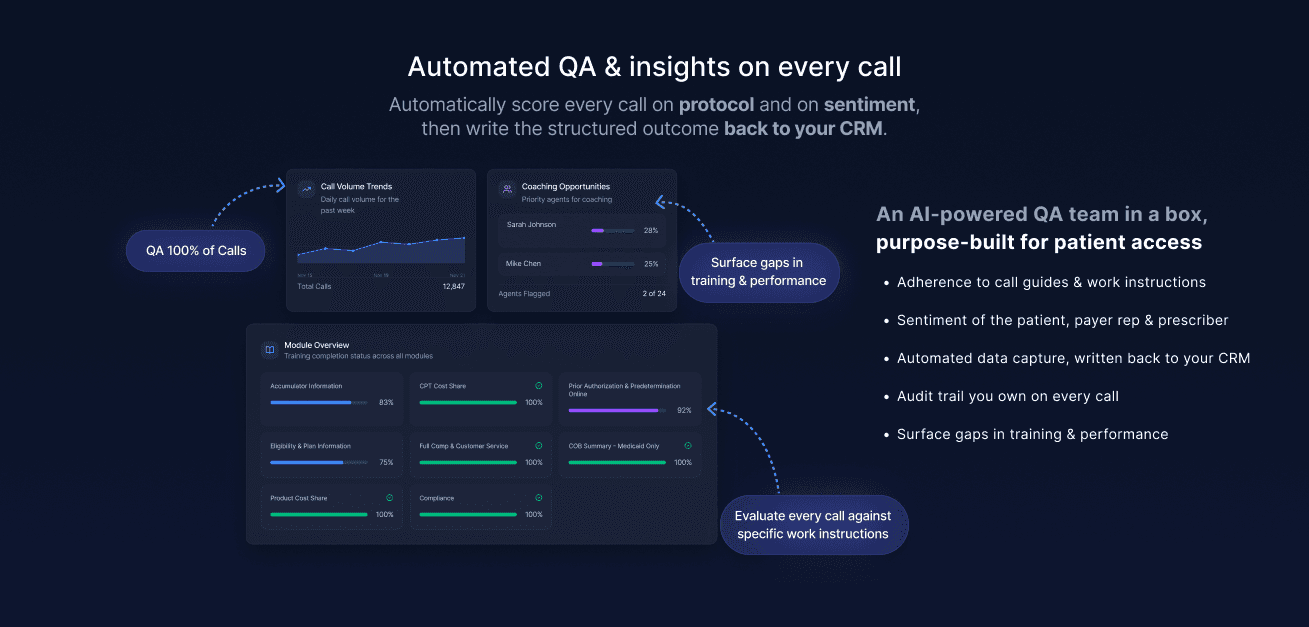
Neon Health deploys AI workers that fully automate patient financial assistance workflows from eligibility screening through enrollment and re-enrollment. Unlike platforms that digitize existing manual processes, Neon's AI workforce operates autonomously: calling payers, navigating portals, verifying income, completing enrollment forms, and following up with patients.
Financial assistance capabilities: End-to-end automation of copay card enrollment, voucher programs, PAP applications, and foundation grant submissions. Neon's AI workers handle the entire workflow: identifying coverage gaps during benefit verification, matching patients to eligible programs, gathering required documentation from patients and providers, completing and submitting applications, and tracking enrollment through fulfillment.
Technology approach: AI-native architecture with modular components (voice AI, portal automation, rules engines) combined into bespoke solutions for each client's workflows. Neon's approach is consultative: the team works with each organization to understand their specific systems, data, and processes before designing an automation solution. HIPAA compliant, HITRUST and SOC 2 certified.
Performance data: Neon Health reports getting patients on therapy twice as fast at 80% lower cost compared to manual processes. The company raised $6 million in September 2025, led by NFX, specifically to expand AI-powered specialty drug access.
Best for: Pharma manufacturers, specialty pharmacies, and health systems that need full workflow automation, not digital forms. Neon Health's AI workers handle the tasks that other platforms still require humans to do: calling payers, navigating IVR systems, collecting documents from patients, and managing the back-and-forth of complex enrollment scenarios. Organizations drowning in manual financial assistance work and looking to scale without proportionally increasing headcount will find the most comprehensive automation here.
Feature Comparison
Platform | Copay Cards | PAP Enrollment | Foundation Grants | Income Verification | Auto Re-enrollment | Patient Communication | Primary Focus |
|---|---|---|---|---|---|---|---|
Atlas Health | Yes | Yes | Yes (strongest) | Yes | Yes | Text, email | Provider / philanthropic aid |
Annexus Health | Yes (strongest) | Yes | Yes | Yes | Yes | In-platform | Provider / copay management |
AssistRx | Yes | Yes | Limited | Yes | Yes | In-platform | Pharma / therapy initiation |
CoverMyMeds | Yes (POS) | Limited | No | No | No | Via pharmacy | Pharmacy / POS copay |
EVERSANA | Yes | Yes (strongest) | Yes | Yes (digital) | Yes | Phone, digital | Pharma / full-service PAP |
Phil | Yes | Yes | Limited | Yes | Yes | Digital hub | Pharma / digital enrollment |
TailorMed | Yes | Yes | Yes | Yes | Yes | Patient portal | Provider / financial navigation |
Drug Assistant | Limited | Yes | Limited | Yes | Limited | Limited | PAP database management |
ConnectiveRx | Yes | Yes | Yes | Yes | Yes | Multi-channel | Pharma / hub services |
Neon Health | Yes | Yes | Yes | Yes (AI-driven) | Yes (automated) | Voice, text, email | End-to-end AI automation |
How to Choose a Financial Assistance Automation Platform
The right platform depends on your organization type, the financial assistance programs you manage, and how much of the workflow you want to automate.
If you need end-to-end automation with minimal human involvement, look at AI-native platforms like Neon Health that handle the entire workflow autonomously. This approach is best for organizations scaling patient access operations without proportionally increasing headcount.
If you manage high volumes of copay card enrollments, Annexus Health's AssistPoint with its direct digital integrations to manufacturer programs provides the fastest enrollment path. For pharmacy point-of-sale copay application, CoverMyMeds integrates at the dispensing step.
If you need broad financial navigation across thousands of programs, TailorMed's 6,000+ resource database and disease-agnostic approach provides the widest coverage. Atlas Health is the strongest option specifically for philanthropic aid and foundation grants.
If you are a pharma manufacturer building a hub program, Phil, AssistRx, EVERSANA, and ConnectiveRx each offer different models: Phil for digital-first with outcome-based pricing, AssistRx for integrated therapy initiation, EVERSANA for full-service outsourced PAP management, and ConnectiveRx for a single-partner hub solution.
If your priority is proactive screening at the point of care, platforms that integrate with EHR and pharmacy systems to flag eligible patients automatically (Atlas Health, TailorMed, AssistRx) will deliver the highest capture rates for patients who would otherwise slip through.
Measuring ROI on Financial Assistance Automation
Financial assistance automation delivers measurable returns across several dimensions. The key is knowing what to track and how to benchmark against manual workflows.
Key Metrics
Enrollment completion rate measures the percentage of eligible patients who successfully complete program enrollment. Traditional call-center hubs achieve 20-30% enrollment rates according to Phil. Digital platforms report 90%+ rates. The gap represents patients who qualify for assistance but never receive it.
Time-to-enrollment tracks how long it takes from eligibility identification to completed enrollment. Manual processes average 15 minutes per enrollment for copay programs. Annexus Health's AssistPoint reduces this to under 20 seconds for digitally integrated programs. For PAPs with income verification requirements, manual processes can take days. Automated income verification tools eliminate the need for hard-copy documentation.
Patient out-of-pocket reduction measures the dollar value of assistance secured per patient. Atlas Health reports up to 800% improvement in financial awards secured compared to manual processes.
Therapy start rate connects financial assistance to the metric that matters most: whether patients actually begin treatment. When out-of-pocket costs drop below the abandonment threshold, therapy starts increase. The IQVIA data showing 60%+ abandonment at $500+ OOP provides the baseline.
Cost Comparison: Manual vs. Automated
A full-time financial counselor costs $45,000-$65,000 annually in salary, plus benefits, training, and management overhead. Each counselor can manage a limited patient caseload given the time required for program research, form completion, and follow-up. Automation platforms handle the routine workflow, allowing counselors to focus on complex cases and patient relationships rather than data entry and phone calls.
Best Practices for Maximizing Financial Assistance Enrollment
Regardless of which platform you choose, these practices consistently improve enrollment outcomes.
Screen proactively at intake, not after denial. The most effective programs identify financial assistance eligibility during benefit verification, before the patient faces a cost barrier. Waiting until a patient reports inability to pay means some have already abandoned therapy.
Use multi-channel patient outreach. Mail-only communication yields low response rates. Text, email, phone, and portal-based outreach in combination reach patients where they are. The best platforms automate multi-channel outreach with escalation logic.
Maintain a real-time program database. Foundation grants open and close based on available funding. Manufacturer programs change eligibility criteria. Copay card terms shift with payer contracts. Any platform you use must keep program data current, not rely on quarterly manual updates.
Integrate with benefit verification. Financial assistance works best when it is connected to BV data. Knowing a patient's exact coverage gaps, deductible status, and formulary tier before screening for assistance programs ensures the right program is matched to the right patient.
Automate re-enrollment. Most copay cards and foundation grants require annual renewal. Patients who received assistance last year frequently fall off therapy when their enrollment lapses. Automated re-enrollment alerts and workflows prevent this predictable drop-off.
The Future of Patient Financial Assistance
Several forces are reshaping how financial assistance works in specialty pharmacy and healthcare broadly.
AI-powered eligibility matching is moving beyond rules-based program lookup. The next generation of platforms uses AI to screen every patient encounter against thousands of programs simultaneously, predict enrollment success probability, and route patients to the highest-value assistance option.
Voice AI for patient enrollment reduces the need for human financial counselors to conduct enrollment conversations. AI workers can call patients, explain program options, collect required documentation, and complete enrollment in a single interaction.
Point-of-sale integration is bringing copay application directly into the pharmacy workflow. Rather than requiring a separate enrollment step before dispensing, copay assistance is applied automatically when the prescription is processed.
Regulatory changes continue to reshape the landscape. The Inflation Reduction Act's drug pricing provisions, evolving copay accumulator and maximizer policies, and potential state-level reforms all affect how financial assistance programs are structured and funded. Organizations that automate their FA workflows can adapt to regulatory changes faster than those running manual processes.
The Bottom Line
Financial assistance is shifting from reactive counseling to proactive automation. The gap between available copay assistance ($30+ billion annually in manufacturer coupons alone) and actual utilization (only 7% of available funds) represents one of the largest addressable inefficiencies in specialty pharmacy.
The organizations that automate financial assistance enrollment will see the highest therapy start rates, the lowest abandonment rates, and the strongest returns on their patient access investments. Whether you start with a focused tool for copay card automation or invest in an end-to-end AI-powered platform, the key is moving away from manual processes that cannot scale to meet patient needs.
For teams evaluating platforms, the comparison table and decision framework above provide a starting point. The right choice depends on your organization type, program mix, and how much of the enrollment workflow you are ready to automate.
Frequently Asked Questions
What is patient financial assistance automation?
Patient financial assistance automation uses software to match patients with eligible copay cards, patient assistance programs (PAPs), and foundation grants, then automates the enrollment process. It replaces manual workflows where financial counselors spend hours per patient navigating program eligibility, completing forms, and tracking status.
How much copay assistance goes unused each year?
According to RxUtility, approximately 93% of more than $30 billion in manufacturer copay coupons goes unused annually. Patients often do not know programs exist, and manual enrollment processes create friction that prevents eligible patients from accessing available funds.
What is the difference between copay cards and patient assistance programs?
Copay cards reduce out-of-pocket costs for commercially insured patients and are funded by drug manufacturers. Patient assistance programs (PAPs) provide free or discounted medications to uninsured or underinsured patients who meet income requirements. Both require separate enrollment processes with different eligibility criteria.
How do copay accumulators affect patient financial assistance?
Copay accumulators are payer policies that exclude manufacturer copay assistance from counting toward a patient's deductible or out-of-pocket maximum. According to a JMCP primer, 39% of commercially insured beneficiaries were in plans with copay accumulators as of 2022, meaning patients may face unexpected costs once their copay card benefits are exhausted.
What ROI metrics should I track for financial assistance automation?
Track enrollment completion rate, time-to-enrollment, patient out-of-pocket reduction, therapy start rate after enrollment, re-enrollment completion rate, and cost per enrollment compared to manual financial counselor workflows. Leading platforms report reducing enrollment time from 15 minutes to under 20 seconds for digitally integrated programs.
Key Takeaways
Out-of-pocket costs drive 60%+ abandonment rates for prescriptions above $500, making financial assistance automation a direct lever for therapy adherence and revenue capture.
Approximately 93% of more than $30 billion in manufacturer copay coupons goes unused each year, according to RxUtility, representing a massive opportunity for automated enrollment.
The financial assistance landscape includes copay cards ($23 billion in 2023), PAPs, foundation grants, and government programs, each with different eligibility rules and enrollment processes.
Digital enrollment platforms achieve 90%+ enrollment rates compared to 20-30% for traditional call-center hubs, according to Phil's published data.
Copay accumulator and maximizer policies (affecting 39-41% of commercially insured patients) add complexity that requires automated monitoring and mid-year program switching.
The most advanced platforms, including Neon Health, use AI workers to handle the entire financial assistance workflow autonomously, from eligibility screening through enrollment and re-enrollment.
Proactive screening at intake, multi-channel outreach, real-time program databases, and automated re-enrollment are the practices that consistently maximize enrollment outcomes regardless of platform choice.
Sources
BrightInsight + Claritas Rx. "Abandonment and Discontinuation Variation in Specialty Drugs." 62% paid fill rate across 85 specialty brands.
IQVIA Institute. "Medicine Use and Spending in the U.S." 60% abandonment at $500+ OOP cost.
ASPE. "Trends in Prescription Drug Spending 2016-2021." Specialty spending $301B in 2021.
RxUtility. "The U.S. Healthcare System Is Losing the Fight for Medication Affordability." 2025. $30B+ in copay coupons available; 93% unused rate.
EMARKETER. "Nearly $30B in Pharma Manufacturer Coupons Go Unused." 2026. Coverage of RxUtility data.
KFF. "Copay Adjustment Programs: What Are They and What Do They Mean for Consumers?" Copay assistance used for 19% of commercially insured Rx, 42% of specialty Rx. Total value $23B in 2023.
JAMA Internal Medicine / IQVIA Formulary Impact Analyzer. 88.2% of manufacturer offsets for brand-name products; median 87.1% OOP coverage.
JMCP. "Primer on Copay Accumulators and Maximizers." 2024. 39% accumulators, 41% maximizers among commercially insured.
PubMed (PMID: 21719593). At least 15 software programs for PAP management.
Phil. "4 Strategies to Maximize Enrollment in Your Patient Services Program." 20-30% enrollment for traditional hubs vs. 90%+ for digital.
Atlas Health. Self-reported data from company website. Accessed February 2026. Up to 800% improvement in financial awards.
Annexus Health. Self-reported data from company website. Accessed February 2026. $9B+ in awards since 2018; enrollment reduced to <20 seconds.
AssistRx. Self-reported data from company website. Accessed February 2026. iAssist platform capabilities.
EVERSANA. Self-reported data from company website. Accessed February 2026. PAP model with process automation and digital enrollment.
TailorMed. Self-reported data from company website. Accessed February 2026. 6,000+ resources; $40M raised October 2024.
ConnectiveRx. Self-reported data from company website. Accessed February 2026. Hub services and affordability programs.
Neon Health. Self-reported data from company website. Accessed February 2026. $6M raised September 2025; "twice as fast, 80% cheaper."
Out-of-pocket cost is the single largest driver of prescription abandonment. According to IQVIA, abandonment rates exceed 60% when patients face more than $500 in out-of-pocket costs.
Across specialty medications broadly, only 62% of prescriptions ever reach a paid fill, according to data from BrightInsight and Claritas Rx covering 85 specialty brands. With specialty drug spending exceeding $301 billion annually and roughly 38% of prescriptions never filled, the revenue at risk runs well into the hundreds of billions.
The painful irony: billions in financial assistance already exists to help these patients. Manufacturer copay cards, patient assistance programs, and foundation grants collectively represent tens of billions in available support. For copay coupons alone, RxUtility reports more than $30 billion available annually, with 93% going unused.
Patients do not know programs exist. Financial counselors cannot keep up with the volume. Eligibility rules change constantly across programs, payers, and therapies.
The result is a system where patients abandon therapy they need, manufacturers lose revenue on drugs they have already developed, and providers absorb the downstream costs of untreated conditions.
Patient financial assistance automation software addresses this gap. These platforms match patients to eligible programs, automate enrollment workflows, and track status through fulfillment. The category ranges from digital enrollment tools to AI-powered systems that handle the entire financial assistance workflow without human intervention.
This guide compares 10 platforms across the full spectrum: established hub solutions, specialized financial navigation tools, and AI-native automation platforms.
What Are Patient Financial Assistance Programs?
Patient financial assistance programs are manufacturer-funded, foundation-funded, or government-funded programs that reduce or eliminate a patient's out-of-pocket cost for medications. They are a critical mechanism for ensuring patients can afford and start therapy.
Types of Programs
Manufacturer copay cards and vouchers are the largest category. According to KFF, copay assistance was used for approximately 19% of all commercially insured prescriptions and 42% of specialty prescriptions in 2023, with a total value of $23 billion. Research published in JAMA Internal Medicine found that 88.2% of manufacturer offsets target brand-name products, with a median coverage of 87.1% of out-of-pocket costs.
Patient assistance programs (PAPs) provide free or discounted medications directly to uninsured or underinsured patients. These are manufacturer-funded and typically require income verification and proof of insurance status. According to a PubMed study, at least 15 dedicated software programs exist specifically for PAP management.
Foundation grants come from independent charitable organizations like PAN Foundation, HealthWell Foundation, and NeedyMeds. These programs open and close based on available funding, creating a moving target for enrollment teams.
State ADAP programs (AIDS Drug Assistance Programs) and 340B considerations add further complexity for specific patient populations and provider types.
The Complicating Factor: Copay Accumulators and Maximizers
A growing challenge for financial assistance programs is the rise of copay accumulator and maximizer policies. According to a JMCP primer, 39% of commercially insured beneficiaries were in plans with copay accumulators and 41% with copay maximizers as of 2022. These policies exclude manufacturer copay assistance from counting toward a patient's deductible or out-of-pocket maximum, meaning patients may face unexpected costs partway through a benefit year.
This makes financial assistance automation even more critical. Programs must not only enroll patients but also monitor for accumulator impacts and re-enroll or switch programs mid-year when needed.
What Financial Assistance Automation Software Does
Patient financial assistance automation software replaces manual workflows where financial counselors spend hours per patient navigating program eligibility, completing forms, submitting applications, and tracking status.
Core capabilities include:
Eligibility matching across copay cards, PAPs, foundation grants, and government programs
Automated form completion and submission using patient data already in the system
Income verification through digital tools rather than paper documentation
Status tracking and re-enrollment alerts for programs with annual renewal requirements
Integration with pharmacy and hub workflows to connect enrollment to dispensing
Patient communication via text, phone, email, or portal for document collection and status updates
The most advanced platforms in this category go beyond form automation. They use AI to proactively screen every patient encounter for eligible programs, predict enrollment outcomes, and handle the entire workflow from identification through fulfillment.
Top Copay and Financial Assistance Automation Platforms
Atlas Health
Atlas Health is a leading platform in philanthropic aid automation for health systems and provider organizations. The platform, Atlas MAP, uses AI-driven matching to screen every patient encounter and prescription against the largest network of funding sources available.
Financial assistance capabilities: Atlas MAP matches patients to eligible funding sources including foundation grants, copay assistance, PAPs, and government programs. The system ranks matches by probability of successful enrollment and uses AI-guided workflows to automate submissions.
Technology approach: AI matching engine with predictive enrollment scoring. Supports ETL, API, HL7, CSV, and FHIR exchange protocols for interoperability. Patient-facing text and email workflows collect required documents during the automatic enrollment process.
Performance data: Atlas Health reports up to 800% improvement in financial awards secured, up to 1000% efficiency improvement in back-office workflows, and 3x the number of patients helped. Up to 30% reduction in uncompensated care.
Recognition: Ranked #1 for improving outcomes and #2 for reducing cost of care in the 2022 KLAS Emerging Solutions Top 20 Report. Winner of the 2021 HFMA Innovation Award and MedTech Breakthrough Award. Ranked No. 540 on the 2024 Inc. 5000 list of fastest-growing private companies.
Clients: Sinai Chicago, ThedaCare, Memorial Healthcare System, Cone Health, OHSU, Prisma Health, University of Miami Health, Covenant Health, Baylor Scott & White, Legacy Health, and others.
Best for: Health systems and provider organizations focused on philanthropic aid and foundation grants. Atlas Health's strength is its comprehensive funding network and provider-centric approach. Organizations that need to maximize every dollar of available charitable funding will find the deepest matching capabilities here.
Considerations: Atlas Health is provider-focused, not pharma-focused. Manufacturers building copay card or voucher programs will find other platforms better suited to their workflow. The platform's strength in philanthropic aid may not extend as deeply into manufacturer-funded copay programs.
Annexus Health
Annexus Health offers AssistPoint, a comprehensive software platform that accelerates financial assistance management for healthcare organizations. The platform has secured over $9 billion in awards since 2018.
Financial assistance capabilities: AssistPoint handles proactive patient screening, program enrollment, and award management. AP Connect provides digital integration directly with manufacturer patient support programs, creating a two-way information exchange that eliminates manual data entry.
Technology approach: Digital integration with manufacturer programs via AP Connect reduces enrollment from a manual 15-minute process to under 20 seconds. The platform also offers Adparo, a tech-enabled service where experienced patient advocates manage assistance workflows using AssistPoint.
Performance data: Over $9 billion in awards secured since 2018. Enrollment time reduced from 15 minutes to less than 20 seconds for digitally integrated programs, according to user testimonials.
Best for: Infusion centers, specialty pharmacies, and provider organizations that manage high volumes of copay and PAP enrollments. Annexus Health's direct digital integration with manufacturer programs (AP Connect) is a differentiator for organizations that need speed and accuracy in copay program enrollment specifically.
Considerations: Annexus Health's platform is provider-centric. Manufacturer teams looking to build and manage their own copay programs will want a pharma-focused partner. The outsourced Adparo service adds cost but provides experienced advocates for organizations with limited financial counseling staff.
AssistRx
AssistRx provides iAssist, an all-in-one specialty therapy initiation platform that includes financial assistance as part of a broader patient access workflow covering ePrescribe, eBV, ePA, and eEnrollment.
Financial assistance capabilities: iAssist includes eCopay and ePAP modules that perform immediate program screening and electronic enrollment. Financial assistance is integrated into the same workflow as benefit verification and prior authorization, so gaps in coverage are identified and addressed before the patient leaves the office.
Technology approach: Built on AssistRx's Advanced eServices infrastructure. The platform completes enrollment in under 5 minutes and returns real-time coverage data. The approach is integrated: financial assistance screening happens automatically alongside BV and PA, not as a separate step.
Performance data: AssistRx reports reduced time to therapy and patients who use iAssist are less likely to abandon therapy (self-reported). The platform serves tens of thousands of registered HCP users across thousands of offices.
Best for: Pharma manufacturers launching specialty products who need a single platform for the full therapy initiation workflow. AssistRx's strength is integration: BV, PA, financial assistance, and ePrescribe in one system. Teams that want financial assistance embedded in the prescribing workflow rather than managed separately will find the tightest integration here.
Considerations: iAssist's financial assistance is one module within a broader therapy initiation platform. Organizations that need deep financial navigation across thousands of programs (foundation grants, government programs, SDOH resources) may find specialized platforms like TailorMed or Atlas Health more comprehensive for FA specifically.
CoverMyMeds
CoverMyMeds, a McKesson subsidiary, is one of the largest electronic prior authorization networks in the United States and offers copay application at the point of sale.
Financial assistance capabilities: CoverMyMeds applies manufacturer copay assistance at the pharmacy point of sale, reducing friction for commercially insured patients. The platform connects prescribers, pharmacies, and payers through a network that processes millions of transactions annually.
Technology approach: Network-based approach that integrates with pharmacy management systems and EHRs. Copay application happens automatically during the dispensing process rather than requiring a separate enrollment step.
Performance data: CoverMyMeds processes prior authorizations and copay transactions across a network of hundreds of thousands of providers and pharmacies.
Best for: Pharmacies and health systems that already use CoverMyMeds for electronic prior authorization and want copay application integrated at the point of dispensing. The platform's scale is its primary advantage, but its financial assistance capabilities are narrower than specialized FA platforms.
Considerations: CoverMyMeds is primarily a prior authorization and pharmacy network tool. Copay application at point of sale is one feature, not the platform's core focus. Organizations that need PAP enrollment, foundation grant management, or proactive eligibility screening across multiple program types will need a dedicated FA platform alongside CoverMyMeds.
EVERSANA
EVERSANA offers full-service patient assistance programs that combine technology automation with outsourced patient services. The approach pairs digital tools with human support for complex enrollment scenarios.
Financial assistance capabilities: EVERSANA's PAP model includes digital enrollment solutions with virtual assistants for patient guidance, scripted process automation for intake and eligibility processing, electronic income validation, and alternate funding database screening. The platform pre-screens patients for PAP eligibility and connects to integrated specialty pharmacies for fulfillment.
Technology approach: Hybrid model combining process automation with human patient services teams. Digital enrollment websites with virtual assistants guide patients through self-service enrollment. The electronic income validation tool eliminates hard-copy documentation requirements.
Best for: Pharma manufacturers that need a full-service PAP partner with both technology and human resources. EVERSANA's strength is its end-to-end commercial services offering: PAP management sits within a broader suite that includes market access, distribution, and patient services. Organizations that want a single outsourced partner for the full commercial lifecycle will find the most comprehensive offering here.
Considerations: EVERSANA's full-service model means higher costs than self-service platforms. The rule-based automation, while effective for structured workflows, may be less adaptive than AI-native approaches when payer portals change or new program types emerge. Organizations looking for a technology platform they control in-house may prefer a SaaS-based alternative.
Phil
Phil provides a digital hub platform focused on maximizing enrollment in manufacturer patient services programs. The company positions itself as a modern alternative to traditional call-center-based hubs.
Financial assistance capabilities: Phil's platform handles copay card enrollment, PAP access, and affordability-first prescription routing through PHIL Direct. The system automates program screening, enrollment, and status tracking with a focus on reducing patient out-of-pocket costs as a driver of prescription pull-through.
Technology approach: Digital-first hub that replaces traditional call-center models. According to Phil's published data, traditional call-center hubs achieve 20-30% enrollment rates, while Phil's digital approach achieves 90%+ enrollment rates. The platform provides territory-level and HCP-level insights for manufacturers to optimize program performance.
Performance data: Phil reports 90%+ enrollment rates for manufacturer partners. One women's health brand went from single-digit enrollment rates with a large specialty pharmacy to 91% enrollment after adopting PhilRx. Phil's model charges for outcomes (enrollments, coverage, dispenses) rather than fixed overhead costs.
Best for: Pharma manufacturers, particularly specialty-lite brands, looking for a digital hub partner that maximizes enrollment rates and provides granular performance analytics. Phil's outcome-based pricing model is attractive for brands that want to avoid the fixed overhead of traditional hub solutions.
Considerations: Phil is a hub platform for manufacturers, not a provider-side tool. Health systems and specialty pharmacies managing their own financial assistance workflows will not find Phil directly applicable. Phil's model works best when the manufacturer is willing to treat the hub as a core go-to-market partner, not an afterthought, as the company's own published guidance emphasizes.
TailorMed
TailorMed is a financial navigation platform that matches patients across more than 6,000 financial assistance resources including copay cards, foundation grants, free drug programs, SDOH resources, and government plans.
Financial assistance capabilities: The platform provides real-time intelligent matching based on insurance coverage, diagnoses, treatment, FPL percentage, and other eligibility factors. Features include PDF auto-population, digital in-platform enrollment, direct connectivity with manufacturers, out-of-pocket projection for buy-and-bill medications, and expedited enrollment workflows.
Technology approach: Disease-agnostic and therapy-agnostic platform that integrates with any EMR, pharmacy, or practice management system via API or data feed. TailorMed Connect is a newer patient-facing solution that gives patients direct access to financial assistance resources. SOC 2 Type II compliant.
Performance data: TailorMed raised $40 million in October 2024 to expand its platform. The company partners with major health systems including OSF Healthcare, UnityPoint Health, and specialty pharmacies including Prime/Magellan Rx. TailorMed's pricing starts at $50 per patient (first 10 patients free), with optional financial counseling ($50), program enrollment ($75), and patient follow-up ($25) services.
Best for: Health systems, oncology practices, and specialty pharmacies that need broad financial navigation across all assistance types. TailorMed's 6,000+ resource database and disease-agnostic approach make it the strongest choice for organizations that serve patients across many therapy areas and need a single platform for all financial assistance types.
Considerations: TailorMed's per-patient pricing model ($50/patient plus optional services) can add up at high volumes. The platform is strong on matching and navigation but relies on financial counselors and optional services for complex enrollment scenarios. Organizations with very high patient volumes may want to compare total cost of ownership against platforms with different pricing structures.
Drug Assistant
Drug Assistant provides a PAP library and automation tools focused specifically on patient assistance program management. The platform maintains a database of manufacturer PAPs with eligibility criteria, application requirements, and program status.
Financial assistance capabilities: Program lookup and eligibility screening across manufacturer PAPs. Application form management and submission tracking. Program status monitoring including open/closed alerts.
Technology approach: Database-driven approach focused on PAP program information accuracy and application workflow management.
Best for: Organizations that primarily need PAP-specific management tools and program database access. Drug Assistant serves a narrower use case than broader financial navigation platforms but provides focused depth on manufacturer patient assistance programs.
ConnectiveRx
ConnectiveRx offers hub services, end-to-end patient affordability programs, and point-of-care awareness and adherence messaging. The company positions itself as a single-partner solution for pharmaceutical manufacturers.
Financial assistance capabilities: ConnectiveRx manages copay programs, PAP enrollment, and broader affordability solutions as part of its hub services. The platform handles program design, enrollment, fulfillment tracking, and patient communication. Recent content from ConnectiveRx addresses the impact of the Inflation Reduction Act on hub, PAP, and affordability programs.
Technology approach: Full-service hub model with technology-enabled workflows. ConnectiveRx combines call center capabilities with digital tools for enrollment and adherence. Point-of-care messaging integrates financial assistance awareness into the prescribing workflow.
Best for: Pharma manufacturers that want a single partner for hub services, affordability programs, and adherence messaging. ConnectiveRx's breadth across the patient journey is its differentiator, but financial assistance automation is one component of a broader services offering rather than the sole focus.
Neon Health
Neon Health deploys AI workers that fully automate patient financial assistance workflows from eligibility screening through enrollment and re-enrollment. Unlike platforms that digitize existing manual processes, Neon's AI workforce operates autonomously: calling payers, navigating portals, verifying income, completing enrollment forms, and following up with patients.
Financial assistance capabilities: End-to-end automation of copay card enrollment, voucher programs, PAP applications, and foundation grant submissions. Neon's AI workers handle the entire workflow: identifying coverage gaps during benefit verification, matching patients to eligible programs, gathering required documentation from patients and providers, completing and submitting applications, and tracking enrollment through fulfillment.
Technology approach: AI-native architecture with modular components (voice AI, portal automation, rules engines) combined into bespoke solutions for each client's workflows. Neon's approach is consultative: the team works with each organization to understand their specific systems, data, and processes before designing an automation solution. HIPAA compliant, HITRUST and SOC 2 certified.
Performance data: Neon Health reports getting patients on therapy twice as fast at 80% lower cost compared to manual processes. The company raised $6 million in September 2025, led by NFX, specifically to expand AI-powered specialty drug access.
Best for: Pharma manufacturers, specialty pharmacies, and health systems that need full workflow automation, not digital forms. Neon Health's AI workers handle the tasks that other platforms still require humans to do: calling payers, navigating IVR systems, collecting documents from patients, and managing the back-and-forth of complex enrollment scenarios. Organizations drowning in manual financial assistance work and looking to scale without proportionally increasing headcount will find the most comprehensive automation here.
Feature Comparison
Platform | Copay Cards | PAP Enrollment | Foundation Grants | Income Verification | Auto Re-enrollment | Patient Communication | Primary Focus |
|---|---|---|---|---|---|---|---|
Atlas Health | Yes | Yes | Yes (strongest) | Yes | Yes | Text, email | Provider / philanthropic aid |
Annexus Health | Yes (strongest) | Yes | Yes | Yes | Yes | In-platform | Provider / copay management |
AssistRx | Yes | Yes | Limited | Yes | Yes | In-platform | Pharma / therapy initiation |
CoverMyMeds | Yes (POS) | Limited | No | No | No | Via pharmacy | Pharmacy / POS copay |
EVERSANA | Yes | Yes (strongest) | Yes | Yes (digital) | Yes | Phone, digital | Pharma / full-service PAP |
Phil | Yes | Yes | Limited | Yes | Yes | Digital hub | Pharma / digital enrollment |
TailorMed | Yes | Yes | Yes | Yes | Yes | Patient portal | Provider / financial navigation |
Drug Assistant | Limited | Yes | Limited | Yes | Limited | Limited | PAP database management |
ConnectiveRx | Yes | Yes | Yes | Yes | Yes | Multi-channel | Pharma / hub services |
Neon Health | Yes | Yes | Yes | Yes (AI-driven) | Yes (automated) | Voice, text, email | End-to-end AI automation |
How to Choose a Financial Assistance Automation Platform
The right platform depends on your organization type, the financial assistance programs you manage, and how much of the workflow you want to automate.
If you need end-to-end automation with minimal human involvement, look at AI-native platforms like Neon Health that handle the entire workflow autonomously. This approach is best for organizations scaling patient access operations without proportionally increasing headcount.
If you manage high volumes of copay card enrollments, Annexus Health's AssistPoint with its direct digital integrations to manufacturer programs provides the fastest enrollment path. For pharmacy point-of-sale copay application, CoverMyMeds integrates at the dispensing step.
If you need broad financial navigation across thousands of programs, TailorMed's 6,000+ resource database and disease-agnostic approach provides the widest coverage. Atlas Health is the strongest option specifically for philanthropic aid and foundation grants.
If you are a pharma manufacturer building a hub program, Phil, AssistRx, EVERSANA, and ConnectiveRx each offer different models: Phil for digital-first with outcome-based pricing, AssistRx for integrated therapy initiation, EVERSANA for full-service outsourced PAP management, and ConnectiveRx for a single-partner hub solution.
If your priority is proactive screening at the point of care, platforms that integrate with EHR and pharmacy systems to flag eligible patients automatically (Atlas Health, TailorMed, AssistRx) will deliver the highest capture rates for patients who would otherwise slip through.
Measuring ROI on Financial Assistance Automation
Financial assistance automation delivers measurable returns across several dimensions. The key is knowing what to track and how to benchmark against manual workflows.
Key Metrics
Enrollment completion rate measures the percentage of eligible patients who successfully complete program enrollment. Traditional call-center hubs achieve 20-30% enrollment rates according to Phil. Digital platforms report 90%+ rates. The gap represents patients who qualify for assistance but never receive it.
Time-to-enrollment tracks how long it takes from eligibility identification to completed enrollment. Manual processes average 15 minutes per enrollment for copay programs. Annexus Health's AssistPoint reduces this to under 20 seconds for digitally integrated programs. For PAPs with income verification requirements, manual processes can take days. Automated income verification tools eliminate the need for hard-copy documentation.
Patient out-of-pocket reduction measures the dollar value of assistance secured per patient. Atlas Health reports up to 800% improvement in financial awards secured compared to manual processes.
Therapy start rate connects financial assistance to the metric that matters most: whether patients actually begin treatment. When out-of-pocket costs drop below the abandonment threshold, therapy starts increase. The IQVIA data showing 60%+ abandonment at $500+ OOP provides the baseline.
Cost Comparison: Manual vs. Automated
A full-time financial counselor costs $45,000-$65,000 annually in salary, plus benefits, training, and management overhead. Each counselor can manage a limited patient caseload given the time required for program research, form completion, and follow-up. Automation platforms handle the routine workflow, allowing counselors to focus on complex cases and patient relationships rather than data entry and phone calls.
Best Practices for Maximizing Financial Assistance Enrollment
Regardless of which platform you choose, these practices consistently improve enrollment outcomes.
Screen proactively at intake, not after denial. The most effective programs identify financial assistance eligibility during benefit verification, before the patient faces a cost barrier. Waiting until a patient reports inability to pay means some have already abandoned therapy.
Use multi-channel patient outreach. Mail-only communication yields low response rates. Text, email, phone, and portal-based outreach in combination reach patients where they are. The best platforms automate multi-channel outreach with escalation logic.
Maintain a real-time program database. Foundation grants open and close based on available funding. Manufacturer programs change eligibility criteria. Copay card terms shift with payer contracts. Any platform you use must keep program data current, not rely on quarterly manual updates.
Integrate with benefit verification. Financial assistance works best when it is connected to BV data. Knowing a patient's exact coverage gaps, deductible status, and formulary tier before screening for assistance programs ensures the right program is matched to the right patient.
Automate re-enrollment. Most copay cards and foundation grants require annual renewal. Patients who received assistance last year frequently fall off therapy when their enrollment lapses. Automated re-enrollment alerts and workflows prevent this predictable drop-off.
The Future of Patient Financial Assistance
Several forces are reshaping how financial assistance works in specialty pharmacy and healthcare broadly.
AI-powered eligibility matching is moving beyond rules-based program lookup. The next generation of platforms uses AI to screen every patient encounter against thousands of programs simultaneously, predict enrollment success probability, and route patients to the highest-value assistance option.
Voice AI for patient enrollment reduces the need for human financial counselors to conduct enrollment conversations. AI workers can call patients, explain program options, collect required documentation, and complete enrollment in a single interaction.
Point-of-sale integration is bringing copay application directly into the pharmacy workflow. Rather than requiring a separate enrollment step before dispensing, copay assistance is applied automatically when the prescription is processed.
Regulatory changes continue to reshape the landscape. The Inflation Reduction Act's drug pricing provisions, evolving copay accumulator and maximizer policies, and potential state-level reforms all affect how financial assistance programs are structured and funded. Organizations that automate their FA workflows can adapt to regulatory changes faster than those running manual processes.
The Bottom Line
Financial assistance is shifting from reactive counseling to proactive automation. The gap between available copay assistance ($30+ billion annually in manufacturer coupons alone) and actual utilization (only 7% of available funds) represents one of the largest addressable inefficiencies in specialty pharmacy.
The organizations that automate financial assistance enrollment will see the highest therapy start rates, the lowest abandonment rates, and the strongest returns on their patient access investments. Whether you start with a focused tool for copay card automation or invest in an end-to-end AI-powered platform, the key is moving away from manual processes that cannot scale to meet patient needs.
For teams evaluating platforms, the comparison table and decision framework above provide a starting point. The right choice depends on your organization type, program mix, and how much of the enrollment workflow you are ready to automate.
Frequently Asked Questions
What is patient financial assistance automation?
Patient financial assistance automation uses software to match patients with eligible copay cards, patient assistance programs (PAPs), and foundation grants, then automates the enrollment process. It replaces manual workflows where financial counselors spend hours per patient navigating program eligibility, completing forms, and tracking status.
How much copay assistance goes unused each year?
According to RxUtility, approximately 93% of more than $30 billion in manufacturer copay coupons goes unused annually. Patients often do not know programs exist, and manual enrollment processes create friction that prevents eligible patients from accessing available funds.
What is the difference between copay cards and patient assistance programs?
Copay cards reduce out-of-pocket costs for commercially insured patients and are funded by drug manufacturers. Patient assistance programs (PAPs) provide free or discounted medications to uninsured or underinsured patients who meet income requirements. Both require separate enrollment processes with different eligibility criteria.
How do copay accumulators affect patient financial assistance?
Copay accumulators are payer policies that exclude manufacturer copay assistance from counting toward a patient's deductible or out-of-pocket maximum. According to a JMCP primer, 39% of commercially insured beneficiaries were in plans with copay accumulators as of 2022, meaning patients may face unexpected costs once their copay card benefits are exhausted.
What ROI metrics should I track for financial assistance automation?
Track enrollment completion rate, time-to-enrollment, patient out-of-pocket reduction, therapy start rate after enrollment, re-enrollment completion rate, and cost per enrollment compared to manual financial counselor workflows. Leading platforms report reducing enrollment time from 15 minutes to under 20 seconds for digitally integrated programs.
Key Takeaways
Out-of-pocket costs drive 60%+ abandonment rates for prescriptions above $500, making financial assistance automation a direct lever for therapy adherence and revenue capture.
Approximately 93% of more than $30 billion in manufacturer copay coupons goes unused each year, according to RxUtility, representing a massive opportunity for automated enrollment.
The financial assistance landscape includes copay cards ($23 billion in 2023), PAPs, foundation grants, and government programs, each with different eligibility rules and enrollment processes.
Digital enrollment platforms achieve 90%+ enrollment rates compared to 20-30% for traditional call-center hubs, according to Phil's published data.
Copay accumulator and maximizer policies (affecting 39-41% of commercially insured patients) add complexity that requires automated monitoring and mid-year program switching.
The most advanced platforms, including Neon Health, use AI workers to handle the entire financial assistance workflow autonomously, from eligibility screening through enrollment and re-enrollment.
Proactive screening at intake, multi-channel outreach, real-time program databases, and automated re-enrollment are the practices that consistently maximize enrollment outcomes regardless of platform choice.
Sources
BrightInsight + Claritas Rx. "Abandonment and Discontinuation Variation in Specialty Drugs." 62% paid fill rate across 85 specialty brands.
IQVIA Institute. "Medicine Use and Spending in the U.S." 60% abandonment at $500+ OOP cost.
ASPE. "Trends in Prescription Drug Spending 2016-2021." Specialty spending $301B in 2021.
RxUtility. "The U.S. Healthcare System Is Losing the Fight for Medication Affordability." 2025. $30B+ in copay coupons available; 93% unused rate.
EMARKETER. "Nearly $30B in Pharma Manufacturer Coupons Go Unused." 2026. Coverage of RxUtility data.
KFF. "Copay Adjustment Programs: What Are They and What Do They Mean for Consumers?" Copay assistance used for 19% of commercially insured Rx, 42% of specialty Rx. Total value $23B in 2023.
JAMA Internal Medicine / IQVIA Formulary Impact Analyzer. 88.2% of manufacturer offsets for brand-name products; median 87.1% OOP coverage.
JMCP. "Primer on Copay Accumulators and Maximizers." 2024. 39% accumulators, 41% maximizers among commercially insured.
PubMed (PMID: 21719593). At least 15 software programs for PAP management.
Phil. "4 Strategies to Maximize Enrollment in Your Patient Services Program." 20-30% enrollment for traditional hubs vs. 90%+ for digital.
Atlas Health. Self-reported data from company website. Accessed February 2026. Up to 800% improvement in financial awards.
Annexus Health. Self-reported data from company website. Accessed February 2026. $9B+ in awards since 2018; enrollment reduced to <20 seconds.
AssistRx. Self-reported data from company website. Accessed February 2026. iAssist platform capabilities.
EVERSANA. Self-reported data from company website. Accessed February 2026. PAP model with process automation and digital enrollment.
TailorMed. Self-reported data from company website. Accessed February 2026. 6,000+ resources; $40M raised October 2024.
ConnectiveRx. Self-reported data from company website. Accessed February 2026. Hub services and affordability programs.
Neon Health. Self-reported data from company website. Accessed February 2026. $6M raised September 2025; "twice as fast, 80% cheaper."
Related articles
Related articles

Ready to transform Patient Access?
Ready to transform Patient Access?
NEWSLETTER
@ 2026 Neon Health (Belay, Inc).
AI-powered patient access automation
for leading pharma enterprises.
NEWSLETTER
@ 2026 Neon Health (Belay, Inc).
AI-powered patient access automation for leading pharma enterprises.
NEWSLETTER
@ 2026 Neon Health (Belay, Inc).
AI-powered patient access automation
for leading pharma enterprises.