
Specialty Medication Enrollment Platforms Compared [2026]
Specialty Medication Enrollment Platforms Compared [2026]
TL;DR: Specialty enrollment platforms range from form-digitization tools to full patient access automation systems. RxLightning and RXNT focus on enrollment form management. CoverMyMeds and AssistRx iAssist bundle enrollment with BV and PA. Phil and ConnectiveRx add dispensing and pharmacy network integration. Neon Health treats enrollment as one step in an AI-automated patient access workflow that spans BV through adherence. The right platform depends on how much of the access workflow you need to automate, not how you submit enrollment forms.
Eighty-seven percent of specialty pharmacists believe enrollment should take two weeks or less. Only 33% say it currently does (Surescripts). That gap represents weeks of delayed therapy for patients who need complex medications, and millions in operational overhead for the teams managing enrollment workflows.
The disconnect is structural. Specialty medications account for 2 to 3% of prescription volume but 53% of total U.S. drug spending (IQVIA). Each specialty prescription triggers a cascade of enrollment steps that general ePrescribing was never built to handle: benefit verification, prior authorization, financial assistance screening, pharmacy selection, patient consent, and clinical data collection.
Most organizations still manage this cascade across up to nine different applications (CoverMyMeds). Sixty-three percent of clinicians identify these access responsibilities as their most time-consuming work.
This guide compares seven specialty medication enrollment platforms: what each does well, where each falls short, and how to choose the right one for your workflows.
What Is Specialty Medication Enrollment and Why Does It Matter?
Specialty medication enrollment is the process of collecting and transmitting the clinical, demographic, and financial data required before a specialty pharmacy can dispense a prescribed medication. It bridges the gap between the prescribing event and therapy initiation.
Standard ePrescribing sends the prescription. Specialty enrollment goes further. The HL7/NCPDP FHIR Specialty Medication Enrollment Implementation Guide was created specifically because standard prescription data lacks the clinical details, insurance specifics, and patient consent that specialty pharmacies need to begin dispensing. Without this data, pharmacies call providers to collect it manually, adding days before therapy can start.
The Enrollment Workflow
A typical specialty enrollment follows this sequence:
Prescription: Provider prescribes a specialty medication via EHR
Data collection: Clinical notes, diagnosis codes, prior therapies, and lab results are gathered
Benefit verification: Insurance coverage, copay amounts, and formulary status are confirmed
Prior authorization: If required, PA is initiated and tracked to resolution
Financial assistance: Patient is screened for copay cards, manufacturer vouchers, PAPs, or foundation grants
Pharmacy routing: Prescription is directed to the appropriate specialty pharmacy
Patient consent: Patient is contacted for consent and onboarding
Dispensing: Specialty pharmacy fills and ships the medication
Why Speed Matters
Every day between prescription and dispensing is a day the patient waits for therapy. Research published in the Journal of Managed Care & Specialty Pharmacy found that specialty pharmacy turnaround times average 2 to 7 days for clean prescriptions, depending on pharmacy type. When prior authorization is required, timelines extend up to 15 days.
The gap compounds for patients who transfer between pharmacy systems. A 2024 JMCP study found that patients whose specialty medications were filled at integrated health system pharmacies started treatment 6 days faster than those transferred to external specialty pharmacies. The difference comes down to data connectivity: integrated systems share enrollment data automatically rather than re-collecting it through fax and phone.
How We Evaluated These Platforms
We assessed each platform across seven criteria that determine how effectively it reduces time-to-therapy through enrollment automation.
Criterion | What we measured | Why it matters |
|---|---|---|
EHR integration | Embedded, portal, or fax-based | Determines whether clinicians leave their workflow |
Enrollment automation | Auto-populated forms vs. manual entry | Reduces data collection time and errors |
Workflow coverage | Enrollment only vs. BV/PA/financial assistance | Determines handoff points between systems |
Pharmacy network | Proprietary, open, or non-commercial | Affects where prescriptions can be routed |
Standards support | HL7 FHIR, NCPDP, Surescripts | Indicates interoperability and future readiness |
Analytics | Real-time tracking, TAT reporting | Enables measurement and improvement |
Manufacturer programs | Copay cards, PAPs, bridge programs | Determines financial assistance coverage |
Platform profiles are based on publicly available documentation, press releases, and published case data. Self-reported claims from vendor websites are noted as such.
Specialty Medication Enrollment Platforms Compared
The seven platforms below represent the range of approaches to specialty enrollment, from form digitization to full patient access automation.
RxLightning (by CoverMyMeds/McKesson)
What it does: RxLightning is a cloud-based enrollment platform that aggregates manufacturer-specific enrollment forms into a single digital interface. Prescribers search for a medication, complete the enrollment form, and submit it electronically to the manufacturer's hub or specialty pharmacy.
Strengths: RxLightning consolidates enrollment forms that would otherwise require separate manufacturer portals, fax machines, or phone calls. Its integration with the CoverMyMeds/McKesson network gives it connectivity to a large pharmacy and manufacturer ecosystem. The platform focuses on the enrollment step specifically, making it straightforward for organizations that need to digitize form submission without adopting a broader suite.
Considerations: RxLightning addresses enrollment form management, not the full access workflow. Benefit verification, prior authorization, and financial assistance screening happen in separate systems. Organizations using RxLightning still manage multiple handoffs between enrollment and other access steps. The platform operates within the McKesson ecosystem, which may influence pharmacy routing.
Best for: Organizations that need to replace fax-based enrollment across multiple manufacturer programs with a single digital portal.
CoverMyMeds Specialty Solutions
What it does: CoverMyMeds Specialty Solutions combines benefit verification, prior authorization, and program enrollment in one integrated medication access platform. Expanded in March 2026, the solution brings these steps together at the point of care through both the CoverMyMeds portal and EHR integrations.
Strengths: The platform connects to a network of over 700,000 providers, 96% of U.S. pharmacies, and more than 200 life science brands (self-reported by CoverMyMeds). Electronic prior authorization for specialty brands is reported to be 10x faster than traditional fax-based methods. Because most providers and pharmacies are already connected, implementation friction is lower than with smaller-network platforms.
Considerations: CoverMyMeds serves general practice, retail pharmacy, and specialty with the same platform. Organizations with highly specialized enrollment workflows may find the general-purpose design less adaptable than tools built for complex specialty access. Enterprise-scale pricing reflects the platform's scope.
Best for: Large health systems and pharmacy organizations already in the CoverMyMeds ecosystem that want BV, PA, and enrollment in one connected workflow.
AssistRx iAssist
What it does: iAssist supports specialty prescribing and program enrollment across multiple therapies and drug categories through a single interface. The platform bundles e-Consent, e-Prescribe, advanced benefit verification, e-Enrollment, and real-time electronic prior authorization.
Strengths: Compatibility with over 150 EHR vendors reduces integration barriers for provider organizations. The platform is free for healthcare providers (manufacturer-funded), removing cost as an adoption barrier. AssistRx reports that iAssist has reduced primary non-adherence from 12% to 0.21% for enrolled patients (self-reported by AssistRx). The multitherapy design means providers use one platform across different manufacturers' specialty medications rather than switching between portals.
Considerations: Because manufacturer programs fund the platform, enrollment workflows and available features vary by therapy. Not all drugs on iAssist have the same depth of automation. Provider-facing functionality is strong, but iAssist is designed for the prescribing and enrollment initiation step rather than downstream pharmacy operations or ongoing adherence management.
Best for: Provider organizations that prescribe across multiple specialty therapies and want a single, free enrollment platform with BV and PA capabilities.
Phil (PhilRx Platform)
What it does: Phil automates front-end enrollment, prescription routing, and dispensing for retail and specialty-lite brands. The PhilRx platform connects prescribers, patients, and pharmacies through a mobile-first enrollment experience.
Strengths: Patient-facing enrollment starts on the phone: patients confirm insurance information on their mobile device, and if they do not complete the process, Phil's team follows up via call. The integrated dispensing network provides nationwide coverage with transparent pricing for manufacturers. A proprietary 1-click PA process addresses a common bottleneck. Prescription routing automatically directs each approved Rx to a pharmacy with the appropriate payer contract, eliminating out-of-network issues.
Considerations: Phil is strongest for retail and specialty-lite medications. Complex specialty drugs with extensive clinical data requirements, multi-step PA workflows, or specialty pharmacy-only distribution may exceed the platform's current focus. The model is manufacturer-centric: it is adopted at the brand level rather than the provider or pharmacy level.
Best for: Pharmaceutical manufacturers launching retail or specialty-lite brands that need integrated enrollment, PA, and dispensing in one platform.
ConnectiveRx (Careform Pharmacy)
What it does: ConnectiveRx delivers hub services through Careform Pharmacy, a non-commercial pharmacy model. Providers select Careform as the destination while prescribing in their EHR, triggering enrollment, benefit verification, and prior authorization support without leaving their workflow.
Strengths: The in-workflow design removes the portal-switching friction that slows clinician adoption. ConnectiveRx reports benefit verification turnaround times averaging 6 business hours (self-reported by ConnectiveRx). Manufacturers receive real-time data visibility through a Tableau-based analytics platform. The non-commercial pharmacy model enables faster access than traditional specialty pharmacy routing for initial fills.
Considerations: The non-commercial pharmacy model may not align with organizations that require dispensing through their own specialty pharmacy network. Careform operates as a routing and access channel for first fills, with subsequent refills handled by the patient's preferred specialty pharmacy. This works best for brands where the priority is speed-to-first-fill.
Best for: Manufacturers wanting fast enrollment with integrated benefit verification, analytics visibility, and a non-commercial pharmacy model for accelerated first fills.
RXNT
What it does: RXNT embeds specialty patient enrollment directly into its EHR using Surescripts Specialty Rx routing. When a provider prescribes a specialty medication, Surescripts identifies it automatically and triggers an enrollment form that populates from the patient's EHR data.
Strengths: For RXNT users, enrollment happens within the prescribing workflow with no additional portal or login. Forms populate with demographic, insurance, and clinical data already in the EHR. Surescripts integration enables automatic specialty medication detection. Specialty enrollment is included at no additional cost for providers on the RXNT EHR platform.
Considerations: Specialty enrollment is tied to the RXNT EHR. Organizations on other systems cannot access this functionality. The workflow relies on Surescripts-enabled connections, limiting pharmacy and manufacturer coverage to network participants. RXNT serves ambulatory practices, not large health systems or specialty pharmacy operations.
Best for: Small to mid-size practices on RXNT's EHR that want built-in specialty enrollment without additional software or cost.
Neon Health
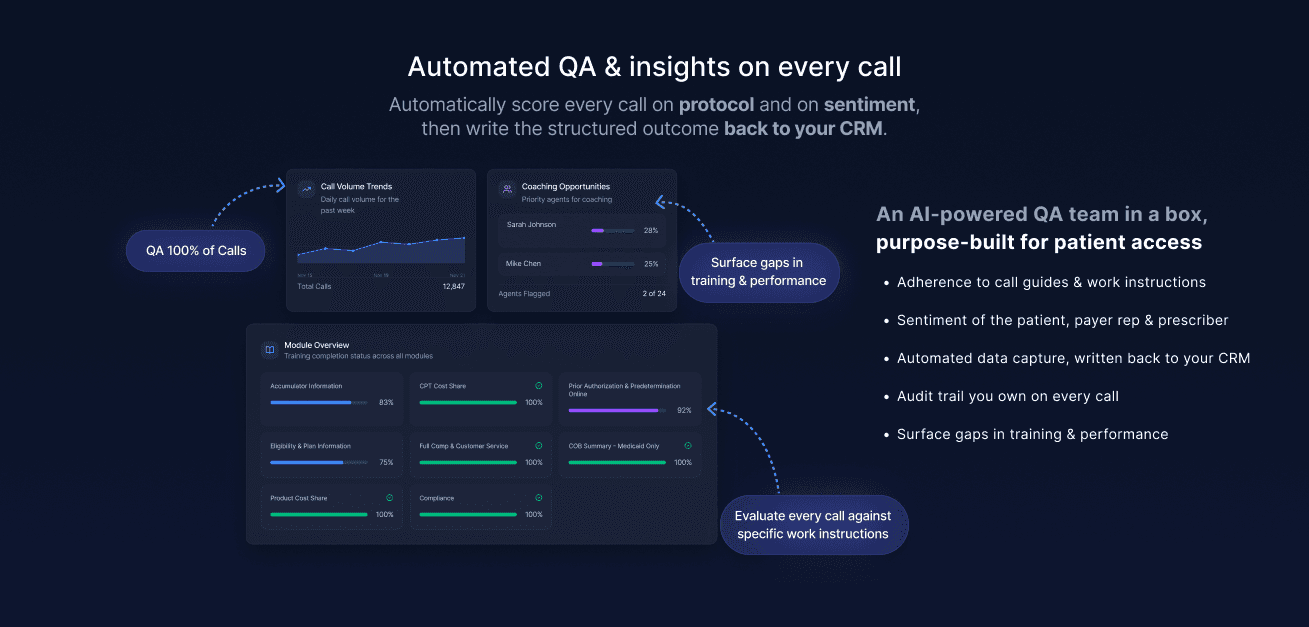
What it does: Neon Health provides an AI workforce that automates the full patient access workflow. Rather than treating enrollment as a standalone step, Neon connects benefit verification, prior authorization, financial assistance screening, enrollment, patient onboarding, and adherence support into a single automated process. AI workers engage with payers, portals, and patients to complete each step without manual intervention.
Strengths: Neon's approach eliminates the handoffs between disconnected systems that create enrollment delays. When a benefit verification reveals specific PA requirements, the AI worker initiates PA immediately rather than waiting for a human to read the BV result and act on it. When PA is approved, financial assistance screening begins automatically. When enrollment data is complete, the patient is onboarded without a separate outreach campaign. This connected automation is how Neon delivers therapy initiation 2x faster at 80% lower cost compared to manual processes.
CareMetx COO Brent Barber describes the impact: "Their AI tools have helped us unlock efficiencies we didn't think were possible, simplifying complex operations and enabling us to focus on what matters most."
Neon is HIPAA compliant, HITRUST certified, and SOC 2 certified. Implementation is consultative: Neon works with each organization to understand their specific workflows, systems, and data before designing a solution.
Considerations: Neon's consultative implementation means it is not a plug-and-play tool. Organizations looking for a self-service enrollment portal deployable in days should consider the form-focused platforms above. Neon is built for enterprise organizations with complex, high-volume specialty workflows where the ROI of full automation justifies a consultative engagement.
Best for: Enterprise organizations managing complex specialty medication access workflows that need enrollment connected to BV, PA, financial assistance, onboarding, and adherence as one automated process.
Specialty Enrollment Platforms at a Glance
Platform | EHR Integration | Enrollment Automation | Workflow Scope | Pharmacy Network | Standards Support | Best For |
|---|---|---|---|---|---|---|
RxLightning | Portal | Digital forms | Enrollment only | McKesson ecosystem | Proprietary | Multi-manufacturer form consolidation |
CoverMyMeds | EHR + portal | Auto-populated forms | BV + PA + enrollment | 96% of U.S. pharmacies | Surescripts, proprietary | Large health systems in CoverMyMeds ecosystem |
AssistRx iAssist | 150+ EHR vendors | e-Enrollment suite | BV + PA + enrollment + e-Consent | Manufacturer-specific | Surescripts, HL7 | Multi-specialty provider practices |
Phil | EMR e-Prescribe | Mobile + phone | PA + enrollment + dispensing | Nationwide integrated | Proprietary | Pharma manufacturers, specialty-lite |
ConnectiveRx | In-workflow EHR | Click-to-enroll | BV + PA + enrollment + dispensing | Careform (non-commercial) | Proprietary | Manufacturers wanting fast first-fill |
RXNT | Native EHR | Auto-populated from EHR | Enrollment | Surescripts network | Surescripts | Small practices on RXNT EHR |
Neon Health | Bespoke integration | AI-automated | BV + PA + enrollment + onboarding + adherence | Open (any pharmacy) | HL7 FHIR, NCPDP, Surescripts | Enterprise full-workflow automation |
What to Look for in a Specialty Enrollment Platform
Selecting an enrollment platform is less about feature checklists and more about matching platform scope to your actual workflow needs. Five criteria matter most.
EHR Integration Depth
Sixty-three percent of clinicians say medication access tasks are their most time-consuming responsibility (CoverMyMeds). Every platform that requires clinicians to leave their EHR, log into a separate portal, and re-enter patient data adds friction that slows adoption. Platforms embedded in the EHR (RXNT, ConnectiveRx's Careform, AssistRx iAssist) eliminate this context switch. Portal-based platforms add a step that clinicians resist in practice.
Automation Depth vs. Digitization
Digital enrollment forms are better than fax. But digitization alone does not reduce manual work. A digitized form still requires someone to populate fields, select the correct program, and verify data before submission.
True automation means the platform pulls patient data from the EHR, identifies the correct enrollment pathway, populates the form, and routes it without human intervention. Ask vendors to demonstrate what happens after the provider clicks "prescribe." If a human touches the enrollment form before it reaches the pharmacy, that is digitization. If the platform handles it end to end, that is automation.
Upstream and Downstream Connectivity
Enrollment does not exist in isolation. The enrollment form requires data from benefit verification (insurance status, PA requirements, copay amounts). The enrollment outcome feeds into pharmacy routing, patient onboarding, and financial assistance. Platforms that treat enrollment as a standalone step create handoff points where data is lost, re-entered, or delayed. Platforms that connect enrollment to upstream BV/PA results and downstream onboarding eliminate these handoffs.
Standards Readiness
The HL7/NCPDP FHIR Specialty Medication Enrollment Implementation Guide defines the emerging standard for electronic specialty enrollment data exchange. This joint HL7/NCPDP effort establishes how demographic, clinical, and financial data should flow between prescribers, pharmacies, and hubs. Platforms built on FHIR standards will have better interoperability as the industry moves toward standardized data exchange. Evaluate whether your platform supports FHIR natively or relies on proprietary integrations.
Analytics and TAT Visibility
If you cannot measure time from prescription to enrollment completion, you cannot improve it. Look for platforms that report turnaround time by step (BV completion, PA resolution, enrollment submission, pharmacy confirmation) rather than aggregate enrollment counts. Step-level visibility reveals where bottlenecks occur.
Frequently Asked Questions
What is the difference between specialty enrollment and ePrescribing?
ePrescribing transmits the prescription from provider to pharmacy. Specialty enrollment collects the additional clinical, demographic, and financial data required before a specialty pharmacy can dispense. The HL7/NCPDP created a separate FHIR Implementation Guide specifically because standard ePrescribing lacks the data specialty pharmacies need.
How long does specialty medication enrollment typically take?
For clean prescriptions without complications, turnaround time ranges from 2 to 7 days depending on pharmacy type. When prior authorization is required, timelines can extend to 15 days (JMCP). Eighty-seven percent of specialty pharmacists believe enrollment should take two weeks or less, but only 33% say it currently does (Surescripts).
Can enrollment platforms reduce prescription abandonment?
Faster enrollment reduces the window during which patients abandon therapy. Cost is the primary driver: 55% of prescriptions with out-of-pocket costs above $250 are never picked up (JMCP). Enrollment platforms that auto-screen patients for copay assistance, manufacturer vouchers, and patient assistance programs address this cost barrier during enrollment rather than after the patient receives a bill.
What data standards exist for specialty enrollment?
The HL7/NCPDP FHIR Specialty Medication Enrollment Implementation Guide defines the standard for exchanging specialty enrollment data electronically. It covers demographic, clinical, and financial data exchange between prescribers, pharmacies, and manufacturer hubs. The NCPDP Foundation and University of Minnesota published an evaluation of this standard in 2024.
Should we choose an enrollment-only platform or a full patient access solution?
That depends on your existing infrastructure. Organizations with mature BV and PA systems that need to digitize enrollment form submission can start with an enrollment-focused tool like RxLightning or RXNT. Organizations managing the full specialty access workflow benefit from platforms that connect enrollment to upstream and downstream steps, eliminating handoffs between disconnected systems.
Key Takeaways
Specialty enrollment platforms range from form-digitization tools to full patient access automation. Match the platform's scope to your workflow needs rather than comparing feature lists in isolation.
The enrollment step alone does not determine time-to-therapy. Platforms that connect enrollment to benefit verification, prior authorization, and financial assistance eliminate the handoff delays that add days between each step.
EHR integration is the strongest predictor of clinician adoption. Platforms requiring portal switching face resistance from the 63% of clinicians who already consider access tasks their most time-consuming work.
Automation depth matters more than digitization. A digital form that still requires manual data entry and routing is a marginal improvement over fax. True automation populates, routes, and tracks enrollment without human intervention.
The HL7/NCPDP FHIR Specialty Medication Enrollment standard is moving the industry toward interoperability. Evaluate platforms for standards readiness, not current integrations alone.
Measure time from prescription to enrollment completion at each step (BV, PA, enrollment, pharmacy confirmation) rather than aggregate submission counts. Step-level analytics reveal where bottlenecks occur.
For enterprise organizations managing complex specialty workflows, Neon Health's AI workforce connects enrollment to the full access workflow, getting patients on therapy 2x faster at 80% lower cost compared to manual processes.
Enrollment is one step in a longer journey. The full specialty medication access pathway stretches from prescription to first dose, through benefit verification, prior authorization, financial assistance, pharmacy routing, patient onboarding, and adherence support. Optimizing enrollment in isolation improves one handoff. Connecting enrollment to the full workflow eliminates handoffs entirely.
At Neon Health, we built an AI workforce that automates this entire pathway. Enrollment is not a separate step. It is one moment in a continuous automated process where BV results trigger PA, PA approvals trigger financial screening, and completed enrollment triggers patient onboarding, without waiting for a human to read a result and act on it.
Schedule a demo to see how Neon automates enrollment as part of end-to-end patient access.
Sources
Surescripts. "Specialty Medication Experience: Obstacles & Opportunities." 2022.
IQVIA Institute. "The Use of Medicines in the U.S. 2024: Usage and Spending Trends and Outlook to 2028." 2024.
JMCP. "Specialty Pharmacy Turnaround Time Impediments, Facilitators, and Good Practices." 2023.
JMCP. "Comparison of Time to Treatment Initiation of Specialty Medications Between an Integrated Health System Specialty Pharmacy and External Specialty Pharmacies." 2024.
JMCP. "Association of Prescription Abandonment with Cost Share for High-Cost Specialty Pharmacy Medications." 2023.
CoverMyMeds/PR Newswire. "CoverMyMeds Expands Specialty Access and Affordability Solutions." March 2026.
HL7/NCPDP. "HL7/NCPDP FHIR Implementation Guide: Specialty Medication Enrollment, Release 1."
NCPDP Foundation/University of Minnesota. "Evaluating the NCPDP/HL7 FHIR Specialty Medication Enrollment Standard." 2024.
ASPE. "Trends in Prescription Drug Spending, 2016-2021."
AssistRx. iAssist platform page. Self-reported data. Accessed March 2026.
ConnectiveRx. Hub Services page. Self-reported data. Accessed March 2026.
Phil. Solution page. Self-reported data. Accessed March 2026.
RXNT. Specialty Patient Enrollment page. Self-reported data. Accessed March 2026.
TL;DR: Specialty enrollment platforms range from form-digitization tools to full patient access automation systems. RxLightning and RXNT focus on enrollment form management. CoverMyMeds and AssistRx iAssist bundle enrollment with BV and PA. Phil and ConnectiveRx add dispensing and pharmacy network integration. Neon Health treats enrollment as one step in an AI-automated patient access workflow that spans BV through adherence. The right platform depends on how much of the access workflow you need to automate, not how you submit enrollment forms.
Eighty-seven percent of specialty pharmacists believe enrollment should take two weeks or less. Only 33% say it currently does (Surescripts). That gap represents weeks of delayed therapy for patients who need complex medications, and millions in operational overhead for the teams managing enrollment workflows.
The disconnect is structural. Specialty medications account for 2 to 3% of prescription volume but 53% of total U.S. drug spending (IQVIA). Each specialty prescription triggers a cascade of enrollment steps that general ePrescribing was never built to handle: benefit verification, prior authorization, financial assistance screening, pharmacy selection, patient consent, and clinical data collection.
Most organizations still manage this cascade across up to nine different applications (CoverMyMeds). Sixty-three percent of clinicians identify these access responsibilities as their most time-consuming work.
This guide compares seven specialty medication enrollment platforms: what each does well, where each falls short, and how to choose the right one for your workflows.
What Is Specialty Medication Enrollment and Why Does It Matter?
Specialty medication enrollment is the process of collecting and transmitting the clinical, demographic, and financial data required before a specialty pharmacy can dispense a prescribed medication. It bridges the gap between the prescribing event and therapy initiation.
Standard ePrescribing sends the prescription. Specialty enrollment goes further. The HL7/NCPDP FHIR Specialty Medication Enrollment Implementation Guide was created specifically because standard prescription data lacks the clinical details, insurance specifics, and patient consent that specialty pharmacies need to begin dispensing. Without this data, pharmacies call providers to collect it manually, adding days before therapy can start.
The Enrollment Workflow
A typical specialty enrollment follows this sequence:
Prescription: Provider prescribes a specialty medication via EHR
Data collection: Clinical notes, diagnosis codes, prior therapies, and lab results are gathered
Benefit verification: Insurance coverage, copay amounts, and formulary status are confirmed
Prior authorization: If required, PA is initiated and tracked to resolution
Financial assistance: Patient is screened for copay cards, manufacturer vouchers, PAPs, or foundation grants
Pharmacy routing: Prescription is directed to the appropriate specialty pharmacy
Patient consent: Patient is contacted for consent and onboarding
Dispensing: Specialty pharmacy fills and ships the medication
Why Speed Matters
Every day between prescription and dispensing is a day the patient waits for therapy. Research published in the Journal of Managed Care & Specialty Pharmacy found that specialty pharmacy turnaround times average 2 to 7 days for clean prescriptions, depending on pharmacy type. When prior authorization is required, timelines extend up to 15 days.
The gap compounds for patients who transfer between pharmacy systems. A 2024 JMCP study found that patients whose specialty medications were filled at integrated health system pharmacies started treatment 6 days faster than those transferred to external specialty pharmacies. The difference comes down to data connectivity: integrated systems share enrollment data automatically rather than re-collecting it through fax and phone.
How We Evaluated These Platforms
We assessed each platform across seven criteria that determine how effectively it reduces time-to-therapy through enrollment automation.
Criterion | What we measured | Why it matters |
|---|---|---|
EHR integration | Embedded, portal, or fax-based | Determines whether clinicians leave their workflow |
Enrollment automation | Auto-populated forms vs. manual entry | Reduces data collection time and errors |
Workflow coverage | Enrollment only vs. BV/PA/financial assistance | Determines handoff points between systems |
Pharmacy network | Proprietary, open, or non-commercial | Affects where prescriptions can be routed |
Standards support | HL7 FHIR, NCPDP, Surescripts | Indicates interoperability and future readiness |
Analytics | Real-time tracking, TAT reporting | Enables measurement and improvement |
Manufacturer programs | Copay cards, PAPs, bridge programs | Determines financial assistance coverage |
Platform profiles are based on publicly available documentation, press releases, and published case data. Self-reported claims from vendor websites are noted as such.
Specialty Medication Enrollment Platforms Compared
The seven platforms below represent the range of approaches to specialty enrollment, from form digitization to full patient access automation.
RxLightning (by CoverMyMeds/McKesson)
What it does: RxLightning is a cloud-based enrollment platform that aggregates manufacturer-specific enrollment forms into a single digital interface. Prescribers search for a medication, complete the enrollment form, and submit it electronically to the manufacturer's hub or specialty pharmacy.
Strengths: RxLightning consolidates enrollment forms that would otherwise require separate manufacturer portals, fax machines, or phone calls. Its integration with the CoverMyMeds/McKesson network gives it connectivity to a large pharmacy and manufacturer ecosystem. The platform focuses on the enrollment step specifically, making it straightforward for organizations that need to digitize form submission without adopting a broader suite.
Considerations: RxLightning addresses enrollment form management, not the full access workflow. Benefit verification, prior authorization, and financial assistance screening happen in separate systems. Organizations using RxLightning still manage multiple handoffs between enrollment and other access steps. The platform operates within the McKesson ecosystem, which may influence pharmacy routing.
Best for: Organizations that need to replace fax-based enrollment across multiple manufacturer programs with a single digital portal.
CoverMyMeds Specialty Solutions
What it does: CoverMyMeds Specialty Solutions combines benefit verification, prior authorization, and program enrollment in one integrated medication access platform. Expanded in March 2026, the solution brings these steps together at the point of care through both the CoverMyMeds portal and EHR integrations.
Strengths: The platform connects to a network of over 700,000 providers, 96% of U.S. pharmacies, and more than 200 life science brands (self-reported by CoverMyMeds). Electronic prior authorization for specialty brands is reported to be 10x faster than traditional fax-based methods. Because most providers and pharmacies are already connected, implementation friction is lower than with smaller-network platforms.
Considerations: CoverMyMeds serves general practice, retail pharmacy, and specialty with the same platform. Organizations with highly specialized enrollment workflows may find the general-purpose design less adaptable than tools built for complex specialty access. Enterprise-scale pricing reflects the platform's scope.
Best for: Large health systems and pharmacy organizations already in the CoverMyMeds ecosystem that want BV, PA, and enrollment in one connected workflow.
AssistRx iAssist
What it does: iAssist supports specialty prescribing and program enrollment across multiple therapies and drug categories through a single interface. The platform bundles e-Consent, e-Prescribe, advanced benefit verification, e-Enrollment, and real-time electronic prior authorization.
Strengths: Compatibility with over 150 EHR vendors reduces integration barriers for provider organizations. The platform is free for healthcare providers (manufacturer-funded), removing cost as an adoption barrier. AssistRx reports that iAssist has reduced primary non-adherence from 12% to 0.21% for enrolled patients (self-reported by AssistRx). The multitherapy design means providers use one platform across different manufacturers' specialty medications rather than switching between portals.
Considerations: Because manufacturer programs fund the platform, enrollment workflows and available features vary by therapy. Not all drugs on iAssist have the same depth of automation. Provider-facing functionality is strong, but iAssist is designed for the prescribing and enrollment initiation step rather than downstream pharmacy operations or ongoing adherence management.
Best for: Provider organizations that prescribe across multiple specialty therapies and want a single, free enrollment platform with BV and PA capabilities.
Phil (PhilRx Platform)
What it does: Phil automates front-end enrollment, prescription routing, and dispensing for retail and specialty-lite brands. The PhilRx platform connects prescribers, patients, and pharmacies through a mobile-first enrollment experience.
Strengths: Patient-facing enrollment starts on the phone: patients confirm insurance information on their mobile device, and if they do not complete the process, Phil's team follows up via call. The integrated dispensing network provides nationwide coverage with transparent pricing for manufacturers. A proprietary 1-click PA process addresses a common bottleneck. Prescription routing automatically directs each approved Rx to a pharmacy with the appropriate payer contract, eliminating out-of-network issues.
Considerations: Phil is strongest for retail and specialty-lite medications. Complex specialty drugs with extensive clinical data requirements, multi-step PA workflows, or specialty pharmacy-only distribution may exceed the platform's current focus. The model is manufacturer-centric: it is adopted at the brand level rather than the provider or pharmacy level.
Best for: Pharmaceutical manufacturers launching retail or specialty-lite brands that need integrated enrollment, PA, and dispensing in one platform.
ConnectiveRx (Careform Pharmacy)
What it does: ConnectiveRx delivers hub services through Careform Pharmacy, a non-commercial pharmacy model. Providers select Careform as the destination while prescribing in their EHR, triggering enrollment, benefit verification, and prior authorization support without leaving their workflow.
Strengths: The in-workflow design removes the portal-switching friction that slows clinician adoption. ConnectiveRx reports benefit verification turnaround times averaging 6 business hours (self-reported by ConnectiveRx). Manufacturers receive real-time data visibility through a Tableau-based analytics platform. The non-commercial pharmacy model enables faster access than traditional specialty pharmacy routing for initial fills.
Considerations: The non-commercial pharmacy model may not align with organizations that require dispensing through their own specialty pharmacy network. Careform operates as a routing and access channel for first fills, with subsequent refills handled by the patient's preferred specialty pharmacy. This works best for brands where the priority is speed-to-first-fill.
Best for: Manufacturers wanting fast enrollment with integrated benefit verification, analytics visibility, and a non-commercial pharmacy model for accelerated first fills.
RXNT
What it does: RXNT embeds specialty patient enrollment directly into its EHR using Surescripts Specialty Rx routing. When a provider prescribes a specialty medication, Surescripts identifies it automatically and triggers an enrollment form that populates from the patient's EHR data.
Strengths: For RXNT users, enrollment happens within the prescribing workflow with no additional portal or login. Forms populate with demographic, insurance, and clinical data already in the EHR. Surescripts integration enables automatic specialty medication detection. Specialty enrollment is included at no additional cost for providers on the RXNT EHR platform.
Considerations: Specialty enrollment is tied to the RXNT EHR. Organizations on other systems cannot access this functionality. The workflow relies on Surescripts-enabled connections, limiting pharmacy and manufacturer coverage to network participants. RXNT serves ambulatory practices, not large health systems or specialty pharmacy operations.
Best for: Small to mid-size practices on RXNT's EHR that want built-in specialty enrollment without additional software or cost.
Neon Health
What it does: Neon Health provides an AI workforce that automates the full patient access workflow. Rather than treating enrollment as a standalone step, Neon connects benefit verification, prior authorization, financial assistance screening, enrollment, patient onboarding, and adherence support into a single automated process. AI workers engage with payers, portals, and patients to complete each step without manual intervention.
Strengths: Neon's approach eliminates the handoffs between disconnected systems that create enrollment delays. When a benefit verification reveals specific PA requirements, the AI worker initiates PA immediately rather than waiting for a human to read the BV result and act on it. When PA is approved, financial assistance screening begins automatically. When enrollment data is complete, the patient is onboarded without a separate outreach campaign. This connected automation is how Neon delivers therapy initiation 2x faster at 80% lower cost compared to manual processes.
CareMetx COO Brent Barber describes the impact: "Their AI tools have helped us unlock efficiencies we didn't think were possible, simplifying complex operations and enabling us to focus on what matters most."
Neon is HIPAA compliant, HITRUST certified, and SOC 2 certified. Implementation is consultative: Neon works with each organization to understand their specific workflows, systems, and data before designing a solution.
Considerations: Neon's consultative implementation means it is not a plug-and-play tool. Organizations looking for a self-service enrollment portal deployable in days should consider the form-focused platforms above. Neon is built for enterprise organizations with complex, high-volume specialty workflows where the ROI of full automation justifies a consultative engagement.
Best for: Enterprise organizations managing complex specialty medication access workflows that need enrollment connected to BV, PA, financial assistance, onboarding, and adherence as one automated process.
Specialty Enrollment Platforms at a Glance
Platform | EHR Integration | Enrollment Automation | Workflow Scope | Pharmacy Network | Standards Support | Best For |
|---|---|---|---|---|---|---|
RxLightning | Portal | Digital forms | Enrollment only | McKesson ecosystem | Proprietary | Multi-manufacturer form consolidation |
CoverMyMeds | EHR + portal | Auto-populated forms | BV + PA + enrollment | 96% of U.S. pharmacies | Surescripts, proprietary | Large health systems in CoverMyMeds ecosystem |
AssistRx iAssist | 150+ EHR vendors | e-Enrollment suite | BV + PA + enrollment + e-Consent | Manufacturer-specific | Surescripts, HL7 | Multi-specialty provider practices |
Phil | EMR e-Prescribe | Mobile + phone | PA + enrollment + dispensing | Nationwide integrated | Proprietary | Pharma manufacturers, specialty-lite |
ConnectiveRx | In-workflow EHR | Click-to-enroll | BV + PA + enrollment + dispensing | Careform (non-commercial) | Proprietary | Manufacturers wanting fast first-fill |
RXNT | Native EHR | Auto-populated from EHR | Enrollment | Surescripts network | Surescripts | Small practices on RXNT EHR |
Neon Health | Bespoke integration | AI-automated | BV + PA + enrollment + onboarding + adherence | Open (any pharmacy) | HL7 FHIR, NCPDP, Surescripts | Enterprise full-workflow automation |
What to Look for in a Specialty Enrollment Platform
Selecting an enrollment platform is less about feature checklists and more about matching platform scope to your actual workflow needs. Five criteria matter most.
EHR Integration Depth
Sixty-three percent of clinicians say medication access tasks are their most time-consuming responsibility (CoverMyMeds). Every platform that requires clinicians to leave their EHR, log into a separate portal, and re-enter patient data adds friction that slows adoption. Platforms embedded in the EHR (RXNT, ConnectiveRx's Careform, AssistRx iAssist) eliminate this context switch. Portal-based platforms add a step that clinicians resist in practice.
Automation Depth vs. Digitization
Digital enrollment forms are better than fax. But digitization alone does not reduce manual work. A digitized form still requires someone to populate fields, select the correct program, and verify data before submission.
True automation means the platform pulls patient data from the EHR, identifies the correct enrollment pathway, populates the form, and routes it without human intervention. Ask vendors to demonstrate what happens after the provider clicks "prescribe." If a human touches the enrollment form before it reaches the pharmacy, that is digitization. If the platform handles it end to end, that is automation.
Upstream and Downstream Connectivity
Enrollment does not exist in isolation. The enrollment form requires data from benefit verification (insurance status, PA requirements, copay amounts). The enrollment outcome feeds into pharmacy routing, patient onboarding, and financial assistance. Platforms that treat enrollment as a standalone step create handoff points where data is lost, re-entered, or delayed. Platforms that connect enrollment to upstream BV/PA results and downstream onboarding eliminate these handoffs.
Standards Readiness
The HL7/NCPDP FHIR Specialty Medication Enrollment Implementation Guide defines the emerging standard for electronic specialty enrollment data exchange. This joint HL7/NCPDP effort establishes how demographic, clinical, and financial data should flow between prescribers, pharmacies, and hubs. Platforms built on FHIR standards will have better interoperability as the industry moves toward standardized data exchange. Evaluate whether your platform supports FHIR natively or relies on proprietary integrations.
Analytics and TAT Visibility
If you cannot measure time from prescription to enrollment completion, you cannot improve it. Look for platforms that report turnaround time by step (BV completion, PA resolution, enrollment submission, pharmacy confirmation) rather than aggregate enrollment counts. Step-level visibility reveals where bottlenecks occur.
Frequently Asked Questions
What is the difference between specialty enrollment and ePrescribing?
ePrescribing transmits the prescription from provider to pharmacy. Specialty enrollment collects the additional clinical, demographic, and financial data required before a specialty pharmacy can dispense. The HL7/NCPDP created a separate FHIR Implementation Guide specifically because standard ePrescribing lacks the data specialty pharmacies need.
How long does specialty medication enrollment typically take?
For clean prescriptions without complications, turnaround time ranges from 2 to 7 days depending on pharmacy type. When prior authorization is required, timelines can extend to 15 days (JMCP). Eighty-seven percent of specialty pharmacists believe enrollment should take two weeks or less, but only 33% say it currently does (Surescripts).
Can enrollment platforms reduce prescription abandonment?
Faster enrollment reduces the window during which patients abandon therapy. Cost is the primary driver: 55% of prescriptions with out-of-pocket costs above $250 are never picked up (JMCP). Enrollment platforms that auto-screen patients for copay assistance, manufacturer vouchers, and patient assistance programs address this cost barrier during enrollment rather than after the patient receives a bill.
What data standards exist for specialty enrollment?
The HL7/NCPDP FHIR Specialty Medication Enrollment Implementation Guide defines the standard for exchanging specialty enrollment data electronically. It covers demographic, clinical, and financial data exchange between prescribers, pharmacies, and manufacturer hubs. The NCPDP Foundation and University of Minnesota published an evaluation of this standard in 2024.
Should we choose an enrollment-only platform or a full patient access solution?
That depends on your existing infrastructure. Organizations with mature BV and PA systems that need to digitize enrollment form submission can start with an enrollment-focused tool like RxLightning or RXNT. Organizations managing the full specialty access workflow benefit from platforms that connect enrollment to upstream and downstream steps, eliminating handoffs between disconnected systems.
Key Takeaways
Specialty enrollment platforms range from form-digitization tools to full patient access automation. Match the platform's scope to your workflow needs rather than comparing feature lists in isolation.
The enrollment step alone does not determine time-to-therapy. Platforms that connect enrollment to benefit verification, prior authorization, and financial assistance eliminate the handoff delays that add days between each step.
EHR integration is the strongest predictor of clinician adoption. Platforms requiring portal switching face resistance from the 63% of clinicians who already consider access tasks their most time-consuming work.
Automation depth matters more than digitization. A digital form that still requires manual data entry and routing is a marginal improvement over fax. True automation populates, routes, and tracks enrollment without human intervention.
The HL7/NCPDP FHIR Specialty Medication Enrollment standard is moving the industry toward interoperability. Evaluate platforms for standards readiness, not current integrations alone.
Measure time from prescription to enrollment completion at each step (BV, PA, enrollment, pharmacy confirmation) rather than aggregate submission counts. Step-level analytics reveal where bottlenecks occur.
For enterprise organizations managing complex specialty workflows, Neon Health's AI workforce connects enrollment to the full access workflow, getting patients on therapy 2x faster at 80% lower cost compared to manual processes.
Enrollment is one step in a longer journey. The full specialty medication access pathway stretches from prescription to first dose, through benefit verification, prior authorization, financial assistance, pharmacy routing, patient onboarding, and adherence support. Optimizing enrollment in isolation improves one handoff. Connecting enrollment to the full workflow eliminates handoffs entirely.
At Neon Health, we built an AI workforce that automates this entire pathway. Enrollment is not a separate step. It is one moment in a continuous automated process where BV results trigger PA, PA approvals trigger financial screening, and completed enrollment triggers patient onboarding, without waiting for a human to read a result and act on it.
Schedule a demo to see how Neon automates enrollment as part of end-to-end patient access.
Sources
Surescripts. "Specialty Medication Experience: Obstacles & Opportunities." 2022.
IQVIA Institute. "The Use of Medicines in the U.S. 2024: Usage and Spending Trends and Outlook to 2028." 2024.
JMCP. "Specialty Pharmacy Turnaround Time Impediments, Facilitators, and Good Practices." 2023.
JMCP. "Comparison of Time to Treatment Initiation of Specialty Medications Between an Integrated Health System Specialty Pharmacy and External Specialty Pharmacies." 2024.
JMCP. "Association of Prescription Abandonment with Cost Share for High-Cost Specialty Pharmacy Medications." 2023.
CoverMyMeds/PR Newswire. "CoverMyMeds Expands Specialty Access and Affordability Solutions." March 2026.
HL7/NCPDP. "HL7/NCPDP FHIR Implementation Guide: Specialty Medication Enrollment, Release 1."
NCPDP Foundation/University of Minnesota. "Evaluating the NCPDP/HL7 FHIR Specialty Medication Enrollment Standard." 2024.
ASPE. "Trends in Prescription Drug Spending, 2016-2021."
AssistRx. iAssist platform page. Self-reported data. Accessed March 2026.
ConnectiveRx. Hub Services page. Self-reported data. Accessed March 2026.
Phil. Solution page. Self-reported data. Accessed March 2026.
RXNT. Specialty Patient Enrollment page. Self-reported data. Accessed March 2026.
Related articles
Related articles

Ready to transform Patient Access?
Ready to transform Patient Access?
NEWSLETTER
@ 2026 Neon Health (Belay, Inc).
AI-powered patient access automation
for leading pharma enterprises.
NEWSLETTER
@ 2026 Neon Health (Belay, Inc).
AI-powered patient access automation for leading pharma enterprises.
NEWSLETTER
@ 2026 Neon Health (Belay, Inc).
AI-powered patient access automation
for leading pharma enterprises.