
AI Agents in Healthcare: Use Cases, Platforms, and What's Actually Working [2026]
AI Agents in Healthcare: Use Cases, Platforms, and What's Actually Working [2026]
Healthcare spends nearly $1 trillion a year on administration. That figure, published in JAMA, includes a detail that explains why: the industry employs twice as many administrative staff as physicians and nurses combined. Benefit verification calls that take 12 minutes each. Prior authorization submissions routed through fax machines. Financial assistance paperwork that delays therapy by weeks.
For decades, the response was more staff. Then it was basic automation: EDI transactions, portal scrapers, rules engines. These tools helped, but they still required humans to manage every exception, every hold queue, every system handoff.
AI agents represent a different category. Not tools that surface information for someone to act on. Not copilots that suggest a next step. Agents that plan, execute, and complete multi-step workflows on their own, escalating to humans only when they hit something they haven't seen before.
At Neon Health, we build AI workers that operate across the full patient access workflow: calling payers, navigating IVR systems, submitting prior authorizations, enrolling patients in financial assistance programs, and following up until the work is done. This gives us a particular vantage point on which AI agent use cases deliver real results and which remain more aspiration than implementation.
This guide maps where AI agents work in healthcare today, profiles the platforms building them, and separates what the evidence supports from what the marketing claims.
What Makes an AI Agent Different from an AI Tool?
An AI agent is software that can pursue a goal across multiple steps, use external tools and systems, adapt when conditions change, and escalate when it reaches its limits, all without requiring human input at each step.
That definition matters because "AI agent" has become a marketing label applied to everything from simple chatbots to genuinely autonomous systems. Understanding the spectrum helps buyers evaluate what they actually need.
Capability | AI Tool | AI Copilot | AI Agent |
|---|---|---|---|
What it does | Executes a single task when triggered | Suggests actions; human decides and executes | Plans and executes multi-step workflows autonomously |
Human role | Operator | Decision-maker | Supervisor (handles exceptions) |
Error handling | Fails and stops | Flags the error to the user | Retries, adapts, or escalates |
System access | One system (API or database) | One system with context | Multiple systems (APIs, portals, phone, fax) |
Healthcare example | EDI 270/271 eligibility check | Clinical documentation assistant | AI worker that calls a payer, navigates hold queues, extracts benefit details, updates the EHR, and flags exceptions |
Healthcare is well-suited for AI agents because its workflows are structured (benefit verification follows predictable steps) but require navigating multiple disconnected systems (payer phone lines, web portals, EHRs, fax). That combination of structure and system complexity is exactly where agents outperform simpler automation.
The market reflects this. MarketsandMarkets valued the healthcare AI agents market at $0.76 billion in 2024 and projects it will reach $6.92 billion by 2030, a 44.1% CAGR. Multi-agent systems, where specialized agents collaborate on complex workflows, represent the fastest-growing segment at 45.3% CAGR.
Where Are AI Agents Working in Healthcare Today?
AI agents are being deployed across five primary areas in healthcare. The maturity and evidence base vary significantly between them.
Clinical Documentation and Ambient AI
This is the most adopted AI agent use case in healthcare. A 2025 survey of 43 US health systems published in the Journal of the American Medical Informatics Association found that 100% of respondents were actively deploying ambient documentation AI. No other use case came close.
Ambient AI agents listen to patient-clinician conversations, generate structured clinical notes, suggest billing codes, and integrate the output into the EHR. The same JAMIA survey found that 53% of health systems reported a high degree of success, and separate research showed clinician burnout declining from 51.9% to 38.8% after implementing AI documentation tools.
The scale of the documentation problem explains the rapid adoption. Studies estimate clinicians spend over 13 hours per week on paperwork. That time comes directly from patient care, contributing to the burnout epidemic that has driven record turnover since the pandemic.
Abridge is the scale leader here, deployed across 200+ enterprise health systems and supporting 50 million medical conversations per year across 55 specialties and 28 languages. Major implementations include UPMC (12,000 clinicians) and Johns Hopkins Medicine (6,700 clinicians across 6 hospitals). Nuance DAX (Microsoft) combines ambient AI with human medical editor review for organizations that want a human-in-the-loop verification step. Sully.ai offers a modular approach with documentation as one component of a broader AI workforce. DeepScribe adds embedded E&M coding suggestions alongside documentation, and Augmedix provides a hybrid model combining real-time AI transcription with optional remote human scribes.
A note on terminology: most ambient documentation tools are more accurately described as AI copilots than AI agents. They process information and generate output, but they typically don't execute multi-step workflows or interact with external systems. True agent capability in clinical documentation (where the system not only generates the note but submits it, triggers follow-up orders, and schedules the next visit) is still emerging.
Patient Access and Administrative Workflows
This is where AI agents have the most room to run, and the most money at stake. The 2024 CAQH Index identified a $20 billion annual savings opportunity from automating manual revenue cycle tasks like eligibility verification, claims processing, and prior authorization.
Patient access workflows are uniquely suited for AI agents because they require exactly the kind of multi-system, multi-step execution that agents excel at:
Benefit verification: Calling payers, navigating IVR phone trees, waiting on hold, extracting coverage details, and updating patient records
Prior authorization: Gathering clinical documentation, submitting requests through payer portals or fax, tracking status, responding to information requests
Financial assistance enrollment: Identifying eligible programs, completing enrollment forms, submitting to foundations or manufacturers
Patient onboarding: Coordinating intake paperwork, scheduling first appointments, verifying insurance, completing consent forms
Consider a typical specialty medication prescription. Before the patient receives their first dose, someone must verify insurance coverage and therapy-specific rules, submit a prior authorization with supporting clinical documentation, wait for and respond to payer requests for additional information, identify and enroll the patient in copay assistance or foundation programs, complete onboarding paperwork, and coordinate with the specialty pharmacy. That is 15 to 20 separate administrative steps across 4 to 5 different systems.
Neon Health's AI workers handle this full workflow end to end, engaging with payers, providers, and patients via voice, text, portal automation, and fax. The system makes payer calls, navigates IVR trees, waits on hold, extracts benefit details, submits PA requests through portals, and enrolls patients in financial assistance, all without requiring human intervention at each step. Infinitus has built specialized AI agents for payer phone calls, focused on navigating the hold times and IVR systems that make benefit verification so labor-intensive. Cohere Health applies AI to the prior authorization decision process from the payer side. Waystar and Change Healthcare address claims and RCM automation at enterprise scale.
This is the use case where the difference between "AI tool" and "AI agent" matters most. A tool that checks eligibility via EDI 270/271 returns coverage status but misses therapy-specific rules, step therapy sequences, and PA requirements. An agent that calls the payer, asks the right follow-up questions, and works through exceptions delivers fundamentally different value. Point solutions that automate just one step (only BV, or only PA) create a faster segment in a still-slow pipeline. The agents that complete entire workflows get patients to therapy faster.
Revenue Cycle and Claims Management
AI agents are automating claims submission, denial management, payment posting, and coding. This is a large and established market where traditional RCM platforms are adding agent capabilities, and the financial incentive is substantial. According to JAMA, financial transactions (claims processing, revenue cycle, prior authorization) account for $200 billion of annual healthcare administrative spending.
Gartner predicts that by 2028, 80% of ambulatory claims will be processed through AI-enabled, real-time adjudication. Amazon entered this space in March 2026 with Amazon Connect Health, which the American Hospital Association reported is already being used by a health system handling 3.2 million patient interactions per year, saving one minute per call and shifting 630 hours of weekly labor from verification to direct patient assistance.
Commure has built purpose-specific agents for revenue cycle tasks: a Denials Autopilot Agent that identifies rejected claims and prepares resubmission packages, a Claims Processing Agent that automates status checks, and a Payer Portal Agent that retrieves EOBs and documentation from external systems. Notable Health applies AI and RPA to administrative workflows including intake, scheduling, and authorization.
The agent architecture in RCM typically follows one of two models. Some platforms deploy specialized single-task agents (one for denials, one for claims status, one for eligibility) that operate independently. Others use multi-agent orchestration where a coordinator agent delegates to specialized sub-agents and manages the overall workflow. MarketsandMarkets projects multi-agent systems as the fastest-growing segment at 45.3% CAGR, suggesting the orchestration model may ultimately dominate for complex RCM workflows.
Patient Engagement and Outreach
AI agents handle appointment scheduling, reminders, medication adherence check-ins, post-discharge follow-up, and care gap closure. These workflows involve direct patient communication, typically through text, voice, or app-based messaging.
TeleVox provides multi-channel patient engagement with what they call SMART Agents that handle voice, SMS, and web communication integrated with EHRs. Hyro focuses on voice AI for patient scheduling and call center automation. Luma Health and Providertech address appointment management and care coordination. Mosaicx automates refill reminders and medication adherence outreach.
The challenge in patient engagement is channel fragmentation. Patients communicate through phone, text, email, patient portals, and in-person visits. Effective engagement agents need to operate across these channels while maintaining context. A patient who confirms an appointment via text and then calls to reschedule should not have to re-identify themselves and repeat their situation.
Vendor-reported results in this category are encouraging (30-50% reductions in call volume for scheduling, per case studies from Hyro and others) but lack independent benchmarks. The CAQH Index found that fully automated administrative workflows save an average of 70 minutes per patient visit, though this covers all administrative tasks, not just engagement.
Call Center and Contact Center Automation
Healthcare call centers face a well-documented capacity problem. Average hold times exceed four minutes, far above the 50-second benchmark set by the Health Financial Management Association. Roughly 30% of patients abandon calls after waiting longer than one minute, according to data cited by Becker's Hospital Review.
AI agents address this by handling inbound calls (scheduling, billing inquiries, triage routing) and, in some cases, outbound calls to payers and patients. Commure's call center analysis notes that most centers operate at just 60% of necessary capacity, with labor accounting for nearly half of total costs.
Assort Health claims 94% patient satisfaction for its AI-powered call handling, trained on 1.2 million edge cases (self-reported). Hyro offers voice AI with high call deflection rates. Notable Health automates administrative calls alongside broader workflow automation.
This use case overlaps significantly with patient access and engagement. The most effective deployments combine inbound patient call handling with outbound payer calls and multi-channel patient communication, creating a unified agent layer across all contact center operations. A call center that deploys separate agents for scheduling, billing, and payer calls without coordination between them risks creating a faster but still fragmented experience. The integration challenge is not just technical (connecting systems) but operational (ensuring agents share context and hand off cleanly).
AI Agent Platforms for Healthcare: Who Does What [2026]
The platforms below represent the range of AI agent approaches in healthcare, from clinical documentation to full workflow automation. Each profile covers what the platform automates, its evidence base, and who it serves best.
Platform | Primary Use Case | Agent Autonomy | Key Evidence | Best For |
|---|---|---|---|---|
Neon Health | Full patient access (BV, PA, financial assistance, onboarding) | Full workflow execution | 2x faster time-to-therapy, 80% cost reduction | Specialty pharma, health systems needing end-to-end access automation |
Sully.ai | Clinical documentation + modular AI workforce | Copilot to agent (varies by module) | CityHealth: ~3 hrs/day saved per clinician (self-reported) | Clinics wanting modular AI starting with documentation |
Abridge | Ambient clinical documentation | Copilot | 200+ health systems, 50M conversations/year, $300M Series E | Large health systems needing ambient documentation at scale |
Commure | RCM agents (denials, claims, payer portal) | Task-specific agents | Funded at $200M+; Memora Health acquisition | Health systems focused on revenue cycle agent automation |
Notable Health | Administrative workflows (intake, scheduling, auth) | Process automation | NKCH: 90% check-in time reduction (self-reported) | Health systems automating front-office operations |
Hippocratic AI | Patient-facing non-diagnostic agents | Conversational agent | $141M Series B, $1.64B valuation (Fierce Healthcare) | Organizations needing patient outreach at scale |
Infinitus | Payer-facing call automation (BV, PA status) | Full workflow execution (phone) | Purpose-built for payer IVR navigation | Organizations with high-volume payer call requirements |
Hyro | Voice AI for scheduling and call center | Conversational agent | Reported 85%+ call deflection (self-reported) | Health systems automating inbound patient calls |
TeleVox | Patient engagement and outreach | Multi-channel agent | Frost & Sullivan Customer Value Leadership 2024 | Organizations focused on patient communication and adherence |
Beam AI | Administrative task automation | Process automation | Avi Medical: 80% inquiries automated, 90% response time reduction (self-reported) | Clinics automating operational tasks |
Cohere Health | Prior authorization intelligence | Decision support + automation | Backed by major payer partnerships | Payer-side PA automation |
Amazon Connect Health | Enterprise patient interaction | Conversational + workflow | 3.2M interactions/year deployment (AHA) | Large health systems on AWS infrastructure |
Neon Health
Neon Health provides an AI workforce that automates patient access workflows end to end. Rather than selling a single-purpose tool, Neon combines modular AI components (voice, portal automation, rules engines) into solutions tailored to each organization's specific workflows, systems, and data.
What sets Neon's approach apart is full workflow coverage. The same AI workers that call payers to verify benefits also submit prior authorizations, enroll patients in copay assistance programs, and manage onboarding. This matters because patient access involves 15 to 20 interconnected steps. Automating one step (just BV or just PA) creates a faster segment in a still-slow pipeline. Automating the full chain gets patients to therapy faster.
Neon reports getting patients on therapy 2x faster at 80% lower cost compared to manual processes. The platform is HIPAA compliant, HITRUST certified, and SOC 2 certified. Implementation follows a consultative model where Neon's team maps existing workflows before designing the AI solution.
Best for: pharmaceutical manufacturers running patient services programs, specialty pharmacies handling high-volume access workflows, and health systems seeking to scale patient access operations without proportionally increasing headcount.
Sully.ai
Sully.ai offers a modular AI workforce with agents for documentation, scheduling, coding, intake, and triage. The platform gained recognition for its ambient documentation capabilities and has expanded into broader administrative automation.
According to Sully.ai, CityHealth reduced clinical operations time by approximately 3 hours per day per clinician and cut operations per patient by 50% after deployment. The platform claims over 98% speech recognition accuracy in its documentation module.
The modular approach has appeal for organizations that want to start with a proven use case (documentation) and expand into broader automation over time, without committing to a platform that only covers one workflow.
Abridge
Abridge is the ambient documentation market leader by deployment scale. The platform converts patient-clinician conversations into structured SOAP notes across 55 specialties and 28 languages. Abridge raised a $300M Series E led by a16z and is now deployed across 200+ enterprise health systems.
Major implementations include UPMC (12,000 clinicians) and Johns Hopkins Medicine (6,700 clinicians across 6 hospitals and 40 patient-care centers). Abridge reports supporting 50 million medical conversations per year.
If your organization needs ambient documentation at enterprise scale and runs a major EHR, Abridge is the established choice.
Commure
Commure builds task-specific agents for revenue cycle operations. Their agent architecture includes a Denials Autopilot Agent (identifies rejected claims and prepares resubmission recommendations), Claims Processing Agent (automates claims lifecycle tasks including status checks), Payer Portal Agent (retrieves EOBs and documentation from external systems), and Outbound Follow-Up Agent (initiates post-visit check-ins with clinical escalation workflows). Each handles a discrete, high-volume task across EHRs, payer portals, and CRM systems.
The company acquired Memora Health, a digital care navigation platform, in late 2024 to extend agent capabilities into patient communication. Commure integrates with Epic, MEDITECH, and athenahealth, and has raised over $200 million in funding. Their approach emphasizes agents as workflow executors that complete tasks across multiple systems, rather than information surfacers that require human follow-through.
Best for: health systems focused on revenue cycle automation with existing EHR infrastructure that want task-specific agents rather than a full-workflow platform.
Notable Health
Notable Health automates administrative workflows using AI combined with robotic process automation. The platform addresses patient intake, scheduling, referrals, care authorization, and registration workflows. At North Kansas City Hospital, Notable reduced check-in time by 90% (from 4 minutes to 10 seconds) and achieved an 80% patient pre-registration rate (self-reported).
Notable's approach emphasizes integration with existing EHR and practice management systems rather than replacement. Their agents operate within the current technology stack, automating the manual steps that staff currently perform across multiple screens and systems. WellSpan Health deployed Notable to automate outreach, contacting over 100 patients in an initial pilot (self-reported).
Best for: health systems seeking to automate front-office operations without overhauling their technology stack, particularly those with high-volume intake and registration workflows.
Hippocratic AI
Hippocratic AI builds patient-facing agents for non-diagnostic healthcare tasks. Their staffing marketplace lets health systems "hire" AI agents for outreach, education, reminders, and post-visit follow-up.
The company raised a $141M Series B at a $1.64 billion valuation led by Kleiner Perkins, with backing from General Catalyst, Andreessen Horowitz, and Nvidia. They subsequently raised a $126M Series C, bringing total funding to $278 million.
The $278 million in total funding signals strong investor confidence in patient-facing AI agents as a category. Organizations that need to scale outreach, follow-up, and education without expanding clinical staff should evaluate Hippocratic's marketplace model.
Infinitus
Infinitus specializes in payer-facing phone automation. Their AI agents call insurance companies, navigate IVR systems, wait on hold, and extract benefit verification and prior authorization status information. The system handles multi-turn phone conversations with payer representatives, adapts to different IVR trees and hold systems, and delivers structured data back to the healthcare organization.
This is one of the purest "AI agent" use cases in healthcare. The average manual benefit verification call involves 12+ minutes of hold time and IVR navigation. Infinitus agents handle this process autonomously, operating around the clock and across hundreds of payer systems. The platform is purpose-built for the specific challenge of phone-based payer interaction rather than a general-purpose AI adapted for healthcare.
Best for: organizations with high-volume payer call requirements (specialty pharmacies, large provider groups, patient access teams) where hold times and manual effort are the primary operational bottleneck.
Hyro
Hyro provides conversational AI focused on voice and chat for healthcare call centers. The platform handles inbound patient calls for scheduling, billing inquiries, and general information, automating routine interactions that would otherwise consume live agent time.
Hyro reports 85%+ call deflection rates (self-reported), meaning the majority of inbound calls are resolved without transferring to a human agent. The platform integrates with major EHR systems and emphasizes natural language understanding that can handle the varied ways patients describe symptoms, request appointments, or ask about their bills.
Health systems with high inbound call volumes and straightforward scheduling needs will find Hyro a natural fit.
TeleVox
TeleVox is an established patient engagement platform that has added AI agent capabilities through what they call SMART Agents. These handle multi-channel communication (voice, SMS, web) with deep EHR integration for appointment reminders, care gap outreach, medication adherence campaigns, and patient surveys.
TeleVox won Frost & Sullivan's 2024 Customer Value Leadership award for patient engagement. The platform's strength is its multi-channel reach: the same agent can text a medication reminder, call with a care gap notification, and route responses to the appropriate clinical team.
Best for: organizations focused on proactive patient engagement and adherence programs that need multi-channel outreach at scale.
Beam AI
Beam AI automates administrative tasks for healthcare organizations using AI agents. At Avi Medical, Beam AI reports automating 80% of patient inquiries, reducing response times by 90%, and improving NPS by 10 points (self-reported).
The platform targets operational efficiency in clinical settings, automating tasks like patient registration, vaccine scheduling, and referral management. Beam AI's agents operate within existing workflows rather than requiring organizations to redesign their processes.
Best for: small to mid-sized clinics and medical groups seeking to automate specific operational tasks without enterprise-scale implementation.
Cohere Health
Cohere Health approaches AI agents from the payer side of prior authorization. Rather than automating the provider's submission process, Cohere's platform helps health plans make faster, more consistent authorization decisions using AI that interprets clinical documentation and applies payer-specific policies.
This payer-side focus is a strategic differentiator. Most prior authorization agents work for providers (submitting PAs faster). Cohere works for payers (processing PAs faster). Both sides of the transaction benefit when AI reduces the back-and-forth that currently delays authorizations.
Best for: health plans and payer organizations seeking to modernize prior authorization processing and reduce decision turnaround times.
Amazon Connect Health
Amazon entered healthcare agentic AI in March 2026 with Amazon Connect Health, built on its existing contact center platform. The American Hospital Association reported that a health system handling 3.2 million patient interactions per year is already using the platform, saving one minute per call and shifting 630 hours of weekly labor from patient verification to direct assistance.
Amazon Connect Health tackles high-volume administrative tasks including clinical documentation, medical coding, and appointment scheduling. The platform benefits from Amazon's existing infrastructure in cloud computing, voice AI, and large-scale data processing.
Best for: large health systems already on AWS infrastructure that need enterprise-scale patient interaction automation.
What's Actually Working? Evidence from Health Systems
The enthusiasm around healthcare AI agents is high. The evidence base is developing but uneven.
What the data shows
The most rigorous data comes from the Scottsdale Institute / JAMIA survey of 43 US health systems. Their findings reveal a clear maturity gradient:
Mature and working: Clinical documentation (ambient AI) is the only use case with universal adoption. Health systems report it as their biggest early win, with 53% achieving high success. The researchers noted that ambient AI appears to have "crossed the chasm" from early adopters to mainstream.
Growing with evidence: Administrative automation (intake, scheduling, billing) is deployed at many health systems with positive but largely vendor-reported results. The CAQH Index reports that automation already helps the industry avoid $222 billion in annual administrative costs, a 15% increase from the previous year.
Early but high-potential: Patient access agents (BV, PA, financial assistance) represent the newest frontier. The workflows are complex, the systems are fragmented, and the stakes are high (delayed therapy, abandoned prescriptions). This is also where the savings opportunity is largest. As JAMA documented, financial transactions alone account for $200 billion in annual healthcare spending, and clinical support (including case management) adds another $105 billion. Combined, these categories represent the primary target for patient access and administrative agents.
What health systems prioritize
The JAMIA survey identified the top three organizational priorities for AI:
Reducing caregiver burden and improving satisfaction (72%)
Patient safety and quality (56%)
Workflow efficiency and productivity (53%)
These priorities explain why documentation AI leads adoption: it directly addresses caregiver burden. Patient access automation addresses all three (freeing staff, reducing errors from manual processes, accelerating workflows) but requires more complex agent architectures.
The evidence gaps
Most performance claims in this space come from vendors, not independent researchers. The JAMIA study flagged three significant barriers:
Immature AI tools (cited by 77% of respondents)
Financial concerns (47%)
Regulatory uncertainty (40%)
Perhaps most telling: only 17% of organizations consistently measure health equity in their AI tool performance. The industry is deploying fast but measuring unevenly.
The maturity gradient
The evidence paints a clear picture of where healthcare AI agents sit across different use cases:
Use Case | Maturity | Adoption Rate | Evidence Quality | Savings Potential |
|---|---|---|---|---|
Clinical documentation | Mature | 100% of surveyed systems | Moderate (peer-reviewed + vendor) | Moderate (time savings, burnout reduction) |
Patient intake/scheduling | Growing | Widespread | Low (mostly vendor-reported) | Moderate |
Revenue cycle/claims | Growing | Widespread | Moderate (CAQH data + vendor) | High ($200B in financial transaction costs) |
Patient access (BV, PA, enrollment) | Early | Emerging | Low (vendor-reported) | Very high ($20B CAQH savings opportunity) |
Patient engagement/adherence | Growing | Moderate | Low (vendor-reported) | Moderate to high |
Call center automation | Growing | Moderate | Low to moderate | Moderate |
The pattern is consistent: the use cases with the highest savings potential (patient access, revenue cycle) have the lowest evidence maturity. This creates both risk and opportunity. Organizations willing to deploy and rigorously measure agents in these areas will generate the evidence base that the rest of the industry needs.
The market trajectory remains strong regardless. MarketsandMarkets projects the healthcare AI agents market will grow from $0.76 billion in 2024 to $6.92 billion by 2030. Gartner predicts 40% of enterprise applications will feature task-specific AI agents by end of 2026, up from less than 5% in 2025.
How to Evaluate AI Agents for Your Healthcare Organization
Not all AI agents are built the same. The following framework helps healthcare organizations evaluate platforms based on what matters for production deployment.
Criterion | What to Ask | Why It Matters |
|---|---|---|
Autonomy level | Does it execute workflows or just recommend actions? Can it complete tasks end to end? | Tools that surface information still require human execution. Agents that complete workflows deliver measurably different ROI. |
Integration depth | Which EHR/PM systems? Payer portals? Phone systems? HL7? FHIR? | Healthcare workflows span multiple systems. Shallow integration means manual handoffs that defeat the purpose of automation. |
Compliance | HIPAA compliant? HITRUST certified? SOC 2? BAA available? | Non-negotiable for healthcare. Ask for audit logs and data handling documentation. |
Error handling | What happens when the agent fails? Escalation protocols? Human-in-the-loop design? | Agents will encounter edge cases. The question is whether they fail gracefully or silently. |
Evidence quality | Vendor case study or independent validation? Self-reported or peer-reviewed? | Most claims in this space are vendor-reported. Weight peer-reviewed evidence (like the JAMIA survey) more heavily than marketing materials. |
Use case fit | What specific workflows does this automate? | Documentation agents are not patient access agents are not billing agents. Match the platform to your actual bottleneck. |
Start with your biggest operational bottleneck. If your staff spends hours on payer calls, evaluate payer-facing agents. If documentation burden drives clinician burnout, ambient AI is the priority. If patient access delays are your primary problem, look for agents that automate the full workflow from benefit verification through therapy initiation.
Avoid two common mistakes. First, don't evaluate a documentation copilot and a patient access agent using the same criteria. They solve different problems with different architectures. Second, don't weight funding rounds or valuation as a proxy for product maturity. Some of the most well-funded companies in this space are still pre-revenue in healthcare. The JAMIA survey found that 77% of health systems consider the AI tools themselves immature, reinforcing that deployment evidence matters more than fundraising press releases.
Ask vendors for three things: a reference customer with a similar workflow, measurable outcomes (not just "time saved" but specific metrics like calls completed, PAs submitted, patients enrolled), and a clear explanation of what happens when the agent encounters an exception it can't handle.
Frequently Asked Questions
What is an AI agent in healthcare?
An AI agent in healthcare is software that autonomously executes multi-step clinical or administrative workflows. Unlike simple AI tools that perform single tasks, agents can plan actions, use multiple systems (EHRs, payer portals, phone lines), adapt to changing conditions, and escalate to humans when needed. They operate more like trained staff than traditional software.
How are AI agents different from healthcare chatbots?
Chatbots handle text-based conversations within predefined flows. AI agents execute full workflows across multiple systems. A chatbot answers "What are your office hours?" An AI agent calls a payer, navigates an IVR system, verifies benefits, updates the patient record, and flags exceptions. The distinction is between answering questions and completing work.
Are AI agents HIPAA compliant?
Leading healthcare AI agent platforms are built with HIPAA compliance, and many hold HITRUST and SOC 2 certifications. However, compliance varies by vendor. Always verify that a platform offers a Business Associate Agreement (BAA), maintains audit logs, and has documented data handling procedures before deployment.
What healthcare tasks can AI agents automate today?
AI agents currently automate clinical documentation, benefit verification, prior authorization, claims management, patient scheduling, medication reminders, financial assistance enrollment, and call center operations. Clinical documentation is the most mature use case. Patient access and revenue cycle agents are growing fastest in deployment and capability.
How much do healthcare AI agent platforms cost?
Pricing varies significantly by platform, deployment scale, and use case. Most enterprise healthcare AI platforms use custom pricing based on volume (transactions processed, conversations handled, users supported). Some offer per-agent or per-interaction models. The CAQH Index estimates that the industry could save $20 billion annually by shifting from manual to automated administrative workflows, providing a useful benchmark for ROI calculations.
Key Takeaways
AI agents in healthcare are software that autonomously complete multi-step workflows, distinct from AI tools that perform single tasks or copilots that suggest actions for humans to execute.
Clinical documentation (ambient AI) is the most mature use case, with 100% of surveyed health systems actively deploying it and 53% reporting high success (JAMIA 2025).
Patient access automation (benefit verification, prior authorization, financial assistance) represents the largest untapped opportunity, with $20 billion in annual savings identified by the CAQH Index.
The healthcare AI agents market is projected to grow from $0.76 billion (2024) to $6.92 billion by 2030, with multi-agent systems as the fastest-growing architecture (MarketsandMarkets).
Most evidence in this space is vendor-reported. Weight peer-reviewed studies and independent benchmarks more heavily than marketing claims.
Evaluate platforms on autonomy level, integration depth, compliance, error handling, and use case fit, not on marketing labels or funding rounds.
The organizations seeing the most impact are those deploying agents across entire workflows, not just single steps.
Healthcare's administrative burden costs nearly $1 trillion a year (JAMA). AI agents won't eliminate all of it. But for structured, repetitive, multi-system workflows like patient access, they represent the most capable automation technology the industry has seen.
For organizations where prior authorization delays, benefit verification bottlenecks, or financial assistance enrollment complexity are the primary barriers to getting patients on therapy, full-workflow AI agents are worth evaluating now rather than waiting for the market to mature further. The technology is here. The evidence is building. And the patients waiting for their medications cannot afford further delay.
To explore how AI agents can automate your specific patient access workflows, see our detailed comparisons of benefit verification software, prior authorization platforms, and healthcare call center AI.
Sources
Primary Sources
Sahni, N.R., Carrus, B., & Cutler, D.M. "Administrative Simplification and the Potential for Saving a Quarter-Trillion Dollars in Health Care." JAMA, 2021. https://jamanetwork.com/journals/jama/fullarticle/2785480
CAQH. "New CAQH Index Reveals $20B Savings Opportunity to Cut Waste, Reduce Costs, and Improve Patient Access." February 2025. https://www.caqh.org/blog/new-caqh-index-reveals-20b-savings-opportunity-to-cut-waste-reduce-costs-and-improve-patient-access
Scottsdale Institute / Journal of the American Medical Informatics Association. "Adoption of artificial intelligence in healthcare: survey of health system priorities, successes, and challenges." July 2025. https://pmc.ncbi.nlm.nih.gov/articles/PMC12202002/
MarketsandMarkets. "AI Agents in Healthcare Market Size & Growth Forecast to 2030." 2025. https://www.marketsandmarkets.com/Market-Reports/ai-agents-in-healthcare-market-231362627.html
Gartner. "Gartner Predicts 80% of Ambulatory Claims via AI-Enabled Adjudication by 2028." October 2025. https://www.gartner.com/en/newsroom/press-releases/2025-10-21-gartner-unveils-top-predictions-for-it-organizations-and-users-in-2026-and-beyond
Gartner. "40% of Enterprise Apps Will Feature Task-Specific AI Agents by 2026." August 2025. https://www.gartner.com/en/newsroom/press-releases/2025-08-26-gartner-predicts-40-percent-of-enterprise-apps-will-feature-task-specific-ai-agents-by-2026-up-from-less-than-5-percent-in-2025
Secondary Sources and Industry Reports
American Hospital Association. "Amazon Introduces Agentic AI for Health Care Providers." March 2026. https://www.aha.org/aha-center-health-innovation-market-scan/2026-03-24-amazon-introduces-agentic-ai-health-care-providers
Fierce Healthcare. "Hippocratic AI banks $141M series B with $1.64B valuation." January 2025. https://www.fiercehealthcare.com/ai-and-machine-learning/hippocratic-ai-banks-141m-series-b-hits-unicorn-status-it-rolls-out-ai
Abridge. "Secures $300M Series E Led by a16z." June 2025. https://www.abridge.com/blog/series-e. Self-reported deployment data.
Commure. "How AI Agents Are Transforming the Healthcare Call Center." 2025. https://www.commure.com/blog/how-ai-agents-are-transforming-the-healthcare-call-center. Sources cited: Physicians Angels, HFMA, Becker's Hospital Review, T2 Group.
Sully.ai, Notable Health, Beam AI, Hyro, TeleVox, Infinitus, Cohere Health. Self-reported data from company websites. Accessed March 2026.
Healthcare spends nearly $1 trillion a year on administration. That figure, published in JAMA, includes a detail that explains why: the industry employs twice as many administrative staff as physicians and nurses combined. Benefit verification calls that take 12 minutes each. Prior authorization submissions routed through fax machines. Financial assistance paperwork that delays therapy by weeks.
For decades, the response was more staff. Then it was basic automation: EDI transactions, portal scrapers, rules engines. These tools helped, but they still required humans to manage every exception, every hold queue, every system handoff.
AI agents represent a different category. Not tools that surface information for someone to act on. Not copilots that suggest a next step. Agents that plan, execute, and complete multi-step workflows on their own, escalating to humans only when they hit something they haven't seen before.
At Neon Health, we build AI workers that operate across the full patient access workflow: calling payers, navigating IVR systems, submitting prior authorizations, enrolling patients in financial assistance programs, and following up until the work is done. This gives us a particular vantage point on which AI agent use cases deliver real results and which remain more aspiration than implementation.
This guide maps where AI agents work in healthcare today, profiles the platforms building them, and separates what the evidence supports from what the marketing claims.
What Makes an AI Agent Different from an AI Tool?
An AI agent is software that can pursue a goal across multiple steps, use external tools and systems, adapt when conditions change, and escalate when it reaches its limits, all without requiring human input at each step.
That definition matters because "AI agent" has become a marketing label applied to everything from simple chatbots to genuinely autonomous systems. Understanding the spectrum helps buyers evaluate what they actually need.
Capability | AI Tool | AI Copilot | AI Agent |
|---|---|---|---|
What it does | Executes a single task when triggered | Suggests actions; human decides and executes | Plans and executes multi-step workflows autonomously |
Human role | Operator | Decision-maker | Supervisor (handles exceptions) |
Error handling | Fails and stops | Flags the error to the user | Retries, adapts, or escalates |
System access | One system (API or database) | One system with context | Multiple systems (APIs, portals, phone, fax) |
Healthcare example | EDI 270/271 eligibility check | Clinical documentation assistant | AI worker that calls a payer, navigates hold queues, extracts benefit details, updates the EHR, and flags exceptions |
Healthcare is well-suited for AI agents because its workflows are structured (benefit verification follows predictable steps) but require navigating multiple disconnected systems (payer phone lines, web portals, EHRs, fax). That combination of structure and system complexity is exactly where agents outperform simpler automation.
The market reflects this. MarketsandMarkets valued the healthcare AI agents market at $0.76 billion in 2024 and projects it will reach $6.92 billion by 2030, a 44.1% CAGR. Multi-agent systems, where specialized agents collaborate on complex workflows, represent the fastest-growing segment at 45.3% CAGR.
Where Are AI Agents Working in Healthcare Today?
AI agents are being deployed across five primary areas in healthcare. The maturity and evidence base vary significantly between them.
Clinical Documentation and Ambient AI
This is the most adopted AI agent use case in healthcare. A 2025 survey of 43 US health systems published in the Journal of the American Medical Informatics Association found that 100% of respondents were actively deploying ambient documentation AI. No other use case came close.
Ambient AI agents listen to patient-clinician conversations, generate structured clinical notes, suggest billing codes, and integrate the output into the EHR. The same JAMIA survey found that 53% of health systems reported a high degree of success, and separate research showed clinician burnout declining from 51.9% to 38.8% after implementing AI documentation tools.
The scale of the documentation problem explains the rapid adoption. Studies estimate clinicians spend over 13 hours per week on paperwork. That time comes directly from patient care, contributing to the burnout epidemic that has driven record turnover since the pandemic.
Abridge is the scale leader here, deployed across 200+ enterprise health systems and supporting 50 million medical conversations per year across 55 specialties and 28 languages. Major implementations include UPMC (12,000 clinicians) and Johns Hopkins Medicine (6,700 clinicians across 6 hospitals). Nuance DAX (Microsoft) combines ambient AI with human medical editor review for organizations that want a human-in-the-loop verification step. Sully.ai offers a modular approach with documentation as one component of a broader AI workforce. DeepScribe adds embedded E&M coding suggestions alongside documentation, and Augmedix provides a hybrid model combining real-time AI transcription with optional remote human scribes.
A note on terminology: most ambient documentation tools are more accurately described as AI copilots than AI agents. They process information and generate output, but they typically don't execute multi-step workflows or interact with external systems. True agent capability in clinical documentation (where the system not only generates the note but submits it, triggers follow-up orders, and schedules the next visit) is still emerging.
Patient Access and Administrative Workflows
This is where AI agents have the most room to run, and the most money at stake. The 2024 CAQH Index identified a $20 billion annual savings opportunity from automating manual revenue cycle tasks like eligibility verification, claims processing, and prior authorization.
Patient access workflows are uniquely suited for AI agents because they require exactly the kind of multi-system, multi-step execution that agents excel at:
Benefit verification: Calling payers, navigating IVR phone trees, waiting on hold, extracting coverage details, and updating patient records
Prior authorization: Gathering clinical documentation, submitting requests through payer portals or fax, tracking status, responding to information requests
Financial assistance enrollment: Identifying eligible programs, completing enrollment forms, submitting to foundations or manufacturers
Patient onboarding: Coordinating intake paperwork, scheduling first appointments, verifying insurance, completing consent forms
Consider a typical specialty medication prescription. Before the patient receives their first dose, someone must verify insurance coverage and therapy-specific rules, submit a prior authorization with supporting clinical documentation, wait for and respond to payer requests for additional information, identify and enroll the patient in copay assistance or foundation programs, complete onboarding paperwork, and coordinate with the specialty pharmacy. That is 15 to 20 separate administrative steps across 4 to 5 different systems.
Neon Health's AI workers handle this full workflow end to end, engaging with payers, providers, and patients via voice, text, portal automation, and fax. The system makes payer calls, navigates IVR trees, waits on hold, extracts benefit details, submits PA requests through portals, and enrolls patients in financial assistance, all without requiring human intervention at each step. Infinitus has built specialized AI agents for payer phone calls, focused on navigating the hold times and IVR systems that make benefit verification so labor-intensive. Cohere Health applies AI to the prior authorization decision process from the payer side. Waystar and Change Healthcare address claims and RCM automation at enterprise scale.
This is the use case where the difference between "AI tool" and "AI agent" matters most. A tool that checks eligibility via EDI 270/271 returns coverage status but misses therapy-specific rules, step therapy sequences, and PA requirements. An agent that calls the payer, asks the right follow-up questions, and works through exceptions delivers fundamentally different value. Point solutions that automate just one step (only BV, or only PA) create a faster segment in a still-slow pipeline. The agents that complete entire workflows get patients to therapy faster.
Revenue Cycle and Claims Management
AI agents are automating claims submission, denial management, payment posting, and coding. This is a large and established market where traditional RCM platforms are adding agent capabilities, and the financial incentive is substantial. According to JAMA, financial transactions (claims processing, revenue cycle, prior authorization) account for $200 billion of annual healthcare administrative spending.
Gartner predicts that by 2028, 80% of ambulatory claims will be processed through AI-enabled, real-time adjudication. Amazon entered this space in March 2026 with Amazon Connect Health, which the American Hospital Association reported is already being used by a health system handling 3.2 million patient interactions per year, saving one minute per call and shifting 630 hours of weekly labor from verification to direct patient assistance.
Commure has built purpose-specific agents for revenue cycle tasks: a Denials Autopilot Agent that identifies rejected claims and prepares resubmission packages, a Claims Processing Agent that automates status checks, and a Payer Portal Agent that retrieves EOBs and documentation from external systems. Notable Health applies AI and RPA to administrative workflows including intake, scheduling, and authorization.
The agent architecture in RCM typically follows one of two models. Some platforms deploy specialized single-task agents (one for denials, one for claims status, one for eligibility) that operate independently. Others use multi-agent orchestration where a coordinator agent delegates to specialized sub-agents and manages the overall workflow. MarketsandMarkets projects multi-agent systems as the fastest-growing segment at 45.3% CAGR, suggesting the orchestration model may ultimately dominate for complex RCM workflows.
Patient Engagement and Outreach
AI agents handle appointment scheduling, reminders, medication adherence check-ins, post-discharge follow-up, and care gap closure. These workflows involve direct patient communication, typically through text, voice, or app-based messaging.
TeleVox provides multi-channel patient engagement with what they call SMART Agents that handle voice, SMS, and web communication integrated with EHRs. Hyro focuses on voice AI for patient scheduling and call center automation. Luma Health and Providertech address appointment management and care coordination. Mosaicx automates refill reminders and medication adherence outreach.
The challenge in patient engagement is channel fragmentation. Patients communicate through phone, text, email, patient portals, and in-person visits. Effective engagement agents need to operate across these channels while maintaining context. A patient who confirms an appointment via text and then calls to reschedule should not have to re-identify themselves and repeat their situation.
Vendor-reported results in this category are encouraging (30-50% reductions in call volume for scheduling, per case studies from Hyro and others) but lack independent benchmarks. The CAQH Index found that fully automated administrative workflows save an average of 70 minutes per patient visit, though this covers all administrative tasks, not just engagement.
Call Center and Contact Center Automation
Healthcare call centers face a well-documented capacity problem. Average hold times exceed four minutes, far above the 50-second benchmark set by the Health Financial Management Association. Roughly 30% of patients abandon calls after waiting longer than one minute, according to data cited by Becker's Hospital Review.
AI agents address this by handling inbound calls (scheduling, billing inquiries, triage routing) and, in some cases, outbound calls to payers and patients. Commure's call center analysis notes that most centers operate at just 60% of necessary capacity, with labor accounting for nearly half of total costs.
Assort Health claims 94% patient satisfaction for its AI-powered call handling, trained on 1.2 million edge cases (self-reported). Hyro offers voice AI with high call deflection rates. Notable Health automates administrative calls alongside broader workflow automation.
This use case overlaps significantly with patient access and engagement. The most effective deployments combine inbound patient call handling with outbound payer calls and multi-channel patient communication, creating a unified agent layer across all contact center operations. A call center that deploys separate agents for scheduling, billing, and payer calls without coordination between them risks creating a faster but still fragmented experience. The integration challenge is not just technical (connecting systems) but operational (ensuring agents share context and hand off cleanly).
AI Agent Platforms for Healthcare: Who Does What [2026]
The platforms below represent the range of AI agent approaches in healthcare, from clinical documentation to full workflow automation. Each profile covers what the platform automates, its evidence base, and who it serves best.
Platform | Primary Use Case | Agent Autonomy | Key Evidence | Best For |
|---|---|---|---|---|
Neon Health | Full patient access (BV, PA, financial assistance, onboarding) | Full workflow execution | 2x faster time-to-therapy, 80% cost reduction | Specialty pharma, health systems needing end-to-end access automation |
Sully.ai | Clinical documentation + modular AI workforce | Copilot to agent (varies by module) | CityHealth: ~3 hrs/day saved per clinician (self-reported) | Clinics wanting modular AI starting with documentation |
Abridge | Ambient clinical documentation | Copilot | 200+ health systems, 50M conversations/year, $300M Series E | Large health systems needing ambient documentation at scale |
Commure | RCM agents (denials, claims, payer portal) | Task-specific agents | Funded at $200M+; Memora Health acquisition | Health systems focused on revenue cycle agent automation |
Notable Health | Administrative workflows (intake, scheduling, auth) | Process automation | NKCH: 90% check-in time reduction (self-reported) | Health systems automating front-office operations |
Hippocratic AI | Patient-facing non-diagnostic agents | Conversational agent | $141M Series B, $1.64B valuation (Fierce Healthcare) | Organizations needing patient outreach at scale |
Infinitus | Payer-facing call automation (BV, PA status) | Full workflow execution (phone) | Purpose-built for payer IVR navigation | Organizations with high-volume payer call requirements |
Hyro | Voice AI for scheduling and call center | Conversational agent | Reported 85%+ call deflection (self-reported) | Health systems automating inbound patient calls |
TeleVox | Patient engagement and outreach | Multi-channel agent | Frost & Sullivan Customer Value Leadership 2024 | Organizations focused on patient communication and adherence |
Beam AI | Administrative task automation | Process automation | Avi Medical: 80% inquiries automated, 90% response time reduction (self-reported) | Clinics automating operational tasks |
Cohere Health | Prior authorization intelligence | Decision support + automation | Backed by major payer partnerships | Payer-side PA automation |
Amazon Connect Health | Enterprise patient interaction | Conversational + workflow | 3.2M interactions/year deployment (AHA) | Large health systems on AWS infrastructure |
Neon Health
Neon Health provides an AI workforce that automates patient access workflows end to end. Rather than selling a single-purpose tool, Neon combines modular AI components (voice, portal automation, rules engines) into solutions tailored to each organization's specific workflows, systems, and data.
What sets Neon's approach apart is full workflow coverage. The same AI workers that call payers to verify benefits also submit prior authorizations, enroll patients in copay assistance programs, and manage onboarding. This matters because patient access involves 15 to 20 interconnected steps. Automating one step (just BV or just PA) creates a faster segment in a still-slow pipeline. Automating the full chain gets patients to therapy faster.
Neon reports getting patients on therapy 2x faster at 80% lower cost compared to manual processes. The platform is HIPAA compliant, HITRUST certified, and SOC 2 certified. Implementation follows a consultative model where Neon's team maps existing workflows before designing the AI solution.
Best for: pharmaceutical manufacturers running patient services programs, specialty pharmacies handling high-volume access workflows, and health systems seeking to scale patient access operations without proportionally increasing headcount.
Sully.ai
Sully.ai offers a modular AI workforce with agents for documentation, scheduling, coding, intake, and triage. The platform gained recognition for its ambient documentation capabilities and has expanded into broader administrative automation.
According to Sully.ai, CityHealth reduced clinical operations time by approximately 3 hours per day per clinician and cut operations per patient by 50% after deployment. The platform claims over 98% speech recognition accuracy in its documentation module.
The modular approach has appeal for organizations that want to start with a proven use case (documentation) and expand into broader automation over time, without committing to a platform that only covers one workflow.
Abridge
Abridge is the ambient documentation market leader by deployment scale. The platform converts patient-clinician conversations into structured SOAP notes across 55 specialties and 28 languages. Abridge raised a $300M Series E led by a16z and is now deployed across 200+ enterprise health systems.
Major implementations include UPMC (12,000 clinicians) and Johns Hopkins Medicine (6,700 clinicians across 6 hospitals and 40 patient-care centers). Abridge reports supporting 50 million medical conversations per year.
If your organization needs ambient documentation at enterprise scale and runs a major EHR, Abridge is the established choice.
Commure
Commure builds task-specific agents for revenue cycle operations. Their agent architecture includes a Denials Autopilot Agent (identifies rejected claims and prepares resubmission recommendations), Claims Processing Agent (automates claims lifecycle tasks including status checks), Payer Portal Agent (retrieves EOBs and documentation from external systems), and Outbound Follow-Up Agent (initiates post-visit check-ins with clinical escalation workflows). Each handles a discrete, high-volume task across EHRs, payer portals, and CRM systems.
The company acquired Memora Health, a digital care navigation platform, in late 2024 to extend agent capabilities into patient communication. Commure integrates with Epic, MEDITECH, and athenahealth, and has raised over $200 million in funding. Their approach emphasizes agents as workflow executors that complete tasks across multiple systems, rather than information surfacers that require human follow-through.
Best for: health systems focused on revenue cycle automation with existing EHR infrastructure that want task-specific agents rather than a full-workflow platform.
Notable Health
Notable Health automates administrative workflows using AI combined with robotic process automation. The platform addresses patient intake, scheduling, referrals, care authorization, and registration workflows. At North Kansas City Hospital, Notable reduced check-in time by 90% (from 4 minutes to 10 seconds) and achieved an 80% patient pre-registration rate (self-reported).
Notable's approach emphasizes integration with existing EHR and practice management systems rather than replacement. Their agents operate within the current technology stack, automating the manual steps that staff currently perform across multiple screens and systems. WellSpan Health deployed Notable to automate outreach, contacting over 100 patients in an initial pilot (self-reported).
Best for: health systems seeking to automate front-office operations without overhauling their technology stack, particularly those with high-volume intake and registration workflows.
Hippocratic AI
Hippocratic AI builds patient-facing agents for non-diagnostic healthcare tasks. Their staffing marketplace lets health systems "hire" AI agents for outreach, education, reminders, and post-visit follow-up.
The company raised a $141M Series B at a $1.64 billion valuation led by Kleiner Perkins, with backing from General Catalyst, Andreessen Horowitz, and Nvidia. They subsequently raised a $126M Series C, bringing total funding to $278 million.
The $278 million in total funding signals strong investor confidence in patient-facing AI agents as a category. Organizations that need to scale outreach, follow-up, and education without expanding clinical staff should evaluate Hippocratic's marketplace model.
Infinitus
Infinitus specializes in payer-facing phone automation. Their AI agents call insurance companies, navigate IVR systems, wait on hold, and extract benefit verification and prior authorization status information. The system handles multi-turn phone conversations with payer representatives, adapts to different IVR trees and hold systems, and delivers structured data back to the healthcare organization.
This is one of the purest "AI agent" use cases in healthcare. The average manual benefit verification call involves 12+ minutes of hold time and IVR navigation. Infinitus agents handle this process autonomously, operating around the clock and across hundreds of payer systems. The platform is purpose-built for the specific challenge of phone-based payer interaction rather than a general-purpose AI adapted for healthcare.
Best for: organizations with high-volume payer call requirements (specialty pharmacies, large provider groups, patient access teams) where hold times and manual effort are the primary operational bottleneck.
Hyro
Hyro provides conversational AI focused on voice and chat for healthcare call centers. The platform handles inbound patient calls for scheduling, billing inquiries, and general information, automating routine interactions that would otherwise consume live agent time.
Hyro reports 85%+ call deflection rates (self-reported), meaning the majority of inbound calls are resolved without transferring to a human agent. The platform integrates with major EHR systems and emphasizes natural language understanding that can handle the varied ways patients describe symptoms, request appointments, or ask about their bills.
Health systems with high inbound call volumes and straightforward scheduling needs will find Hyro a natural fit.
TeleVox
TeleVox is an established patient engagement platform that has added AI agent capabilities through what they call SMART Agents. These handle multi-channel communication (voice, SMS, web) with deep EHR integration for appointment reminders, care gap outreach, medication adherence campaigns, and patient surveys.
TeleVox won Frost & Sullivan's 2024 Customer Value Leadership award for patient engagement. The platform's strength is its multi-channel reach: the same agent can text a medication reminder, call with a care gap notification, and route responses to the appropriate clinical team.
Best for: organizations focused on proactive patient engagement and adherence programs that need multi-channel outreach at scale.
Beam AI
Beam AI automates administrative tasks for healthcare organizations using AI agents. At Avi Medical, Beam AI reports automating 80% of patient inquiries, reducing response times by 90%, and improving NPS by 10 points (self-reported).
The platform targets operational efficiency in clinical settings, automating tasks like patient registration, vaccine scheduling, and referral management. Beam AI's agents operate within existing workflows rather than requiring organizations to redesign their processes.
Best for: small to mid-sized clinics and medical groups seeking to automate specific operational tasks without enterprise-scale implementation.
Cohere Health
Cohere Health approaches AI agents from the payer side of prior authorization. Rather than automating the provider's submission process, Cohere's platform helps health plans make faster, more consistent authorization decisions using AI that interprets clinical documentation and applies payer-specific policies.
This payer-side focus is a strategic differentiator. Most prior authorization agents work for providers (submitting PAs faster). Cohere works for payers (processing PAs faster). Both sides of the transaction benefit when AI reduces the back-and-forth that currently delays authorizations.
Best for: health plans and payer organizations seeking to modernize prior authorization processing and reduce decision turnaround times.
Amazon Connect Health
Amazon entered healthcare agentic AI in March 2026 with Amazon Connect Health, built on its existing contact center platform. The American Hospital Association reported that a health system handling 3.2 million patient interactions per year is already using the platform, saving one minute per call and shifting 630 hours of weekly labor from patient verification to direct assistance.
Amazon Connect Health tackles high-volume administrative tasks including clinical documentation, medical coding, and appointment scheduling. The platform benefits from Amazon's existing infrastructure in cloud computing, voice AI, and large-scale data processing.
Best for: large health systems already on AWS infrastructure that need enterprise-scale patient interaction automation.
What's Actually Working? Evidence from Health Systems
The enthusiasm around healthcare AI agents is high. The evidence base is developing but uneven.
What the data shows
The most rigorous data comes from the Scottsdale Institute / JAMIA survey of 43 US health systems. Their findings reveal a clear maturity gradient:
Mature and working: Clinical documentation (ambient AI) is the only use case with universal adoption. Health systems report it as their biggest early win, with 53% achieving high success. The researchers noted that ambient AI appears to have "crossed the chasm" from early adopters to mainstream.
Growing with evidence: Administrative automation (intake, scheduling, billing) is deployed at many health systems with positive but largely vendor-reported results. The CAQH Index reports that automation already helps the industry avoid $222 billion in annual administrative costs, a 15% increase from the previous year.
Early but high-potential: Patient access agents (BV, PA, financial assistance) represent the newest frontier. The workflows are complex, the systems are fragmented, and the stakes are high (delayed therapy, abandoned prescriptions). This is also where the savings opportunity is largest. As JAMA documented, financial transactions alone account for $200 billion in annual healthcare spending, and clinical support (including case management) adds another $105 billion. Combined, these categories represent the primary target for patient access and administrative agents.
What health systems prioritize
The JAMIA survey identified the top three organizational priorities for AI:
Reducing caregiver burden and improving satisfaction (72%)
Patient safety and quality (56%)
Workflow efficiency and productivity (53%)
These priorities explain why documentation AI leads adoption: it directly addresses caregiver burden. Patient access automation addresses all three (freeing staff, reducing errors from manual processes, accelerating workflows) but requires more complex agent architectures.
The evidence gaps
Most performance claims in this space come from vendors, not independent researchers. The JAMIA study flagged three significant barriers:
Immature AI tools (cited by 77% of respondents)
Financial concerns (47%)
Regulatory uncertainty (40%)
Perhaps most telling: only 17% of organizations consistently measure health equity in their AI tool performance. The industry is deploying fast but measuring unevenly.
The maturity gradient
The evidence paints a clear picture of where healthcare AI agents sit across different use cases:
Use Case | Maturity | Adoption Rate | Evidence Quality | Savings Potential |
|---|---|---|---|---|
Clinical documentation | Mature | 100% of surveyed systems | Moderate (peer-reviewed + vendor) | Moderate (time savings, burnout reduction) |
Patient intake/scheduling | Growing | Widespread | Low (mostly vendor-reported) | Moderate |
Revenue cycle/claims | Growing | Widespread | Moderate (CAQH data + vendor) | High ($200B in financial transaction costs) |
Patient access (BV, PA, enrollment) | Early | Emerging | Low (vendor-reported) | Very high ($20B CAQH savings opportunity) |
Patient engagement/adherence | Growing | Moderate | Low (vendor-reported) | Moderate to high |
Call center automation | Growing | Moderate | Low to moderate | Moderate |
The pattern is consistent: the use cases with the highest savings potential (patient access, revenue cycle) have the lowest evidence maturity. This creates both risk and opportunity. Organizations willing to deploy and rigorously measure agents in these areas will generate the evidence base that the rest of the industry needs.
The market trajectory remains strong regardless. MarketsandMarkets projects the healthcare AI agents market will grow from $0.76 billion in 2024 to $6.92 billion by 2030. Gartner predicts 40% of enterprise applications will feature task-specific AI agents by end of 2026, up from less than 5% in 2025.
How to Evaluate AI Agents for Your Healthcare Organization
Not all AI agents are built the same. The following framework helps healthcare organizations evaluate platforms based on what matters for production deployment.
Criterion | What to Ask | Why It Matters |
|---|---|---|
Autonomy level | Does it execute workflows or just recommend actions? Can it complete tasks end to end? | Tools that surface information still require human execution. Agents that complete workflows deliver measurably different ROI. |
Integration depth | Which EHR/PM systems? Payer portals? Phone systems? HL7? FHIR? | Healthcare workflows span multiple systems. Shallow integration means manual handoffs that defeat the purpose of automation. |
Compliance | HIPAA compliant? HITRUST certified? SOC 2? BAA available? | Non-negotiable for healthcare. Ask for audit logs and data handling documentation. |
Error handling | What happens when the agent fails? Escalation protocols? Human-in-the-loop design? | Agents will encounter edge cases. The question is whether they fail gracefully or silently. |
Evidence quality | Vendor case study or independent validation? Self-reported or peer-reviewed? | Most claims in this space are vendor-reported. Weight peer-reviewed evidence (like the JAMIA survey) more heavily than marketing materials. |
Use case fit | What specific workflows does this automate? | Documentation agents are not patient access agents are not billing agents. Match the platform to your actual bottleneck. |
Start with your biggest operational bottleneck. If your staff spends hours on payer calls, evaluate payer-facing agents. If documentation burden drives clinician burnout, ambient AI is the priority. If patient access delays are your primary problem, look for agents that automate the full workflow from benefit verification through therapy initiation.
Avoid two common mistakes. First, don't evaluate a documentation copilot and a patient access agent using the same criteria. They solve different problems with different architectures. Second, don't weight funding rounds or valuation as a proxy for product maturity. Some of the most well-funded companies in this space are still pre-revenue in healthcare. The JAMIA survey found that 77% of health systems consider the AI tools themselves immature, reinforcing that deployment evidence matters more than fundraising press releases.
Ask vendors for three things: a reference customer with a similar workflow, measurable outcomes (not just "time saved" but specific metrics like calls completed, PAs submitted, patients enrolled), and a clear explanation of what happens when the agent encounters an exception it can't handle.
Frequently Asked Questions
What is an AI agent in healthcare?
An AI agent in healthcare is software that autonomously executes multi-step clinical or administrative workflows. Unlike simple AI tools that perform single tasks, agents can plan actions, use multiple systems (EHRs, payer portals, phone lines), adapt to changing conditions, and escalate to humans when needed. They operate more like trained staff than traditional software.
How are AI agents different from healthcare chatbots?
Chatbots handle text-based conversations within predefined flows. AI agents execute full workflows across multiple systems. A chatbot answers "What are your office hours?" An AI agent calls a payer, navigates an IVR system, verifies benefits, updates the patient record, and flags exceptions. The distinction is between answering questions and completing work.
Are AI agents HIPAA compliant?
Leading healthcare AI agent platforms are built with HIPAA compliance, and many hold HITRUST and SOC 2 certifications. However, compliance varies by vendor. Always verify that a platform offers a Business Associate Agreement (BAA), maintains audit logs, and has documented data handling procedures before deployment.
What healthcare tasks can AI agents automate today?
AI agents currently automate clinical documentation, benefit verification, prior authorization, claims management, patient scheduling, medication reminders, financial assistance enrollment, and call center operations. Clinical documentation is the most mature use case. Patient access and revenue cycle agents are growing fastest in deployment and capability.
How much do healthcare AI agent platforms cost?
Pricing varies significantly by platform, deployment scale, and use case. Most enterprise healthcare AI platforms use custom pricing based on volume (transactions processed, conversations handled, users supported). Some offer per-agent or per-interaction models. The CAQH Index estimates that the industry could save $20 billion annually by shifting from manual to automated administrative workflows, providing a useful benchmark for ROI calculations.
Key Takeaways
AI agents in healthcare are software that autonomously complete multi-step workflows, distinct from AI tools that perform single tasks or copilots that suggest actions for humans to execute.
Clinical documentation (ambient AI) is the most mature use case, with 100% of surveyed health systems actively deploying it and 53% reporting high success (JAMIA 2025).
Patient access automation (benefit verification, prior authorization, financial assistance) represents the largest untapped opportunity, with $20 billion in annual savings identified by the CAQH Index.
The healthcare AI agents market is projected to grow from $0.76 billion (2024) to $6.92 billion by 2030, with multi-agent systems as the fastest-growing architecture (MarketsandMarkets).
Most evidence in this space is vendor-reported. Weight peer-reviewed studies and independent benchmarks more heavily than marketing claims.
Evaluate platforms on autonomy level, integration depth, compliance, error handling, and use case fit, not on marketing labels or funding rounds.
The organizations seeing the most impact are those deploying agents across entire workflows, not just single steps.
Healthcare's administrative burden costs nearly $1 trillion a year (JAMA). AI agents won't eliminate all of it. But for structured, repetitive, multi-system workflows like patient access, they represent the most capable automation technology the industry has seen.
For organizations where prior authorization delays, benefit verification bottlenecks, or financial assistance enrollment complexity are the primary barriers to getting patients on therapy, full-workflow AI agents are worth evaluating now rather than waiting for the market to mature further. The technology is here. The evidence is building. And the patients waiting for their medications cannot afford further delay.
To explore how AI agents can automate your specific patient access workflows, see our detailed comparisons of benefit verification software, prior authorization platforms, and healthcare call center AI.
Sources
Primary Sources
Sahni, N.R., Carrus, B., & Cutler, D.M. "Administrative Simplification and the Potential for Saving a Quarter-Trillion Dollars in Health Care." JAMA, 2021. https://jamanetwork.com/journals/jama/fullarticle/2785480
CAQH. "New CAQH Index Reveals $20B Savings Opportunity to Cut Waste, Reduce Costs, and Improve Patient Access." February 2025. https://www.caqh.org/blog/new-caqh-index-reveals-20b-savings-opportunity-to-cut-waste-reduce-costs-and-improve-patient-access
Scottsdale Institute / Journal of the American Medical Informatics Association. "Adoption of artificial intelligence in healthcare: survey of health system priorities, successes, and challenges." July 2025. https://pmc.ncbi.nlm.nih.gov/articles/PMC12202002/
MarketsandMarkets. "AI Agents in Healthcare Market Size & Growth Forecast to 2030." 2025. https://www.marketsandmarkets.com/Market-Reports/ai-agents-in-healthcare-market-231362627.html
Gartner. "Gartner Predicts 80% of Ambulatory Claims via AI-Enabled Adjudication by 2028." October 2025. https://www.gartner.com/en/newsroom/press-releases/2025-10-21-gartner-unveils-top-predictions-for-it-organizations-and-users-in-2026-and-beyond
Gartner. "40% of Enterprise Apps Will Feature Task-Specific AI Agents by 2026." August 2025. https://www.gartner.com/en/newsroom/press-releases/2025-08-26-gartner-predicts-40-percent-of-enterprise-apps-will-feature-task-specific-ai-agents-by-2026-up-from-less-than-5-percent-in-2025
Secondary Sources and Industry Reports
American Hospital Association. "Amazon Introduces Agentic AI for Health Care Providers." March 2026. https://www.aha.org/aha-center-health-innovation-market-scan/2026-03-24-amazon-introduces-agentic-ai-health-care-providers
Fierce Healthcare. "Hippocratic AI banks $141M series B with $1.64B valuation." January 2025. https://www.fiercehealthcare.com/ai-and-machine-learning/hippocratic-ai-banks-141m-series-b-hits-unicorn-status-it-rolls-out-ai
Abridge. "Secures $300M Series E Led by a16z." June 2025. https://www.abridge.com/blog/series-e. Self-reported deployment data.
Commure. "How AI Agents Are Transforming the Healthcare Call Center." 2025. https://www.commure.com/blog/how-ai-agents-are-transforming-the-healthcare-call-center. Sources cited: Physicians Angels, HFMA, Becker's Hospital Review, T2 Group.
Sully.ai, Notable Health, Beam AI, Hyro, TeleVox, Infinitus, Cohere Health. Self-reported data from company websites. Accessed March 2026.
Related articles
Related articles
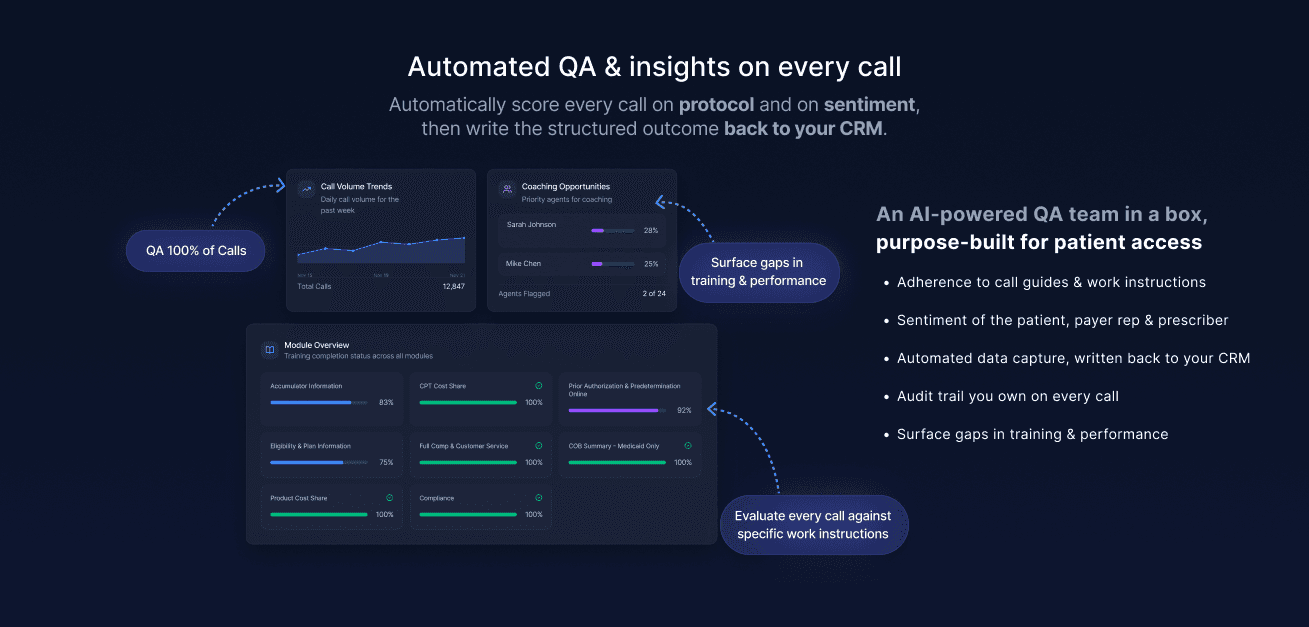

Ready to transform Patient Access?
Ready to transform Patient Access?
NEWSLETTER
@ 2026 Neon Health (Belay, Inc).
AI-powered patient access automation
for leading pharma enterprises.
NEWSLETTER
@ 2026 Neon Health (Belay, Inc).
AI-powered patient access automation for leading pharma enterprises.
NEWSLETTER
@ 2026 Neon Health (Belay, Inc).
AI-powered patient access automation
for leading pharma enterprises.