
Case Management Software for Healthcare: Platforms Compared [2026]
Case Management Software for Healthcare: Platforms Compared [2026]
Most case management software was built for legal firms, IT help desks, or social work agencies. Healthcare teams end up using these tools anyway, then spend months configuring them to handle HIPAA compliance, EHR integration, and the regulatory complexity of patient workflows.
The problem is not a lack of software. It is a lack of software designed for how healthcare actually works. A case in healthcare is not a support ticket. It is a patient moving through benefit verification, prior authorization, financial assistance, therapy initiation, and adherence monitoring. Each step involves different stakeholders, different systems, and different compliance requirements.
At Neon Health, we built our AI workforce for this gap: the space between care coordination platforms that track patient status and the operational tools that actually execute patient access workflows. This guide compares 10 platforms across the healthcare case management landscape, from enterprise CRMs to specialty-focused AI solutions, so you can find the right fit for your organization.
The global case management software market reached $7.32 billion in 2023 and is projected to hit $15 billion by 2030, growing at an 11.2% CAGR (Grand View Research). Healthcare is one of the primary growth drivers, yet most platforms still treat it as one vertical among many.
What Makes Healthcare Case Management Different from General Case Management?
Healthcare case management is the process of coordinating clinical, financial, and administrative workflows around individual patients to ensure timely access to care while meeting regulatory and compliance requirements.
General case management software handles tickets, tasks, and service-level agreements. Healthcare case management adds layers that generic tools cannot replicate without heavy customization.
HIPAA and PHI handling. Every interaction with patient data must comply with HIPAA privacy and security rules. Generic tools lack built-in audit trails, access controls, and encryption standards required for protected health information.
EHR integration. Healthcare teams work in Epic, Oracle Health (Cerner), or athenahealth. Case management software that cannot read from and write to these systems creates duplicate data entry, delays, and errors.
Payer connectivity. Patient access cases require real-time benefit verification, prior authorization submission, and claims status checks. This means integrating with payer portals and clearinghouses, not just internal databases.
Clinical protocol compliance. Case managers must track step therapy requirements, REMS program enrollment, accreditation standards (URAC, ACHC), and quality measures tied to value-based contracts.
Financial complexity. Healthcare cases often involve copay assistance programs, foundation grants, bridge programs, and manufacturer vouchers. Each has different eligibility criteria, enrollment processes, and renewal cycles.
The Agency for Healthcare Research and Quality (AHRQ) defines care coordination as "deliberately organizing patient care activities and sharing information among all of the participants concerned with a patient's care to achieve safer and more effective care." Case management software is the operational backbone that makes this coordination possible at scale.
Why Healthcare Organizations Are Investing in Case Management Software
Healthcare administrative spending in the U.S. reached an estimated $950 billion in 2019. A McKinsey and Harvard study published in JAMA found that $265 billion of that could be reduced without compromising care quality or access. The study identified 30 specific interventions, many of which depend on better case management technology. The American Hospital Association documented how these costs continue to rise, with commercial insurer policies adding further burden.
Three forces are accelerating adoption:
CMS readmission penalties. The Hospital Readmissions Reduction Program penalizes hospitals for excess 30-day readmissions. Structured care coordination is a primary strategy to reduce these penalties, and systematic reviews confirm that coordinated interventions linking health and social services reduce hospitalizations and emergency department visits.
Value-based care expansion. CMS aims for 100% of Traditional Medicare beneficiaries in accountable care relationships by 2030. This requires tools that track patients across providers, measure outcomes, and coordinate services proactively rather than reactively.
Specialty drug complexity. Specialty medications represent 2-3% of prescription volume but over 50% of total U.S. drug spending. Each specialty prescription requires a cascade of administrative steps (BV, PA, financial assistance, onboarding, adherence support) that overwhelm manual case management. The medical case management market alone is projected to grow from $5.68 billion in 2024 to $9.23 billion by 2035 (Market Research Future).
10 Healthcare Case Management Platforms Compared
Salesforce Health Cloud
Salesforce Health Cloud extends the Salesforce CRM platform with healthcare-specific data models, care plan management, and patient timeline views. It supports social determinants tracking, referral management, and integrations with major EHR systems through its AppExchange ecosystem.
Key capabilities:
Care plan creation and tracking with timeline views
Patient 360 view aggregating clinical, claims, and social data
Configurable workflows and automation rules
Large partner ecosystem for EHR and payer integrations
Best for: Large health systems and payers with existing Salesforce investments that need a flexible CRM-based care management layer.
Limitation: Requires third-party apps for healthcare-specific workflows like PA submission or BV automation. Implementation timelines can stretch to 6-12 months.
ServiceNow Healthcare & Life Sciences
ServiceNow brings IT service management discipline to healthcare operations. Its healthcare module supports case routing, provider credentialing, utilization management, and compliance tracking with the same workflow engine used across IT and HR.
Key capabilities:
Automated case routing based on patient attributes and urgency
Provider credentialing and network management
Utilization management workflows
Compliance tracking and audit trail
Best for: Organizations wanting to unify IT operations and clinical workflows on a single platform, particularly those already using ServiceNow for IT service management.
Limitation: Healthcare-specific features are newer than the core platform. Teams may need to build custom workflows for patient access scenarios like PA or financial assistance.
Arcadia
Arcadia combines data aggregation, risk stratification, and care management into a population health platform. It ingests data from EHRs, claims, and health information exchanges to identify high-risk patients and coordinate interventions across providers.
Key capabilities:
Multi-source data aggregation and normalization
Risk stratification and predictive analytics
Care gap identification and outreach management
Quality measure tracking for value-based contracts
Best for: Health systems and ACOs managing large patient populations under value-based contracts.
Limitation: Focused on population-level analytics rather than individual case execution. Does not automate operational tasks like PA submission or payer phone calls.
WellSky
WellSky serves the post-acute care market with intake, care planning, visit scheduling, and outcomes reporting. In early 2026, WellSky launched new AI capabilities to automate referral intake, reflecting the broader shift toward automation in care settings where patients transition between facilities and home.
Referral management and intake automation
Care planning with clinical assessments
Visit scheduling and field staff management
Regulatory compliance (OASIS, HIPAA)
Best for: Home health agencies, hospice providers, and post-acute care organizations managing patient transitions.
Limitation: Strongest in post-acute settings. Organizations focused on specialty pharmacy or patient access workflows will need supplemental tools.
PointClickCare
PointClickCare is a cloud EHR with integrated case management for senior living and skilled nursing facilities. It covers resident assessments, care planning, medication management, and billing within a single platform, making it the dominant choice in long-term post-acute care (LTPAC).
Resident assessment and care planning
Medication management and eMAR
Billing and revenue cycle management
Network connectivity for care transitions
Best for: Long-term care facilities and skilled nursing organizations needing an all-in-one clinical and administrative platform. Not designed for specialty pharmacy or ambulatory patient access workflows.
Bonterra (Apricot and Penelope)
Bonterra offers case management for nonprofits and human services. Apricot focuses on program management and outcomes tracking, while Penelope supports clinical documentation and case notes for behavioral health and community services. The two products serve overlapping but distinct audiences within the human services ecosystem.
Key capabilities:
Client intake, assessment, and referral tracking
Program-level outcomes measurement and reporting
Configurable forms and workflows
Grant and funder reporting
Best for: Community health organizations, behavioral health providers, and social services agencies managing multi-program caseloads.
Limitation: Designed for human services rather than healthcare operations. Lacks native EHR integration, payer connectivity, or PA/BV automation.
CaseWorthy (ClientTrack)
CaseWorthy unified its Eccovia ClientTrack and CaseWorthy platforms into a single enterprise case management solution for health and human services. It supports multi-agency coordination, eligibility determination, and complex program management at government scale.
Key capabilities:
Multi-agency case coordination and data sharing
Eligibility determination and program enrollment
Configurable workflows for diverse program types
Compliance reporting for government contracts
Best for: Large-scale government programs, community health networks, and organizations coordinating services across multiple agencies.
Limitation: Enterprise complexity means longer implementation timelines. More oriented toward social determinants and human services than clinical or specialty pharmacy workflows.
HUB Healthcare
HUB Healthcare provides care coordination with standardized care pathways, automated messaging, and HIPAA-compliant document management. It focuses on reducing communication gaps between providers without the overhead of an enterprise platform.
Key capabilities:
Standardized care pathways and protocols
Automated provider and patient messaging
HIPAA-compliant document sharing
Real-time analytics and performance monitoring
Best for: Provider groups and clinics wanting lightweight care coordination. Not suited for patient access workflows that require payer portal integration or PA/BV automation.
Creatio
Creatio is a low-code CRM and business process management platform with configurable healthcare workflows. Organizations can build custom case management applications using drag-and-drop process designers, which appeals to teams that want control over their workflow logic without heavy development investment.
Low-code workflow builder for custom case types
CRM with 360-degree customer/patient views
Process automation with rules engines
Analytics and reporting dashboards
Best for: Organizations wanting maximum customization without committing to a healthcare-only platform. Healthcare is one of many verticals, so teams must build compliance, EHR integration, and payer connectivity rather than getting them out of the box.
Neon Health
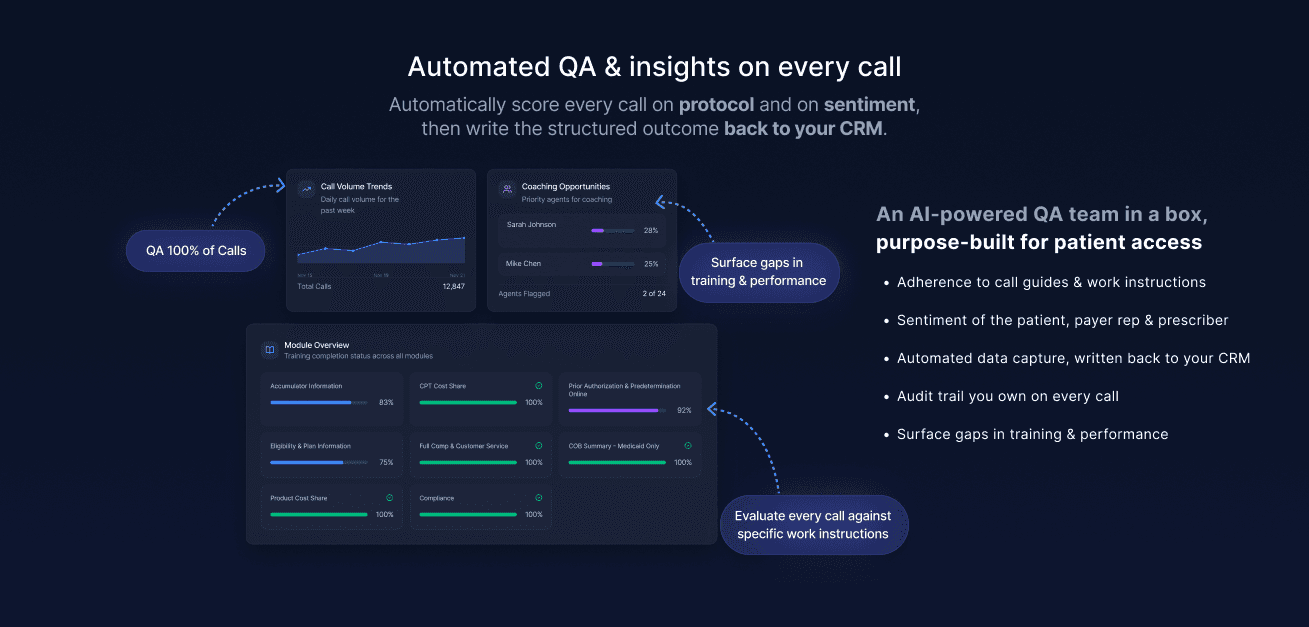
Neon Health provides an AI workforce that automates patient access case management end to end. Rather than tracking cases for human case managers to work, Neon's AI workers execute the tasks directly: navigating payer portals, submitting prior authorizations, enrolling patients in financial assistance programs, conducting outreach calls, and monitoring adherence.
Key capabilities:
AI-driven benefit verification and prior authorization
Automated enrollment in copay, voucher, and foundation programs
Patient onboarding and adherence outreach via voice, SMS, and email
Care coordination with EHR write-back to Epic and Oracle Health
Best for: Specialty pharmacies, pharmaceutical manufacturer hub programs, and health systems managing specialty drug access that need to reduce time-to-therapy and cost-per-patient.
What sets it apart: Where other platforms provide software for case managers to use, Neon Health provides AI workers that perform the case management work. Routine cases are handled autonomously; human staff focus solely on complex exceptions. Neon reports 300% ROI on call center automation, 70% labor cost reduction, and 2x faster benefit verification (self-reported data). CareMetx COO Brent Barber noted that Neon's AI tools "helped us unlock efficiencies we didn't think were possible, simplifying complex operations and enabling us to focus on what matters most."
Consideration: Best suited for organizations with specialty medication workflows. General practice case management is not the primary focus.
Feature Comparison Matrix
Platform | Healthcare Focus | HIPAA | EHR Integration | PA/BV Automation | Financial Assistance | Patient Outreach | AI Capabilities | Best For |
|---|---|---|---|---|---|---|---|---|
Salesforce Health Cloud | Multi-vertical | Yes | Via AppExchange | Via partners | Configurable | Yes | Einstein AI | Health systems, payers |
ServiceNow Healthcare | Multi-vertical | Yes | API-based | Custom workflows | Custom workflows | Limited | Now Intelligence | IT-clinical unification |
Arcadia | Population health | Yes | Native multi-source | No | No | Outreach tools | Predictive analytics | ACOs, health systems |
WellSky | Post-acute care | Yes | Native (post-acute) | No | No | Visit coordination | AI referral intake | Home health, hospice |
PointClickCare | Senior care | Yes | Native (LTPAC) | No | No | Resident-focused | Limited | Long-term care |
Bonterra | Human services | Configurable | No native | No | Grant tracking | Client outreach | No | Community health, nonprofits |
CaseWorthy | Human services | Configurable | Limited | No | Eligibility mgmt | Agency coordination | No | Government programs |
HUB Healthcare | Care coordination | Yes | Limited | No | No | Automated messaging | No | Provider groups, clinics |
Creatio | Multi-vertical | Configurable | Custom | Custom | Custom | CRM-based | Rules engine | Custom workflow needs |
Neon Health | Patient access | Yes (HITRUST, SOC 2) | Epic, Oracle Health | Native AI | Native AI | Voice, SMS, email | AI workforce | Specialty pharma, hubs |
How to Choose Case Management Software for Your Organization
By Organization Type
Health systems and hospitals. Priority: EHR integration, readmission tracking, CMS quality reporting. Salesforce Health Cloud offers the broadest configurability for large enterprises. Arcadia adds population health analytics for value-based care programs. ServiceNow suits organizations that want clinical and IT operations on one platform.
Specialty pharmacies and pharma hub programs. Priority: PA/BV automation, financial assistance enrollment, adherence monitoring, time-to-therapy metrics. Neon Health is purpose-built for this workflow, automating the administrative steps that drive up cost-per-patient and delay therapy initiation.
Community health and behavioral health organizations. Priority: intake and referral management, social determinants tracking, program outcomes reporting. Bonterra and CaseWorthy serve this segment with tools designed for multi-program, multi-agency coordination.
Post-acute and home health providers. Priority: visit scheduling, care planning, regulatory compliance (OASIS), transitions of care. WellSky and PointClickCare dominate their respective niches in home health and senior care.
Key Evaluation Criteria
Integration depth. Can it read and write to your EHR? Does it connect to payer portals? Healthcare case management fails when data lives in silos.
Compliance certifications. HIPAA is the baseline. For organizations handling sensitive data, look for HITRUST and SOC 2 certifications. Ask vendors for their most recent audit reports.
Automation level. Distinguish between rules-based automation (if/then triggers) and AI-driven automation (autonomous task execution). The gap between these two determines how much human labor the software actually eliminates.
Scalability and pricing. Per-user pricing works for small teams but can escalate quickly for large organizations. Enterprise licensing with flat fees may offer better economics at scale.
Implementation timeline. Some platforms deploy in weeks; others require 6-12 months of configuration. Factor in the cost of delayed value when comparing options.
The Role of AI in Healthcare Case Management
AI in healthcare case management refers to systems that autonomously execute administrative and clinical workflow tasks, rather than organizing them for human workers to complete.
The distinction matters because tracking does not reduce workload. It organizes it. AI-driven case management reduces the number of tasks humans need to perform. Healthcare is shifting from software that tracks cases to AI that works them.
The most impactful applications today:
Benefit verification and prior authorization. AI workers navigate payer portals, extract coverage details, and submit authorization requests. This eliminates the most time-consuming manual task in patient access.
Patient risk prediction. Machine learning models identify patients likely to miss appointments, abandon therapy, or experience complications, allowing proactive intervention before a case escalates.
Case routing and prioritization. AI triages incoming cases by urgency and complexity, ensuring that human case managers spend their time on exceptions rather than routine tasks.
Patient outreach. Automated voice, SMS, and email outreach for appointment reminders, refill notifications, and onboarding support scales communication without adding headcount.
The financial case is strong. One health system's care transitions program saved nearly $2 million by reducing 30-day all-cause readmissions through structured case management. The McKinsey/Harvard study identified $175 billion in savings achievable by individual organizations through administrative simplification, without requiring industry-wide policy changes.
Neon Health represents the AI-native end of this spectrum: instead of adding AI features to existing case management software, the entire platform is built around AI workers that execute patient access workflows autonomously.
Frequently Asked Questions
What is healthcare case management software?
Healthcare case management software coordinates clinical, financial, and administrative workflows for individual patients. It tracks cases across benefit verification, prior authorization, financial assistance, therapy initiation, and adherence while ensuring HIPAA compliance and connecting to EHR systems and payer portals.
How is case management different from care coordination?
Case management focuses on managing the lifecycle of individual patient cases through defined workflows and tasks. Care coordination is the broader practice of organizing patient care activities across multiple providers and settings. Case management software provides the operational tools; care coordination is the strategy those tools support.
What HIPAA requirements apply to case management software?
Any software handling protected health information (PHI) must implement administrative, physical, and technical safeguards per the HIPAA Security Rule. This includes access controls, audit logging, encryption in transit and at rest, and business associate agreements with the vendor. HITRUST certification provides independent validation beyond baseline HIPAA compliance.
Can case management software integrate with EHR systems?
Most healthcare-focused platforms offer some level of EHR integration, but depth varies. Some provide native bidirectional APIs (read and write to Epic or Oracle Health in real time), while others offer limited one-way data feeds or require middleware. Ask vendors to demonstrate live EHR integration, not just connectivity claims.
How much does healthcare case management software cost?
Pricing models range from per-user monthly fees ($10-200/user/month for platforms like Kissflow or Creatio) to enterprise contracts with custom pricing (Salesforce Health Cloud, ServiceNow, Neon Health). Total cost depends on user count, modules needed, integration requirements, and implementation services. Specialty solutions often price per-case or per-patient rather than per-seat.
Key Takeaways
The global case management software market is projected to grow from $7.32 billion (2023) to $15 billion by 2030 at an 11.2% CAGR, with healthcare as a primary growth driver (Grand View Research).
Healthcare case management requires HIPAA compliance, EHR integration, payer connectivity, and clinical protocol adherence that generic tools lack.
U.S. healthcare could save $265 billion annually by reducing administrative complexity, and case management technology is a primary lever (McKinsey/JAMA).
Organization type determines the right platform: enterprise CRMs for large health systems, population health tools for ACOs, human services platforms for community health, and AI-native solutions for specialty pharma.
AI is shifting case management from tracking workflows to executing them, with the most impact in benefit verification, prior authorization, and patient outreach.
Integration depth with existing EHR, payer, and pharmacy systems is the most important evaluation criterion.
CMS readmission penalties and value-based care expansion are accelerating adoption of structured case management technology (CMS HRRP).
Sources
Grand View Research. "Case Management Software Market Size, Share & Trends Analysis Report, 2024-2030." https://www.grandviewresearch.com/industry-analysis/case-management-software-market-report
Agency for Healthcare Research and Quality (AHRQ). "Care Coordination." https://www.ahrq.gov/ncepcr/care/coordination.html
Sahni, N.R., Cutler, D.M., et al. "Administrative Simplification and the Potential for Saving a Quarter-Trillion Dollars in Health Care." JAMA, October 2021. Reported by Fierce Healthcare.
Centers for Medicare & Medicaid Services (CMS). "Hospital Readmissions Reduction Program (HRRP)." https://www.cms.gov/medicare/payment/prospective-payment-systems/acute-inpatient-pps/hospital-readmissions-reduction-program-hrrp
Systematic Review of Care Coordination Interventions Linking Health and Social Services. PMC, 2022. https://pmc.ncbi.nlm.nih.gov/articles/PMC8861924/
Health Catalyst. "Care Transitions Improvements Reduces 30-Day All-Cause Readmissions Saving Nearly $2 Million." https://www.healthcatalyst.com/learn/success-stories/reduce-hospital-readmission-rates-utmb
American Hospital Association (AHA). "Skyrocketing Hospital Administrative Costs, Burdensome Commercial Insurer Policies Impacting Patient Care." September 2024. https://www.aha.org/guidesreports/2024-09-10-skyrocketing-hospital-administrative-costs-burdensome-commercial-insurer-policies-are-impacting
Market Research Future. "Medical Case Management Market." https://www.marketresearchfuture.com/reports/medical-case-management-market-7164
Neon Health. Self-reported data from company website and blog. Accessed March 2026. https://neonhealth.com
Most case management software was built for legal firms, IT help desks, or social work agencies. Healthcare teams end up using these tools anyway, then spend months configuring them to handle HIPAA compliance, EHR integration, and the regulatory complexity of patient workflows.
The problem is not a lack of software. It is a lack of software designed for how healthcare actually works. A case in healthcare is not a support ticket. It is a patient moving through benefit verification, prior authorization, financial assistance, therapy initiation, and adherence monitoring. Each step involves different stakeholders, different systems, and different compliance requirements.
At Neon Health, we built our AI workforce for this gap: the space between care coordination platforms that track patient status and the operational tools that actually execute patient access workflows. This guide compares 10 platforms across the healthcare case management landscape, from enterprise CRMs to specialty-focused AI solutions, so you can find the right fit for your organization.
The global case management software market reached $7.32 billion in 2023 and is projected to hit $15 billion by 2030, growing at an 11.2% CAGR (Grand View Research). Healthcare is one of the primary growth drivers, yet most platforms still treat it as one vertical among many.
What Makes Healthcare Case Management Different from General Case Management?
Healthcare case management is the process of coordinating clinical, financial, and administrative workflows around individual patients to ensure timely access to care while meeting regulatory and compliance requirements.
General case management software handles tickets, tasks, and service-level agreements. Healthcare case management adds layers that generic tools cannot replicate without heavy customization.
HIPAA and PHI handling. Every interaction with patient data must comply with HIPAA privacy and security rules. Generic tools lack built-in audit trails, access controls, and encryption standards required for protected health information.
EHR integration. Healthcare teams work in Epic, Oracle Health (Cerner), or athenahealth. Case management software that cannot read from and write to these systems creates duplicate data entry, delays, and errors.
Payer connectivity. Patient access cases require real-time benefit verification, prior authorization submission, and claims status checks. This means integrating with payer portals and clearinghouses, not just internal databases.
Clinical protocol compliance. Case managers must track step therapy requirements, REMS program enrollment, accreditation standards (URAC, ACHC), and quality measures tied to value-based contracts.
Financial complexity. Healthcare cases often involve copay assistance programs, foundation grants, bridge programs, and manufacturer vouchers. Each has different eligibility criteria, enrollment processes, and renewal cycles.
The Agency for Healthcare Research and Quality (AHRQ) defines care coordination as "deliberately organizing patient care activities and sharing information among all of the participants concerned with a patient's care to achieve safer and more effective care." Case management software is the operational backbone that makes this coordination possible at scale.
Why Healthcare Organizations Are Investing in Case Management Software
Healthcare administrative spending in the U.S. reached an estimated $950 billion in 2019. A McKinsey and Harvard study published in JAMA found that $265 billion of that could be reduced without compromising care quality or access. The study identified 30 specific interventions, many of which depend on better case management technology. The American Hospital Association documented how these costs continue to rise, with commercial insurer policies adding further burden.
Three forces are accelerating adoption:
CMS readmission penalties. The Hospital Readmissions Reduction Program penalizes hospitals for excess 30-day readmissions. Structured care coordination is a primary strategy to reduce these penalties, and systematic reviews confirm that coordinated interventions linking health and social services reduce hospitalizations and emergency department visits.
Value-based care expansion. CMS aims for 100% of Traditional Medicare beneficiaries in accountable care relationships by 2030. This requires tools that track patients across providers, measure outcomes, and coordinate services proactively rather than reactively.
Specialty drug complexity. Specialty medications represent 2-3% of prescription volume but over 50% of total U.S. drug spending. Each specialty prescription requires a cascade of administrative steps (BV, PA, financial assistance, onboarding, adherence support) that overwhelm manual case management. The medical case management market alone is projected to grow from $5.68 billion in 2024 to $9.23 billion by 2035 (Market Research Future).
10 Healthcare Case Management Platforms Compared
Salesforce Health Cloud
Salesforce Health Cloud extends the Salesforce CRM platform with healthcare-specific data models, care plan management, and patient timeline views. It supports social determinants tracking, referral management, and integrations with major EHR systems through its AppExchange ecosystem.
Key capabilities:
Care plan creation and tracking with timeline views
Patient 360 view aggregating clinical, claims, and social data
Configurable workflows and automation rules
Large partner ecosystem for EHR and payer integrations
Best for: Large health systems and payers with existing Salesforce investments that need a flexible CRM-based care management layer.
Limitation: Requires third-party apps for healthcare-specific workflows like PA submission or BV automation. Implementation timelines can stretch to 6-12 months.
ServiceNow Healthcare & Life Sciences
ServiceNow brings IT service management discipline to healthcare operations. Its healthcare module supports case routing, provider credentialing, utilization management, and compliance tracking with the same workflow engine used across IT and HR.
Key capabilities:
Automated case routing based on patient attributes and urgency
Provider credentialing and network management
Utilization management workflows
Compliance tracking and audit trail
Best for: Organizations wanting to unify IT operations and clinical workflows on a single platform, particularly those already using ServiceNow for IT service management.
Limitation: Healthcare-specific features are newer than the core platform. Teams may need to build custom workflows for patient access scenarios like PA or financial assistance.
Arcadia
Arcadia combines data aggregation, risk stratification, and care management into a population health platform. It ingests data from EHRs, claims, and health information exchanges to identify high-risk patients and coordinate interventions across providers.
Key capabilities:
Multi-source data aggregation and normalization
Risk stratification and predictive analytics
Care gap identification and outreach management
Quality measure tracking for value-based contracts
Best for: Health systems and ACOs managing large patient populations under value-based contracts.
Limitation: Focused on population-level analytics rather than individual case execution. Does not automate operational tasks like PA submission or payer phone calls.
WellSky
WellSky serves the post-acute care market with intake, care planning, visit scheduling, and outcomes reporting. In early 2026, WellSky launched new AI capabilities to automate referral intake, reflecting the broader shift toward automation in care settings where patients transition between facilities and home.
Referral management and intake automation
Care planning with clinical assessments
Visit scheduling and field staff management
Regulatory compliance (OASIS, HIPAA)
Best for: Home health agencies, hospice providers, and post-acute care organizations managing patient transitions.
Limitation: Strongest in post-acute settings. Organizations focused on specialty pharmacy or patient access workflows will need supplemental tools.
PointClickCare
PointClickCare is a cloud EHR with integrated case management for senior living and skilled nursing facilities. It covers resident assessments, care planning, medication management, and billing within a single platform, making it the dominant choice in long-term post-acute care (LTPAC).
Resident assessment and care planning
Medication management and eMAR
Billing and revenue cycle management
Network connectivity for care transitions
Best for: Long-term care facilities and skilled nursing organizations needing an all-in-one clinical and administrative platform. Not designed for specialty pharmacy or ambulatory patient access workflows.
Bonterra (Apricot and Penelope)
Bonterra offers case management for nonprofits and human services. Apricot focuses on program management and outcomes tracking, while Penelope supports clinical documentation and case notes for behavioral health and community services. The two products serve overlapping but distinct audiences within the human services ecosystem.
Key capabilities:
Client intake, assessment, and referral tracking
Program-level outcomes measurement and reporting
Configurable forms and workflows
Grant and funder reporting
Best for: Community health organizations, behavioral health providers, and social services agencies managing multi-program caseloads.
Limitation: Designed for human services rather than healthcare operations. Lacks native EHR integration, payer connectivity, or PA/BV automation.
CaseWorthy (ClientTrack)
CaseWorthy unified its Eccovia ClientTrack and CaseWorthy platforms into a single enterprise case management solution for health and human services. It supports multi-agency coordination, eligibility determination, and complex program management at government scale.
Key capabilities:
Multi-agency case coordination and data sharing
Eligibility determination and program enrollment
Configurable workflows for diverse program types
Compliance reporting for government contracts
Best for: Large-scale government programs, community health networks, and organizations coordinating services across multiple agencies.
Limitation: Enterprise complexity means longer implementation timelines. More oriented toward social determinants and human services than clinical or specialty pharmacy workflows.
HUB Healthcare
HUB Healthcare provides care coordination with standardized care pathways, automated messaging, and HIPAA-compliant document management. It focuses on reducing communication gaps between providers without the overhead of an enterprise platform.
Key capabilities:
Standardized care pathways and protocols
Automated provider and patient messaging
HIPAA-compliant document sharing
Real-time analytics and performance monitoring
Best for: Provider groups and clinics wanting lightweight care coordination. Not suited for patient access workflows that require payer portal integration or PA/BV automation.
Creatio
Creatio is a low-code CRM and business process management platform with configurable healthcare workflows. Organizations can build custom case management applications using drag-and-drop process designers, which appeals to teams that want control over their workflow logic without heavy development investment.
Low-code workflow builder for custom case types
CRM with 360-degree customer/patient views
Process automation with rules engines
Analytics and reporting dashboards
Best for: Organizations wanting maximum customization without committing to a healthcare-only platform. Healthcare is one of many verticals, so teams must build compliance, EHR integration, and payer connectivity rather than getting them out of the box.
Neon Health
Neon Health provides an AI workforce that automates patient access case management end to end. Rather than tracking cases for human case managers to work, Neon's AI workers execute the tasks directly: navigating payer portals, submitting prior authorizations, enrolling patients in financial assistance programs, conducting outreach calls, and monitoring adherence.
Key capabilities:
AI-driven benefit verification and prior authorization
Automated enrollment in copay, voucher, and foundation programs
Patient onboarding and adherence outreach via voice, SMS, and email
Care coordination with EHR write-back to Epic and Oracle Health
Best for: Specialty pharmacies, pharmaceutical manufacturer hub programs, and health systems managing specialty drug access that need to reduce time-to-therapy and cost-per-patient.
What sets it apart: Where other platforms provide software for case managers to use, Neon Health provides AI workers that perform the case management work. Routine cases are handled autonomously; human staff focus solely on complex exceptions. Neon reports 300% ROI on call center automation, 70% labor cost reduction, and 2x faster benefit verification (self-reported data). CareMetx COO Brent Barber noted that Neon's AI tools "helped us unlock efficiencies we didn't think were possible, simplifying complex operations and enabling us to focus on what matters most."
Consideration: Best suited for organizations with specialty medication workflows. General practice case management is not the primary focus.
Feature Comparison Matrix
Platform | Healthcare Focus | HIPAA | EHR Integration | PA/BV Automation | Financial Assistance | Patient Outreach | AI Capabilities | Best For |
|---|---|---|---|---|---|---|---|---|
Salesforce Health Cloud | Multi-vertical | Yes | Via AppExchange | Via partners | Configurable | Yes | Einstein AI | Health systems, payers |
ServiceNow Healthcare | Multi-vertical | Yes | API-based | Custom workflows | Custom workflows | Limited | Now Intelligence | IT-clinical unification |
Arcadia | Population health | Yes | Native multi-source | No | No | Outreach tools | Predictive analytics | ACOs, health systems |
WellSky | Post-acute care | Yes | Native (post-acute) | No | No | Visit coordination | AI referral intake | Home health, hospice |
PointClickCare | Senior care | Yes | Native (LTPAC) | No | No | Resident-focused | Limited | Long-term care |
Bonterra | Human services | Configurable | No native | No | Grant tracking | Client outreach | No | Community health, nonprofits |
CaseWorthy | Human services | Configurable | Limited | No | Eligibility mgmt | Agency coordination | No | Government programs |
HUB Healthcare | Care coordination | Yes | Limited | No | No | Automated messaging | No | Provider groups, clinics |
Creatio | Multi-vertical | Configurable | Custom | Custom | Custom | CRM-based | Rules engine | Custom workflow needs |
Neon Health | Patient access | Yes (HITRUST, SOC 2) | Epic, Oracle Health | Native AI | Native AI | Voice, SMS, email | AI workforce | Specialty pharma, hubs |
How to Choose Case Management Software for Your Organization
By Organization Type
Health systems and hospitals. Priority: EHR integration, readmission tracking, CMS quality reporting. Salesforce Health Cloud offers the broadest configurability for large enterprises. Arcadia adds population health analytics for value-based care programs. ServiceNow suits organizations that want clinical and IT operations on one platform.
Specialty pharmacies and pharma hub programs. Priority: PA/BV automation, financial assistance enrollment, adherence monitoring, time-to-therapy metrics. Neon Health is purpose-built for this workflow, automating the administrative steps that drive up cost-per-patient and delay therapy initiation.
Community health and behavioral health organizations. Priority: intake and referral management, social determinants tracking, program outcomes reporting. Bonterra and CaseWorthy serve this segment with tools designed for multi-program, multi-agency coordination.
Post-acute and home health providers. Priority: visit scheduling, care planning, regulatory compliance (OASIS), transitions of care. WellSky and PointClickCare dominate their respective niches in home health and senior care.
Key Evaluation Criteria
Integration depth. Can it read and write to your EHR? Does it connect to payer portals? Healthcare case management fails when data lives in silos.
Compliance certifications. HIPAA is the baseline. For organizations handling sensitive data, look for HITRUST and SOC 2 certifications. Ask vendors for their most recent audit reports.
Automation level. Distinguish between rules-based automation (if/then triggers) and AI-driven automation (autonomous task execution). The gap between these two determines how much human labor the software actually eliminates.
Scalability and pricing. Per-user pricing works for small teams but can escalate quickly for large organizations. Enterprise licensing with flat fees may offer better economics at scale.
Implementation timeline. Some platforms deploy in weeks; others require 6-12 months of configuration. Factor in the cost of delayed value when comparing options.
The Role of AI in Healthcare Case Management
AI in healthcare case management refers to systems that autonomously execute administrative and clinical workflow tasks, rather than organizing them for human workers to complete.
The distinction matters because tracking does not reduce workload. It organizes it. AI-driven case management reduces the number of tasks humans need to perform. Healthcare is shifting from software that tracks cases to AI that works them.
The most impactful applications today:
Benefit verification and prior authorization. AI workers navigate payer portals, extract coverage details, and submit authorization requests. This eliminates the most time-consuming manual task in patient access.
Patient risk prediction. Machine learning models identify patients likely to miss appointments, abandon therapy, or experience complications, allowing proactive intervention before a case escalates.
Case routing and prioritization. AI triages incoming cases by urgency and complexity, ensuring that human case managers spend their time on exceptions rather than routine tasks.
Patient outreach. Automated voice, SMS, and email outreach for appointment reminders, refill notifications, and onboarding support scales communication without adding headcount.
The financial case is strong. One health system's care transitions program saved nearly $2 million by reducing 30-day all-cause readmissions through structured case management. The McKinsey/Harvard study identified $175 billion in savings achievable by individual organizations through administrative simplification, without requiring industry-wide policy changes.
Neon Health represents the AI-native end of this spectrum: instead of adding AI features to existing case management software, the entire platform is built around AI workers that execute patient access workflows autonomously.
Frequently Asked Questions
What is healthcare case management software?
Healthcare case management software coordinates clinical, financial, and administrative workflows for individual patients. It tracks cases across benefit verification, prior authorization, financial assistance, therapy initiation, and adherence while ensuring HIPAA compliance and connecting to EHR systems and payer portals.
How is case management different from care coordination?
Case management focuses on managing the lifecycle of individual patient cases through defined workflows and tasks. Care coordination is the broader practice of organizing patient care activities across multiple providers and settings. Case management software provides the operational tools; care coordination is the strategy those tools support.
What HIPAA requirements apply to case management software?
Any software handling protected health information (PHI) must implement administrative, physical, and technical safeguards per the HIPAA Security Rule. This includes access controls, audit logging, encryption in transit and at rest, and business associate agreements with the vendor. HITRUST certification provides independent validation beyond baseline HIPAA compliance.
Can case management software integrate with EHR systems?
Most healthcare-focused platforms offer some level of EHR integration, but depth varies. Some provide native bidirectional APIs (read and write to Epic or Oracle Health in real time), while others offer limited one-way data feeds or require middleware. Ask vendors to demonstrate live EHR integration, not just connectivity claims.
How much does healthcare case management software cost?
Pricing models range from per-user monthly fees ($10-200/user/month for platforms like Kissflow or Creatio) to enterprise contracts with custom pricing (Salesforce Health Cloud, ServiceNow, Neon Health). Total cost depends on user count, modules needed, integration requirements, and implementation services. Specialty solutions often price per-case or per-patient rather than per-seat.
Key Takeaways
The global case management software market is projected to grow from $7.32 billion (2023) to $15 billion by 2030 at an 11.2% CAGR, with healthcare as a primary growth driver (Grand View Research).
Healthcare case management requires HIPAA compliance, EHR integration, payer connectivity, and clinical protocol adherence that generic tools lack.
U.S. healthcare could save $265 billion annually by reducing administrative complexity, and case management technology is a primary lever (McKinsey/JAMA).
Organization type determines the right platform: enterprise CRMs for large health systems, population health tools for ACOs, human services platforms for community health, and AI-native solutions for specialty pharma.
AI is shifting case management from tracking workflows to executing them, with the most impact in benefit verification, prior authorization, and patient outreach.
Integration depth with existing EHR, payer, and pharmacy systems is the most important evaluation criterion.
CMS readmission penalties and value-based care expansion are accelerating adoption of structured case management technology (CMS HRRP).
Sources
Grand View Research. "Case Management Software Market Size, Share & Trends Analysis Report, 2024-2030." https://www.grandviewresearch.com/industry-analysis/case-management-software-market-report
Agency for Healthcare Research and Quality (AHRQ). "Care Coordination." https://www.ahrq.gov/ncepcr/care/coordination.html
Sahni, N.R., Cutler, D.M., et al. "Administrative Simplification and the Potential for Saving a Quarter-Trillion Dollars in Health Care." JAMA, October 2021. Reported by Fierce Healthcare.
Centers for Medicare & Medicaid Services (CMS). "Hospital Readmissions Reduction Program (HRRP)." https://www.cms.gov/medicare/payment/prospective-payment-systems/acute-inpatient-pps/hospital-readmissions-reduction-program-hrrp
Systematic Review of Care Coordination Interventions Linking Health and Social Services. PMC, 2022. https://pmc.ncbi.nlm.nih.gov/articles/PMC8861924/
Health Catalyst. "Care Transitions Improvements Reduces 30-Day All-Cause Readmissions Saving Nearly $2 Million." https://www.healthcatalyst.com/learn/success-stories/reduce-hospital-readmission-rates-utmb
American Hospital Association (AHA). "Skyrocketing Hospital Administrative Costs, Burdensome Commercial Insurer Policies Impacting Patient Care." September 2024. https://www.aha.org/guidesreports/2024-09-10-skyrocketing-hospital-administrative-costs-burdensome-commercial-insurer-policies-are-impacting
Market Research Future. "Medical Case Management Market." https://www.marketresearchfuture.com/reports/medical-case-management-market-7164
Neon Health. Self-reported data from company website and blog. Accessed March 2026. https://neonhealth.com
Related articles
Related articles

Ready to transform Patient Access?
Ready to transform Patient Access?
NEWSLETTER
@ 2026 Neon Health (Belay, Inc).
AI-powered patient access automation
for leading pharma enterprises.
NEWSLETTER
@ 2026 Neon Health (Belay, Inc).
AI-powered patient access automation for leading pharma enterprises.
NEWSLETTER
@ 2026 Neon Health (Belay, Inc).
AI-powered patient access automation
for leading pharma enterprises.