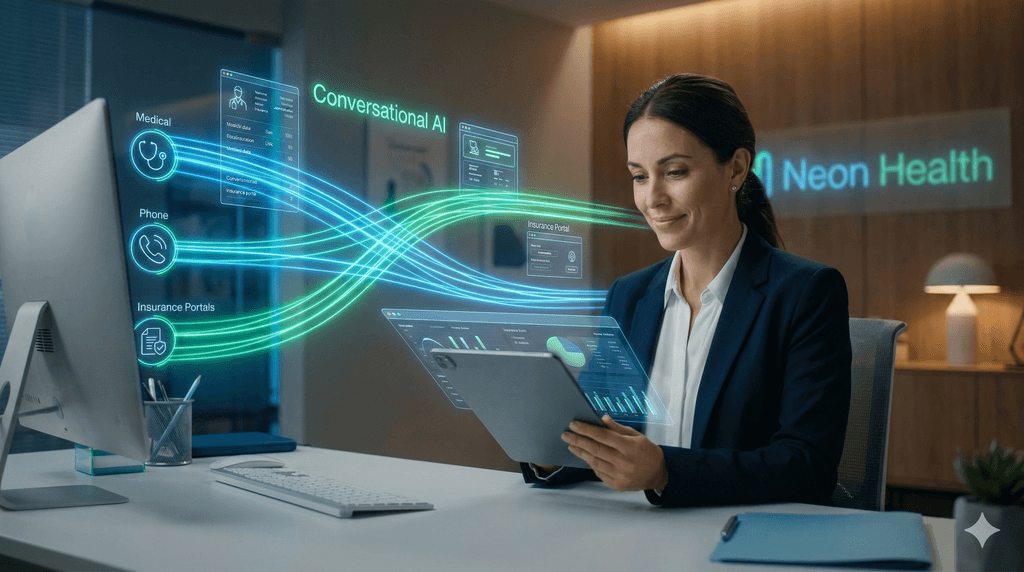
Conversational AI in Healthcare: Use Cases, Platforms, and What Actually Works [2026]
Conversational AI in Healthcare: Use Cases, Platforms, and What Actually Works [2026]
A single prior authorization for a specialty medication can require three phone calls, two portal logins, and 45 minutes of staff time. Multiply that by hundreds of patients per week, and the costs compound fast. According to the 2024 CAQH Index, the U.S. healthcare industry could save $13.9 billion annually by fully automating eligibility and benefit verification. Conversational AI is making that automation possible, but not in the way most vendor marketing suggests.
The term "conversational AI" covers everything from an FAQ bot on a hospital website to an autonomous AI worker that calls United Healthcare, navigates the IVR, waits on hold, and extracts structured benefit data from a verbal conversation. These are not the same technology. They solve different problems, require different infrastructure, and deliver different ROI.
The market is growing but fragmented. Some platforms focus on patient scheduling. Others handle clinical triage. A smaller group specializes in payer-facing calls for benefit verification, prior authorization, and claims follow-up. And a few attempt to cover the full patient access workflow from prescription to first dose.
For buyers evaluating conversational AI for healthcare, the challenge is not finding options. It is matching the right platform to the right problem. A scheduling bot will not solve a prior authorization backlog. A payer-facing voice agent will not answer patient billing questions.
This guide maps the conversational AI landscape by use case, profiles the platforms operating in each category, and clarifies what separates marketing claims from working technology. Whether you are a health system CIO exploring call center automation, a contact center director evaluating AI voice agents, or a pharma patient services lead looking to reduce time-to-therapy, the goal is the same: understand what conversational AI actually does in healthcare and where it delivers measurable results.
The stakes are high. Specialty medications account for a small fraction of prescription volume but roughly 54% of total U.S. drug spending, according to the IQVIA Institute. The administrative workflows required to get patients access to these medications (benefit verification, prior authorization, financial assistance enrollment) are manual, time-consuming, and error-prone. An average practice spends 12.64 minutes per manual eligibility check. A denied claim costs roughly $118 to rework (a figure from 2017 that has likely risen since). The operational burden is not just inconvenient. It delays patient care and costs the system billions.
What Is Conversational AI in Healthcare? (And What It Isn't)
Conversational AI in healthcare refers to AI systems that engage in natural-language dialogue with patients, providers, or payers through voice, text, chat, or messaging channels.
That definition is broad by design. The category spans a wide spectrum of complexity, and understanding where a given platform falls on that spectrum matters more than the label a vendor applies to it.
The Healthcare Conversational AI Spectrum
Think of conversational AI in healthcare as four levels, each building on the capabilities of the one below it.
Level 1: Rule-based response systems. Decision trees with scripted responses. The "chatbot" that answers "What are your office hours?" or walks a patient through a symptom checklist. These systems follow predetermined paths. They break when a user says something unexpected.
Level 2: NLU-powered assistants. Natural language understanding enables intent recognition and context awareness. These handle scheduling requests, basic billing inquiries, and appointment reminders. They can interpret variations in phrasing ("I need to reschedule my Tuesday appointment" vs. "Can I move my visit?") and route accordingly.
Level 3: Voice AI agents. These handle live phone conversations in real time. They process audio, respond naturally, navigate IVR phone trees, manage hold times, and conduct multi-turn dialogue. A voice AI agent calling a payer to check prior authorization status is fundamentally different technology from a text-based scheduling bot.
Level 4: Autonomous AI workers. Complete entire workflows end-to-end. They make calls, update systems, send messages to patients, follow up on exceptions, and escalate when needed. An autonomous AI worker handling benefit verification does not just make the phone call. It interprets the response, updates the patient record, identifies gaps in coverage, and triggers the next step in the workflow.
Level | Technology | Example Use Case | Channel | Complexity |
|---|---|---|---|---|
1 - Rule-based | Decision trees, scripted responses | Office hours FAQ, symptom checklist | Text, chat | Low |
2 - NLU-powered | Intent recognition, context awareness | Appointment scheduling, billing inquiries | Text, chat, voice | Medium |
3 - Voice AI | Real-time audio processing, IVR navigation | Payer benefit verification calls, patient outreach | Voice | High |
4 - Autonomous AI workers | Multi-system orchestration, end-to-end workflow | Full PA submission, financial assistance enrollment | Voice, text, portal, fax | Very high |
Why does this distinction matter for buyers? Because a health system looking to reduce inbound call volume for scheduling needs a Level 2 solution. A specialty pharmacy trying to automate benefit verification calls to payers needs Level 3 or 4. Buying the wrong level wastes budget and creates disillusionment with the technology.
The platforms profiled in this guide span all four levels. Each use case section identifies which level of conversational AI applies.
What Does Conversational AI Solve in Healthcare?
Conversational AI in healthcare addresses six core operational problems: patient scheduling, intake and triage, billing communication, payer-facing calls, patient outreach, and end-to-end patient access workflows.
The most useful way to evaluate the technology is by the problem it solves, not by the vendor selling it. Each use case below maps to a specific operational challenge, identifies the platforms that address it, and notes the level of conversational AI involved.
Patient Scheduling and Appointment Management
The highest-volume, most mature use case for conversational AI in healthcare. Inbound calls for booking, rescheduling, and canceling appointments account for a large share of contact center volume in most health systems and practices.
What AI handles:
Inbound scheduling: patients calling to book, reschedule, or cancel
Outbound reminders: appointment confirmations, no-show follow-up, waitlist management
Overflow routing: after-hours scheduling, peak volume handling
Conversational AI level: Primarily Level 2 (NLU-powered), with some platforms adding Level 3 voice capabilities.
Who does this well: Hyro specializes in healthcare call center automation, reporting 85%+ call deflection rates for routine inquiries. Notable Health combines scheduling with broader clinical workflow automation. Luma Health focuses on patient communication and waitlist management.
Impact data: Vendor-reported case studies suggest 30-50% reduction in scheduling-related call volume. Nimblr AI reports phones ringing "about 50% less" after implementation. SparkTG cites up to 40% reduction in hospital call center load. These are self-reported figures from individual deployments. No independent benchmark study has confirmed these numbers across the industry, though MGMA's 2025 analysis provides guidance on tracking ROI for AI scheduling tools.
Buyer consideration: Scheduling automation delivers the fastest, most visible ROI because the problem is high-volume and relatively straightforward. If your primary pain point is inbound call volume, this is where to start.
The implementation pattern is well-established: most deployments begin with after-hours and overflow handling, then expand to cover peak-hours call routing once accuracy is validated. Organizations with multiple locations or specialties benefit most because scheduling rules differ by department, creating complexity that AI handles more consistently than staff navigating multiple scheduling templates.
Patient Scheduling and Triage
Pre-visit intake and clinical triage represent the next layer of complexity. These workflows involve collecting patient demographics, insurance information, and clinical data before a visit, then routing patients based on urgency.
What AI handles:
Pre-visit intake via text or chat: demographics, insurance verification, symptom collection
Clinical triage: symptom assessment, urgency routing, care navigation
Follow-up data collection: post-visit surveys, outcome tracking
Conversational AI level: Level 2 for intake; pushing toward Level 3 for clinical triage, which requires more nuanced understanding.
Who does this well: Assort Health focuses specifically on patient access and front-door AI. According to the company and a Becker's Hospital Review profile (October 2025), Assort Health reports 94% patient satisfaction and claims its AI is trained on 1.2 million edge cases. These are self-reported metrics. Phreesia handles digital intake at scale, and NexHealth provides patient communication across the intake workflow.
Buyer consideration: Clinical triage AI carries higher risk than scheduling automation. Hallucination and misrouting can have clinical consequences. Ask vendors about error rates, clinical review processes, and escalation protocols before deploying triage use cases.
The distinction between intake and triage matters for procurement. Intake (collecting demographics, verifying insurance, gathering symptoms) is lower risk and can be deployed broadly. Triage (deciding whether a patient needs urgent care, routing to appropriate specialties) requires clinical validation and should go through your clinical informatics team, not just IT. Some organizations deploy intake AI enterprise-wide while limiting triage AI to specific departments with dedicated physician oversight.
Billing and Revenue Cycle Communication
The key question when evaluating billing AI: does the platform handle the full billing conversation, or does it deflect simple questions and escalate everything else? A platform that resolves 95% of inquiries but only handles "what's my balance?" is not solving the same problem as one that can set up payment plans, explain complex insurance adjustments, and process payments during the conversation.
Billing AI covers inbound patient inquiries (balance questions, statement explanations, payment options), payment plan setup, outbound balance notifications, and claims follow-up with payers. The conversational AI level ranges from Level 2 for patient-facing billing inquiries to Level 3 for payer-facing claims communication.
EliseAI operates across healthcare and real estate, handling patient inquiries around the clock. According to VentureBeat (August 2024), EliseAI claims 95% of patient inquiries are handled without human intervention. Cedar launched Kora, a voice agent for billing automation. Cedar reports that Kora automates approximately 30% of billing calls and has partnered with Sanford Health to serve 2.4 million patients. Both figures are vendor-reported.
Billing communication AI has the clearest ROI model of any use case in this space. The input (staff hours handling billing calls) and the output (collections, payment plan adoption) are both measurable in dollars. Faster payment plan setup and proactive balance notifications improve collection rates directly.
Payer-Facing Calls: Benefit Verification, PA Status, and Claims
This use case is fundamentally different from patient-facing conversational AI. Payer-facing automation requires an AI system that can call insurance companies, navigate automated phone menus, wait on hold, and extract structured data from verbal responses.
What AI handles:
Navigating payer IVR systems and hold queues
Benefit verification: extracting coverage details, copay amounts, deductible status, formulary placement
Prior authorization status checks
Claims follow-up and appeals tracking
Multi-turn dialogue with payer representatives
Conversational AI level: Level 3 (Voice AI agents) minimum. Level 4 (Autonomous AI workers) for end-to-end workflows that include follow-up actions.
The technology requirements here are distinct. Patient-facing AI needs to be empathetic and clear. Payer-facing AI needs to be patient with IVR trees, persistent through hold music, and precise in extracting data from payer-specific response patterns. These are different engineering challenges.
Consider what a typical benefit verification call looks like for a specialty medication. The AI agent dials the payer, navigates 3-5 IVR menu layers, waits on hold (often 15-30 minutes), reaches a representative, verifies member identity, and then asks a series of specific questions: Is the drug on formulary? What tier? Is prior authorization required? What is the patient's deductible status? Are there step therapy requirements? What is the copay or coinsurance? The AI must interpret verbal responses, handle payer-specific terminology, and extract structured data from unstructured conversation.
This is not a task that text-based AI can handle. Payers require phone calls. The IVR systems only accept voice or DTMF input. The information that comes back is verbal, often ambiguous, and varies by payer. Building AI that can reliably do this at scale across dozens of payers is a fundamentally harder problem than building a scheduling bot.
Who does this well: Infinitus is purpose-built for payer calls. Their platform handles benefit verification and prior authorization calls at scale, and the company is among the most-cited in the conversational AI for healthcare space, appearing in 27 citations and 14 AI-generated answers across GEO tracking datasets. Neon Health's AI workers operate in this space as well, handling BV, PA status, and claims follow-up calls as part of broader patient access workflows with a key distinction: Neon can augment hub operations, embedding into existing processes rather than competing with the hub's core function.
Neon Health's AI workers also operate in this space, handling voice calls to payers for benefit verification, prior authorization status, and claims follow-up as part of broader patient access workflows.
Buyer consideration: Payer-facing AI is harder to build and harder to evaluate than patient-facing AI. The variables are enormous: each payer has different IVR trees, different hold protocols, different response formats. Ask vendors how many payers they support, how they handle payer-side changes, and what their accuracy rates are for data extraction. For a deeper comparison of AI platforms in this space, see our benefit verification software comparison and electronic prior authorization platforms guide.
Patient Outreach and Care Management
Before evaluating outreach AI, ask a foundational question: how does your organization get paid? Under fee-for-service, adherence reminders are a cost center. Under value-based contracts, they directly affect shared savings and quality bonuses. Your reimbursement model determines whether outreach AI is a nice-to-have or a revenue driver.
This use case is growing rapidly as value-based care creates financial incentives for keeping patients engaged between visits. The capabilities span medication reminders and refill coordination, adherence check-ins, post-discharge follow-up, care gap closure, and chronic disease management. Text-based reminders sit at Level 2. Voice outreach with multi-turn dialogue requires Level 3.
Providertech focuses on conversational AI for healthcare call centers, with strong presence in patient outreach workflows. Their platform appears in 19 AI-generated answers across GEO tracking datasets. Mosaicx provides intelligent virtual agents for refill reminders and medication adherence, also appearing in 19 AI-generated answers. TeleVox offers multi-channel patient outreach across voice, text, and email. Neon Health extends into this space through care management AI workers that handle adherence support and care coordination as part of specialty medication workflows.
Patient Access Workflows: BV, PA, Financial Assistance, and Onboarding
This is the most complex use case for conversational AI in healthcare. Patient access workflows combine multiple AI capabilities across multiple channels to move a patient from prescription to first dose.
A single specialty medication access workflow might require:
A voice call to a payer to verify benefits
Portal automation to submit a prior authorization
Text messages to a patient to collect financial information
Enrollment in a copay assistance or foundation program
Fax communication with a specialty pharmacy
Follow-up across all parties until the medication ships
No single "conversational AI" category covers this. It requires orchestrating voice, text, portal, and fax across payers, providers, pharmacies, and patients.
Conversational AI level: Level 4 (Autonomous AI workers). This is where the term "AI worker" becomes more accurate than "conversational AI," because the system is not just conversing. It is executing multi-step workflows across multiple systems and stakeholders.
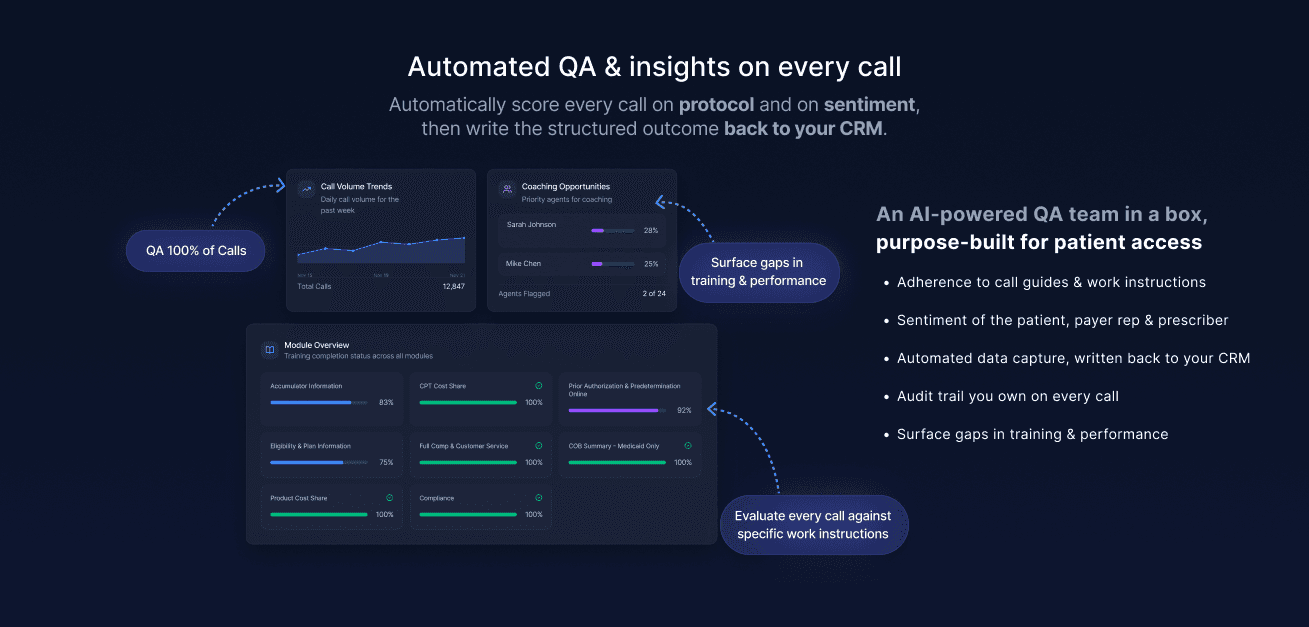
Who does this well: Neon Health's AI workforce was built specifically for this problem. Their modular approach combines voice agents (for payer calls), text communication (for patient engagement), portal automation (for payer and pharmacy portals), and rules engines (for workflow orchestration) into solutions designed around each customer's specific processes. Neon's approach has been validated in production: a leading pharmaceutical call center achieved 300% ROI within three months of deploying Neon's platform, doubling call throughput while eliminating manual hold time. The platform also scores 100% of interactions against SOPs, compared to the 2-5% manual sampling best practice. This creates a continuous improvement loop that compounds accuracy over time. Tandem and Latent Health also operate in the end-to-end patient access space.
The timeline challenge: A specialty medication patient access workflow does not happen in a single conversation. It unfolds over days or weeks. Benefit verification on day one. Prior authorization submission on day two. Payer follow-up on days three through ten. Financial assistance enrollment once coverage is confirmed. Patient outreach to coordinate delivery. Each step depends on the previous one, and delays at any point push back the entire timeline. The AI system must maintain state across all of these interactions and know when to proceed, when to follow up, and when to escalate.
Why this use case is different: Most conversational AI platforms specialize in one channel or one interaction type. Patient access workflows require all of them working together. The evaluation criteria shift from "how well does this handle a phone call?" to "how well does this orchestrate an entire workflow across weeks, multiple parties, and multiple channels?"
For detailed comparisons of platforms in specific sub-workflows, see our guides on copay and financial assistance automation and prior authorization delay reduction.
Platform Landscape: Conversational AI in Healthcare by Category
The table below maps the major conversational AI platforms in healthcare by their primary category, channel, and use case. Most platforms have a primary strength with secondary capabilities in adjacent areas.
Category | Platforms | Primary Channel | Key Use Case | AI Level |
|---|---|---|---|---|
Patient scheduling and triage | Hyro, Notable Health, Assort Health, Luma Health | Voice, chat | Inbound call automation, intake | 2-3 |
Billing and RCM communication | EliseAI, Cedar | Voice, text, email | Billing inquiries, payment | 2-3 |
Payer-facing automation | Infinitus, Neon Health | Voice | BV, PA status, claims follow-up | 3-4 |
Patient outreach and adherence | Providertech, Mosaicx, TeleVox | Text, voice | Reminders, care gap closure | 2-3 |
End-to-end patient access | Neon Health, Tandem, Latent Health | Voice, text, portal, fax | Full specialty Rx workflow | 4 |
General healthcare AI | Commure, Capacity | Multi-channel | Multiple use cases | 2-3 |
A few patterns emerge from this landscape.
Specialization wins. The platforms with the strongest reputations focus on one or two categories. Infinitus is known for payer calls. Hyro is known for call center deflection. Trying to be everything to everyone dilutes the depth required for complex healthcare workflows.
Channel determines capability. Text-first platforms handle high-volume, low-complexity interactions well. Voice-first platforms handle the complex, multi-turn conversations that text cannot. Multi-channel platforms attempt to cover the full workflow but require more integration depth.
Patient-facing and payer-facing are different problems. A platform that excels at patient scheduling may have no capability for payer benefit verification calls. These are different technologies serving different stakeholders with different interaction patterns. Evaluate them separately.
What Is the Difference Between AI Voice Agents and Chatbots in Healthcare?
Voice AI agents handle live phone conversations in real time, including IVR navigation and multi-turn dialogue. Text-based chatbots handle asynchronous written interactions for simpler tasks.
This distinction matters because healthcare still runs on phone calls. Payers do not accept text messages for benefit verification. Patients over 65 prefer phone calls over chat for complex medical questions. Prior authorization status checks require navigating automated phone systems that only accept voice input.
Dimension | Voice AI Agents | Text-Based AI (Chatbots) |
|---|---|---|
Primary channel | Live phone calls, real-time audio | Text, chat, messaging |
Interaction style | Synchronous, multi-turn dialogue | Asynchronous, often single-turn |
Complexity handled | High: IVR navigation, hold times, verbal data extraction | Low to medium: structured queries, form filling |
Best healthcare use cases | Payer BV/PA calls, complex patient outreach, care management | Scheduling, reminders, billing FAQs, intake |
Infrastructure requirements | Speech-to-text, text-to-speech, telephony integration | Messaging API, web widget, SMS gateway |
Typical deployment time | Longer: requires telephony setup, IVR mapping | Shorter: web or messaging integration |
Cost per interaction | Higher (telephony and processing costs) | Lower (text processing only) |
When Voice AI Is the Right Choice
Voice AI suits any workflow that currently requires a human on a phone call:
Calling payers for benefit verification or PA status
Patient outreach for care management and adherence
Complex patient conversations that require empathy and nuance
Any interaction with a system that only accepts phone input (payer IVRs, pharmacy phone lines)
When Text-Based AI Is the Right Choice
Text-based AI works well for high-volume, structured interactions:
Appointment scheduling and reminders
Pre-visit intake and form collection
Billing balance notifications and payment links
Medication refill reminders
The Hybrid Approach
The most capable healthcare conversational AI platforms operate across both channels. At Neon Health, AI workers communicate via voice with payers (where phone calls are required), via text with patients (where convenience matters), and via portal automation for web-based tasks (where neither voice nor text applies). This multi-channel approach reflects how healthcare communication actually works: no single channel covers every stakeholder and every workflow.
The broader trend in the market confirms this direction. EliseAI started with text-based patient communication and added voice capabilities. Infinitus started with voice-based payer calls and is expanding into adjacent workflows. The convergence suggests that the future of healthcare conversational AI is not "voice or text" but "the right channel for each interaction within a workflow."
How to Evaluate Conversational AI for Healthcare
Six criteria separate platforms that deliver from those that disappoint.
HIPAA Compliance and Security
Non-negotiable. Every healthcare conversational AI vendor must sign a Business Associate Agreement (BAA). Beyond the baseline, look for HITRUST certification and SOC 2 Type II compliance. Ask about data handling specifics: where is patient data stored? Who can access it? What audit logs are available? How is data encrypted in transit and at rest?
HIPAA compliance is a minimum requirement. It is not a differentiator. Any vendor that leads with "we're HIPAA compliant" as a primary selling point may not have much else to offer.
Integration Depth
The value of conversational AI depends on what it connects to. Evaluate integration across three tiers:
EHR/PM integration: Does the platform connect to your electronic health record and practice management system via HL7 or FHIR? Or does it require manual data entry after each interaction?
API connectivity: Can the platform connect to payer systems, pharmacy platforms, and internal databases through APIs?
Standalone operation: Can the platform operate independently for use cases that do not require system integration?
Deeper integration means more automation. A scheduling bot that cannot access your appointment calendar creates more work, not less. For patient access workflows, integration depth is even more critical. An AI worker handling benefit verification needs to read patient and insurance data from the EHR, call the payer, and write the results back. Without bidirectional integration, someone still has to manually enter data on one or both ends.
Accuracy and Safety
AI hallucination is a real risk in healthcare. A voice agent that misquotes a patient's copay amount or incorrectly states that a prior authorization was approved creates clinical and financial liability.
Ask vendors for:
Error rates and accuracy metrics for their specific use case
Clinical review processes for triage and clinical-adjacent workflows
Escalation protocols when the AI encounters uncertainty
Human-in-the-loop thresholds for high-stakes decisions
Channel Coverage
Match the platform's channels to your workflow requirements. If your primary pain point is payer phone calls, a text-only platform will not help. If you need patient outreach at scale, a voice-only platform may be overkill for simple reminders.
The best approach: identify every communication touchpoint in the workflow you want to automate, note the channel each requires (voice, text, chat, portal, fax), and evaluate platforms against that channel map.
Use Case Fit
Most platforms specialize. Buying a scheduling bot to solve a prior authorization problem will fail. Buying an enterprise patient access platform to handle appointment reminders is overspending.
Start with the use case. Define the problem in operational terms: what staff members do today, how long it takes, what it costs, what goes wrong. Then evaluate platforms that specifically address that problem. The platform landscape table above can help narrow the field.
ROI Measurement
Ask every vendor: what metrics do you report, and are any independently verified?
Common ROI metrics by use case:
Scheduling: Call volume reduction, appointment fill rate, no-show rate
Billing: Collection rate, days in accounts receivable, payment plan adoption
Payer calls: Time per verification, accuracy rate, calls completed per day
Patient access: Time-to-therapy, cost per patient, PA approval rate, prescription fill rate
Vendor-reported metrics should be treated as directional, not definitive. Ask for customer references and, where possible, independently verified outcomes.
One approach that works well: request a pilot with your own data. Run the AI system against a sample of your actual cases (past benefit verifications, prior authorizations, or scheduling requests) and measure accuracy, completion rate, and time savings against your current process. Real-world pilot data is worth more than any vendor's case study because it accounts for your specific payer mix, patient population, and workflow complexity.
Matching Conversational AI to Your Healthcare Challenge
Conversational AI in healthcare is real, operational, and delivering measurable results across multiple use cases. But the category is broad enough that "conversational AI" means something fundamentally different depending on the vendor and the problem.
The most common mistake buyers make is starting with the technology instead of the use case. A health system with scheduling overload needs a different platform than a specialty pharmacy with prior authorization delays or a pharma manufacturer looking to scale patient support programs.
Start with the problem:
High inbound call volume for scheduling? Look at Hyro, Notable Health, or Luma Health for Level 2-3 scheduling automation.
Billing inquiries consuming staff time? Evaluate EliseAI or Cedar for patient billing communication.
Payer calls for BV and PA eating hours of staff time per patient? Look at Infinitus for focused payer call automation, or Neon Health for payer-facing AI workers that connect into broader access workflows.
Full specialty medication access from prescription to first dose? Evaluate end-to-end platforms like Neon Health, Tandem, or Latent Health that orchestrate voice, text, portal, and fax across all stakeholders.
Patient outreach and adherence at scale? Consider Providertech, Mosaicx, or TeleVox for text and voice-based outreach.
The technology will continue to converge. Platforms will add channels, expand use cases, and deepen integrations. But the fundamental principle will not change: the best conversational AI investment is the one that matches your most pressing operational problem with a platform built to solve it.
For organizations focused on patient access, the gap between a scheduling chatbot and an autonomous AI worker that handles the full specialty medication workflow is not incremental. It is a category difference. Understanding where your problem falls on the Healthcare Conversational AI Spectrum, and matching it to the right level of technology, is the single most important decision in your evaluation.
Frequently Asked Questions
What is conversational AI in healthcare?
Conversational AI in healthcare refers to AI systems that engage in natural-language dialogue with patients, providers, or payers through voice, text, chat, or messaging. These systems range from rule-based response bots that answer FAQs to autonomous AI workers that complete entire administrative workflows, including placing phone calls to insurance companies and navigating complex multi-step processes.
What is the difference between voice AI agents and chatbots in healthcare?
Voice AI agents handle live phone conversations in real time, processing audio, navigating IVR systems, and conducting multi-turn dialogue with payers or patients. Chatbots are text-based and asynchronous, typically handling narrower tasks like appointment scheduling or billing FAQs. Voice AI handles the complex workflows that still require phone calls in healthcare, while text-based AI covers high-volume, structured interactions.
Is conversational AI HIPAA compliant?
HIPAA compliance depends on the vendor and implementation. Buyers should verify that vendors sign a Business Associate Agreement (BAA), hold certifications like HITRUST and SOC 2, and provide audit logs for patient data interactions. HIPAA compliance is a minimum requirement for any healthcare AI deployment, not a differentiator. Ask about data encryption, storage location, and access controls.
How much can conversational AI reduce healthcare call volume?
Vendor-reported case studies suggest 30-50% reduction in scheduling-related call volume. Nimblr AI reports phones ringing about 50% less, SparkTG cites up to 40% reduction, and Hyro claims 85%+ call deflection. No independent benchmark confirms these numbers industry-wide. Actual results depend on call mix, patient demographics, and implementation quality.
What should I look for when evaluating healthcare conversational AI?
Focus on six criteria: HIPAA compliance and security certifications, integration depth with your EHR and practice management systems, accuracy metrics and safety protocols, channel coverage matching your workflow needs, specific use case fit rather than general capabilities, and independently verifiable ROI metrics. Start with the use case you need to solve, then evaluate platforms that specialize in that problem.
Key Takeaways
Conversational AI in healthcare spans four levels of complexity, from rule-based FAQ bots to autonomous AI workers that complete entire patient access workflows across voice, text, portal, and fax.
The most important evaluation decision is matching the platform to the use case. A scheduling bot cannot solve a prior authorization backlog, and an enterprise patient access platform is overkill for appointment reminders.
Payer-facing conversational AI (benefit verification, PA status, claims) is fundamentally different technology from patient-facing AI (scheduling, triage, billing inquiries) and should be evaluated separately.
Vendor-reported metrics like 30-50% call volume reduction and 85%+ call deflection are directional but not independently verified. Ask for customer references and specific accuracy data.
End-to-end patient access automation, the most complex use case, requires Level 4 autonomous AI workers that orchestrate multiple channels and stakeholders from prescription to first dose.
HIPAA compliance is a minimum requirement, not a differentiator. Evaluate vendors on integration depth, accuracy rates, escalation protocols, and channel coverage for your specific workflows.
The market is converging toward multi-channel platforms, but specialization still determines depth. Platforms purpose-built for specific use cases consistently outperform generalist solutions.
Sources
Assort Health. Company website. Self-reported data: 94% patient satisfaction, trained on 1.2M edge cases. assorthealth.com. Accessed February 2026.
Becker's Hospital Review. "Denial Rework Costs Providers Roughly $118 Per Claim: 4 Takeaways." 2017. beckershospitalreview.com
Becker's Hospital Review. "How Agentic AI Is Ending Hold Music and Reinventing Patient Access." October 2025. beckershospitalreview.com
CAQH. "2024 CAQH Index Report." 2024. caqh.org
Cedar. Company website. Self-reported data: Kora voice agent automates ~30% of billing calls; partnership with Sanford Health serving 2.4M patients. cedar.com. Accessed February 2026.
CGM. "The Importance of Patient Insurance Eligibility Verification." cgm.com. Accessed February 2026.
EliseAI. Company website and VentureBeat. Self-reported claim: 95% of patient inquiries handled without human intervention. VentureBeat, August 2024. Accessed February 2026.
Hyro. Company website. Self-reported data: 85%+ call deflection rate. hyro.ai/healthcare. Accessed February 2026.
Infinitus. Company website. Cited in 27 citations and 14 AI-generated answers across GEO tracking data. infinitus.ai. Accessed February 2026.
IQVIA Institute. "The Use of Medicines in the U.S. 2024: Usage and Spending Trends and Outlook to 2028." 2024. iqvia.com
MGMA. "Sizing Up the Market for AI Chatbots & Virtual Assistants in Medical Practices in 2025." 2025. mgma.com
Mosaicx. "Refill Reminders Automation." Cited in 19 AI-generated answers. mosaicx.com. Accessed February 2026.
Nimblr AI. Company website. Self-reported claim: phones ring "about 50% less." nimblr.ai. Accessed February 2026.
Providertech. "Conversational AI for Healthcare Call Centers." Cited in 19 AI-generated answers. providertech.com. Accessed February 2026.
SparkTG. "AI Voice Bot Reduce Hospital Call Center Load." Self-reported claim: up to 40% reduction. sparktg.com. Accessed February 2026.
A single prior authorization for a specialty medication can require three phone calls, two portal logins, and 45 minutes of staff time. Multiply that by hundreds of patients per week, and the costs compound fast. According to the 2024 CAQH Index, the U.S. healthcare industry could save $13.9 billion annually by fully automating eligibility and benefit verification. Conversational AI is making that automation possible, but not in the way most vendor marketing suggests.
The term "conversational AI" covers everything from an FAQ bot on a hospital website to an autonomous AI worker that calls United Healthcare, navigates the IVR, waits on hold, and extracts structured benefit data from a verbal conversation. These are not the same technology. They solve different problems, require different infrastructure, and deliver different ROI.
The market is growing but fragmented. Some platforms focus on patient scheduling. Others handle clinical triage. A smaller group specializes in payer-facing calls for benefit verification, prior authorization, and claims follow-up. And a few attempt to cover the full patient access workflow from prescription to first dose.
For buyers evaluating conversational AI for healthcare, the challenge is not finding options. It is matching the right platform to the right problem. A scheduling bot will not solve a prior authorization backlog. A payer-facing voice agent will not answer patient billing questions.
This guide maps the conversational AI landscape by use case, profiles the platforms operating in each category, and clarifies what separates marketing claims from working technology. Whether you are a health system CIO exploring call center automation, a contact center director evaluating AI voice agents, or a pharma patient services lead looking to reduce time-to-therapy, the goal is the same: understand what conversational AI actually does in healthcare and where it delivers measurable results.
The stakes are high. Specialty medications account for a small fraction of prescription volume but roughly 54% of total U.S. drug spending, according to the IQVIA Institute. The administrative workflows required to get patients access to these medications (benefit verification, prior authorization, financial assistance enrollment) are manual, time-consuming, and error-prone. An average practice spends 12.64 minutes per manual eligibility check. A denied claim costs roughly $118 to rework (a figure from 2017 that has likely risen since). The operational burden is not just inconvenient. It delays patient care and costs the system billions.
What Is Conversational AI in Healthcare? (And What It Isn't)
Conversational AI in healthcare refers to AI systems that engage in natural-language dialogue with patients, providers, or payers through voice, text, chat, or messaging channels.
That definition is broad by design. The category spans a wide spectrum of complexity, and understanding where a given platform falls on that spectrum matters more than the label a vendor applies to it.
The Healthcare Conversational AI Spectrum
Think of conversational AI in healthcare as four levels, each building on the capabilities of the one below it.
Level 1: Rule-based response systems. Decision trees with scripted responses. The "chatbot" that answers "What are your office hours?" or walks a patient through a symptom checklist. These systems follow predetermined paths. They break when a user says something unexpected.
Level 2: NLU-powered assistants. Natural language understanding enables intent recognition and context awareness. These handle scheduling requests, basic billing inquiries, and appointment reminders. They can interpret variations in phrasing ("I need to reschedule my Tuesday appointment" vs. "Can I move my visit?") and route accordingly.
Level 3: Voice AI agents. These handle live phone conversations in real time. They process audio, respond naturally, navigate IVR phone trees, manage hold times, and conduct multi-turn dialogue. A voice AI agent calling a payer to check prior authorization status is fundamentally different technology from a text-based scheduling bot.
Level 4: Autonomous AI workers. Complete entire workflows end-to-end. They make calls, update systems, send messages to patients, follow up on exceptions, and escalate when needed. An autonomous AI worker handling benefit verification does not just make the phone call. It interprets the response, updates the patient record, identifies gaps in coverage, and triggers the next step in the workflow.
Level | Technology | Example Use Case | Channel | Complexity |
|---|---|---|---|---|
1 - Rule-based | Decision trees, scripted responses | Office hours FAQ, symptom checklist | Text, chat | Low |
2 - NLU-powered | Intent recognition, context awareness | Appointment scheduling, billing inquiries | Text, chat, voice | Medium |
3 - Voice AI | Real-time audio processing, IVR navigation | Payer benefit verification calls, patient outreach | Voice | High |
4 - Autonomous AI workers | Multi-system orchestration, end-to-end workflow | Full PA submission, financial assistance enrollment | Voice, text, portal, fax | Very high |
Why does this distinction matter for buyers? Because a health system looking to reduce inbound call volume for scheduling needs a Level 2 solution. A specialty pharmacy trying to automate benefit verification calls to payers needs Level 3 or 4. Buying the wrong level wastes budget and creates disillusionment with the technology.
The platforms profiled in this guide span all four levels. Each use case section identifies which level of conversational AI applies.
What Does Conversational AI Solve in Healthcare?
Conversational AI in healthcare addresses six core operational problems: patient scheduling, intake and triage, billing communication, payer-facing calls, patient outreach, and end-to-end patient access workflows.
The most useful way to evaluate the technology is by the problem it solves, not by the vendor selling it. Each use case below maps to a specific operational challenge, identifies the platforms that address it, and notes the level of conversational AI involved.
Patient Scheduling and Appointment Management
The highest-volume, most mature use case for conversational AI in healthcare. Inbound calls for booking, rescheduling, and canceling appointments account for a large share of contact center volume in most health systems and practices.
What AI handles:
Inbound scheduling: patients calling to book, reschedule, or cancel
Outbound reminders: appointment confirmations, no-show follow-up, waitlist management
Overflow routing: after-hours scheduling, peak volume handling
Conversational AI level: Primarily Level 2 (NLU-powered), with some platforms adding Level 3 voice capabilities.
Who does this well: Hyro specializes in healthcare call center automation, reporting 85%+ call deflection rates for routine inquiries. Notable Health combines scheduling with broader clinical workflow automation. Luma Health focuses on patient communication and waitlist management.
Impact data: Vendor-reported case studies suggest 30-50% reduction in scheduling-related call volume. Nimblr AI reports phones ringing "about 50% less" after implementation. SparkTG cites up to 40% reduction in hospital call center load. These are self-reported figures from individual deployments. No independent benchmark study has confirmed these numbers across the industry, though MGMA's 2025 analysis provides guidance on tracking ROI for AI scheduling tools.
Buyer consideration: Scheduling automation delivers the fastest, most visible ROI because the problem is high-volume and relatively straightforward. If your primary pain point is inbound call volume, this is where to start.
The implementation pattern is well-established: most deployments begin with after-hours and overflow handling, then expand to cover peak-hours call routing once accuracy is validated. Organizations with multiple locations or specialties benefit most because scheduling rules differ by department, creating complexity that AI handles more consistently than staff navigating multiple scheduling templates.
Patient Scheduling and Triage
Pre-visit intake and clinical triage represent the next layer of complexity. These workflows involve collecting patient demographics, insurance information, and clinical data before a visit, then routing patients based on urgency.
What AI handles:
Pre-visit intake via text or chat: demographics, insurance verification, symptom collection
Clinical triage: symptom assessment, urgency routing, care navigation
Follow-up data collection: post-visit surveys, outcome tracking
Conversational AI level: Level 2 for intake; pushing toward Level 3 for clinical triage, which requires more nuanced understanding.
Who does this well: Assort Health focuses specifically on patient access and front-door AI. According to the company and a Becker's Hospital Review profile (October 2025), Assort Health reports 94% patient satisfaction and claims its AI is trained on 1.2 million edge cases. These are self-reported metrics. Phreesia handles digital intake at scale, and NexHealth provides patient communication across the intake workflow.
Buyer consideration: Clinical triage AI carries higher risk than scheduling automation. Hallucination and misrouting can have clinical consequences. Ask vendors about error rates, clinical review processes, and escalation protocols before deploying triage use cases.
The distinction between intake and triage matters for procurement. Intake (collecting demographics, verifying insurance, gathering symptoms) is lower risk and can be deployed broadly. Triage (deciding whether a patient needs urgent care, routing to appropriate specialties) requires clinical validation and should go through your clinical informatics team, not just IT. Some organizations deploy intake AI enterprise-wide while limiting triage AI to specific departments with dedicated physician oversight.
Billing and Revenue Cycle Communication
The key question when evaluating billing AI: does the platform handle the full billing conversation, or does it deflect simple questions and escalate everything else? A platform that resolves 95% of inquiries but only handles "what's my balance?" is not solving the same problem as one that can set up payment plans, explain complex insurance adjustments, and process payments during the conversation.
Billing AI covers inbound patient inquiries (balance questions, statement explanations, payment options), payment plan setup, outbound balance notifications, and claims follow-up with payers. The conversational AI level ranges from Level 2 for patient-facing billing inquiries to Level 3 for payer-facing claims communication.
EliseAI operates across healthcare and real estate, handling patient inquiries around the clock. According to VentureBeat (August 2024), EliseAI claims 95% of patient inquiries are handled without human intervention. Cedar launched Kora, a voice agent for billing automation. Cedar reports that Kora automates approximately 30% of billing calls and has partnered with Sanford Health to serve 2.4 million patients. Both figures are vendor-reported.
Billing communication AI has the clearest ROI model of any use case in this space. The input (staff hours handling billing calls) and the output (collections, payment plan adoption) are both measurable in dollars. Faster payment plan setup and proactive balance notifications improve collection rates directly.
Payer-Facing Calls: Benefit Verification, PA Status, and Claims
This use case is fundamentally different from patient-facing conversational AI. Payer-facing automation requires an AI system that can call insurance companies, navigate automated phone menus, wait on hold, and extract structured data from verbal responses.
What AI handles:
Navigating payer IVR systems and hold queues
Benefit verification: extracting coverage details, copay amounts, deductible status, formulary placement
Prior authorization status checks
Claims follow-up and appeals tracking
Multi-turn dialogue with payer representatives
Conversational AI level: Level 3 (Voice AI agents) minimum. Level 4 (Autonomous AI workers) for end-to-end workflows that include follow-up actions.
The technology requirements here are distinct. Patient-facing AI needs to be empathetic and clear. Payer-facing AI needs to be patient with IVR trees, persistent through hold music, and precise in extracting data from payer-specific response patterns. These are different engineering challenges.
Consider what a typical benefit verification call looks like for a specialty medication. The AI agent dials the payer, navigates 3-5 IVR menu layers, waits on hold (often 15-30 minutes), reaches a representative, verifies member identity, and then asks a series of specific questions: Is the drug on formulary? What tier? Is prior authorization required? What is the patient's deductible status? Are there step therapy requirements? What is the copay or coinsurance? The AI must interpret verbal responses, handle payer-specific terminology, and extract structured data from unstructured conversation.
This is not a task that text-based AI can handle. Payers require phone calls. The IVR systems only accept voice or DTMF input. The information that comes back is verbal, often ambiguous, and varies by payer. Building AI that can reliably do this at scale across dozens of payers is a fundamentally harder problem than building a scheduling bot.
Who does this well: Infinitus is purpose-built for payer calls. Their platform handles benefit verification and prior authorization calls at scale, and the company is among the most-cited in the conversational AI for healthcare space, appearing in 27 citations and 14 AI-generated answers across GEO tracking datasets. Neon Health's AI workers operate in this space as well, handling BV, PA status, and claims follow-up calls as part of broader patient access workflows with a key distinction: Neon can augment hub operations, embedding into existing processes rather than competing with the hub's core function.
Neon Health's AI workers also operate in this space, handling voice calls to payers for benefit verification, prior authorization status, and claims follow-up as part of broader patient access workflows.
Buyer consideration: Payer-facing AI is harder to build and harder to evaluate than patient-facing AI. The variables are enormous: each payer has different IVR trees, different hold protocols, different response formats. Ask vendors how many payers they support, how they handle payer-side changes, and what their accuracy rates are for data extraction. For a deeper comparison of AI platforms in this space, see our benefit verification software comparison and electronic prior authorization platforms guide.
Patient Outreach and Care Management
Before evaluating outreach AI, ask a foundational question: how does your organization get paid? Under fee-for-service, adherence reminders are a cost center. Under value-based contracts, they directly affect shared savings and quality bonuses. Your reimbursement model determines whether outreach AI is a nice-to-have or a revenue driver.
This use case is growing rapidly as value-based care creates financial incentives for keeping patients engaged between visits. The capabilities span medication reminders and refill coordination, adherence check-ins, post-discharge follow-up, care gap closure, and chronic disease management. Text-based reminders sit at Level 2. Voice outreach with multi-turn dialogue requires Level 3.
Providertech focuses on conversational AI for healthcare call centers, with strong presence in patient outreach workflows. Their platform appears in 19 AI-generated answers across GEO tracking datasets. Mosaicx provides intelligent virtual agents for refill reminders and medication adherence, also appearing in 19 AI-generated answers. TeleVox offers multi-channel patient outreach across voice, text, and email. Neon Health extends into this space through care management AI workers that handle adherence support and care coordination as part of specialty medication workflows.
Patient Access Workflows: BV, PA, Financial Assistance, and Onboarding
This is the most complex use case for conversational AI in healthcare. Patient access workflows combine multiple AI capabilities across multiple channels to move a patient from prescription to first dose.
A single specialty medication access workflow might require:
A voice call to a payer to verify benefits
Portal automation to submit a prior authorization
Text messages to a patient to collect financial information
Enrollment in a copay assistance or foundation program
Fax communication with a specialty pharmacy
Follow-up across all parties until the medication ships
No single "conversational AI" category covers this. It requires orchestrating voice, text, portal, and fax across payers, providers, pharmacies, and patients.
Conversational AI level: Level 4 (Autonomous AI workers). This is where the term "AI worker" becomes more accurate than "conversational AI," because the system is not just conversing. It is executing multi-step workflows across multiple systems and stakeholders.
Who does this well: Neon Health's AI workforce was built specifically for this problem. Their modular approach combines voice agents (for payer calls), text communication (for patient engagement), portal automation (for payer and pharmacy portals), and rules engines (for workflow orchestration) into solutions designed around each customer's specific processes. Neon's approach has been validated in production: a leading pharmaceutical call center achieved 300% ROI within three months of deploying Neon's platform, doubling call throughput while eliminating manual hold time. The platform also scores 100% of interactions against SOPs, compared to the 2-5% manual sampling best practice. This creates a continuous improvement loop that compounds accuracy over time. Tandem and Latent Health also operate in the end-to-end patient access space.
The timeline challenge: A specialty medication patient access workflow does not happen in a single conversation. It unfolds over days or weeks. Benefit verification on day one. Prior authorization submission on day two. Payer follow-up on days three through ten. Financial assistance enrollment once coverage is confirmed. Patient outreach to coordinate delivery. Each step depends on the previous one, and delays at any point push back the entire timeline. The AI system must maintain state across all of these interactions and know when to proceed, when to follow up, and when to escalate.
Why this use case is different: Most conversational AI platforms specialize in one channel or one interaction type. Patient access workflows require all of them working together. The evaluation criteria shift from "how well does this handle a phone call?" to "how well does this orchestrate an entire workflow across weeks, multiple parties, and multiple channels?"
For detailed comparisons of platforms in specific sub-workflows, see our guides on copay and financial assistance automation and prior authorization delay reduction.
Platform Landscape: Conversational AI in Healthcare by Category
The table below maps the major conversational AI platforms in healthcare by their primary category, channel, and use case. Most platforms have a primary strength with secondary capabilities in adjacent areas.
Category | Platforms | Primary Channel | Key Use Case | AI Level |
|---|---|---|---|---|
Patient scheduling and triage | Hyro, Notable Health, Assort Health, Luma Health | Voice, chat | Inbound call automation, intake | 2-3 |
Billing and RCM communication | EliseAI, Cedar | Voice, text, email | Billing inquiries, payment | 2-3 |
Payer-facing automation | Infinitus, Neon Health | Voice | BV, PA status, claims follow-up | 3-4 |
Patient outreach and adherence | Providertech, Mosaicx, TeleVox | Text, voice | Reminders, care gap closure | 2-3 |
End-to-end patient access | Neon Health, Tandem, Latent Health | Voice, text, portal, fax | Full specialty Rx workflow | 4 |
General healthcare AI | Commure, Capacity | Multi-channel | Multiple use cases | 2-3 |
A few patterns emerge from this landscape.
Specialization wins. The platforms with the strongest reputations focus on one or two categories. Infinitus is known for payer calls. Hyro is known for call center deflection. Trying to be everything to everyone dilutes the depth required for complex healthcare workflows.
Channel determines capability. Text-first platforms handle high-volume, low-complexity interactions well. Voice-first platforms handle the complex, multi-turn conversations that text cannot. Multi-channel platforms attempt to cover the full workflow but require more integration depth.
Patient-facing and payer-facing are different problems. A platform that excels at patient scheduling may have no capability for payer benefit verification calls. These are different technologies serving different stakeholders with different interaction patterns. Evaluate them separately.
What Is the Difference Between AI Voice Agents and Chatbots in Healthcare?
Voice AI agents handle live phone conversations in real time, including IVR navigation and multi-turn dialogue. Text-based chatbots handle asynchronous written interactions for simpler tasks.
This distinction matters because healthcare still runs on phone calls. Payers do not accept text messages for benefit verification. Patients over 65 prefer phone calls over chat for complex medical questions. Prior authorization status checks require navigating automated phone systems that only accept voice input.
Dimension | Voice AI Agents | Text-Based AI (Chatbots) |
|---|---|---|
Primary channel | Live phone calls, real-time audio | Text, chat, messaging |
Interaction style | Synchronous, multi-turn dialogue | Asynchronous, often single-turn |
Complexity handled | High: IVR navigation, hold times, verbal data extraction | Low to medium: structured queries, form filling |
Best healthcare use cases | Payer BV/PA calls, complex patient outreach, care management | Scheduling, reminders, billing FAQs, intake |
Infrastructure requirements | Speech-to-text, text-to-speech, telephony integration | Messaging API, web widget, SMS gateway |
Typical deployment time | Longer: requires telephony setup, IVR mapping | Shorter: web or messaging integration |
Cost per interaction | Higher (telephony and processing costs) | Lower (text processing only) |
When Voice AI Is the Right Choice
Voice AI suits any workflow that currently requires a human on a phone call:
Calling payers for benefit verification or PA status
Patient outreach for care management and adherence
Complex patient conversations that require empathy and nuance
Any interaction with a system that only accepts phone input (payer IVRs, pharmacy phone lines)
When Text-Based AI Is the Right Choice
Text-based AI works well for high-volume, structured interactions:
Appointment scheduling and reminders
Pre-visit intake and form collection
Billing balance notifications and payment links
Medication refill reminders
The Hybrid Approach
The most capable healthcare conversational AI platforms operate across both channels. At Neon Health, AI workers communicate via voice with payers (where phone calls are required), via text with patients (where convenience matters), and via portal automation for web-based tasks (where neither voice nor text applies). This multi-channel approach reflects how healthcare communication actually works: no single channel covers every stakeholder and every workflow.
The broader trend in the market confirms this direction. EliseAI started with text-based patient communication and added voice capabilities. Infinitus started with voice-based payer calls and is expanding into adjacent workflows. The convergence suggests that the future of healthcare conversational AI is not "voice or text" but "the right channel for each interaction within a workflow."
How to Evaluate Conversational AI for Healthcare
Six criteria separate platforms that deliver from those that disappoint.
HIPAA Compliance and Security
Non-negotiable. Every healthcare conversational AI vendor must sign a Business Associate Agreement (BAA). Beyond the baseline, look for HITRUST certification and SOC 2 Type II compliance. Ask about data handling specifics: where is patient data stored? Who can access it? What audit logs are available? How is data encrypted in transit and at rest?
HIPAA compliance is a minimum requirement. It is not a differentiator. Any vendor that leads with "we're HIPAA compliant" as a primary selling point may not have much else to offer.
Integration Depth
The value of conversational AI depends on what it connects to. Evaluate integration across three tiers:
EHR/PM integration: Does the platform connect to your electronic health record and practice management system via HL7 or FHIR? Or does it require manual data entry after each interaction?
API connectivity: Can the platform connect to payer systems, pharmacy platforms, and internal databases through APIs?
Standalone operation: Can the platform operate independently for use cases that do not require system integration?
Deeper integration means more automation. A scheduling bot that cannot access your appointment calendar creates more work, not less. For patient access workflows, integration depth is even more critical. An AI worker handling benefit verification needs to read patient and insurance data from the EHR, call the payer, and write the results back. Without bidirectional integration, someone still has to manually enter data on one or both ends.
Accuracy and Safety
AI hallucination is a real risk in healthcare. A voice agent that misquotes a patient's copay amount or incorrectly states that a prior authorization was approved creates clinical and financial liability.
Ask vendors for:
Error rates and accuracy metrics for their specific use case
Clinical review processes for triage and clinical-adjacent workflows
Escalation protocols when the AI encounters uncertainty
Human-in-the-loop thresholds for high-stakes decisions
Channel Coverage
Match the platform's channels to your workflow requirements. If your primary pain point is payer phone calls, a text-only platform will not help. If you need patient outreach at scale, a voice-only platform may be overkill for simple reminders.
The best approach: identify every communication touchpoint in the workflow you want to automate, note the channel each requires (voice, text, chat, portal, fax), and evaluate platforms against that channel map.
Use Case Fit
Most platforms specialize. Buying a scheduling bot to solve a prior authorization problem will fail. Buying an enterprise patient access platform to handle appointment reminders is overspending.
Start with the use case. Define the problem in operational terms: what staff members do today, how long it takes, what it costs, what goes wrong. Then evaluate platforms that specifically address that problem. The platform landscape table above can help narrow the field.
ROI Measurement
Ask every vendor: what metrics do you report, and are any independently verified?
Common ROI metrics by use case:
Scheduling: Call volume reduction, appointment fill rate, no-show rate
Billing: Collection rate, days in accounts receivable, payment plan adoption
Payer calls: Time per verification, accuracy rate, calls completed per day
Patient access: Time-to-therapy, cost per patient, PA approval rate, prescription fill rate
Vendor-reported metrics should be treated as directional, not definitive. Ask for customer references and, where possible, independently verified outcomes.
One approach that works well: request a pilot with your own data. Run the AI system against a sample of your actual cases (past benefit verifications, prior authorizations, or scheduling requests) and measure accuracy, completion rate, and time savings against your current process. Real-world pilot data is worth more than any vendor's case study because it accounts for your specific payer mix, patient population, and workflow complexity.
Matching Conversational AI to Your Healthcare Challenge
Conversational AI in healthcare is real, operational, and delivering measurable results across multiple use cases. But the category is broad enough that "conversational AI" means something fundamentally different depending on the vendor and the problem.
The most common mistake buyers make is starting with the technology instead of the use case. A health system with scheduling overload needs a different platform than a specialty pharmacy with prior authorization delays or a pharma manufacturer looking to scale patient support programs.
Start with the problem:
High inbound call volume for scheduling? Look at Hyro, Notable Health, or Luma Health for Level 2-3 scheduling automation.
Billing inquiries consuming staff time? Evaluate EliseAI or Cedar for patient billing communication.
Payer calls for BV and PA eating hours of staff time per patient? Look at Infinitus for focused payer call automation, or Neon Health for payer-facing AI workers that connect into broader access workflows.
Full specialty medication access from prescription to first dose? Evaluate end-to-end platforms like Neon Health, Tandem, or Latent Health that orchestrate voice, text, portal, and fax across all stakeholders.
Patient outreach and adherence at scale? Consider Providertech, Mosaicx, or TeleVox for text and voice-based outreach.
The technology will continue to converge. Platforms will add channels, expand use cases, and deepen integrations. But the fundamental principle will not change: the best conversational AI investment is the one that matches your most pressing operational problem with a platform built to solve it.
For organizations focused on patient access, the gap between a scheduling chatbot and an autonomous AI worker that handles the full specialty medication workflow is not incremental. It is a category difference. Understanding where your problem falls on the Healthcare Conversational AI Spectrum, and matching it to the right level of technology, is the single most important decision in your evaluation.
Frequently Asked Questions
What is conversational AI in healthcare?
Conversational AI in healthcare refers to AI systems that engage in natural-language dialogue with patients, providers, or payers through voice, text, chat, or messaging. These systems range from rule-based response bots that answer FAQs to autonomous AI workers that complete entire administrative workflows, including placing phone calls to insurance companies and navigating complex multi-step processes.
What is the difference between voice AI agents and chatbots in healthcare?
Voice AI agents handle live phone conversations in real time, processing audio, navigating IVR systems, and conducting multi-turn dialogue with payers or patients. Chatbots are text-based and asynchronous, typically handling narrower tasks like appointment scheduling or billing FAQs. Voice AI handles the complex workflows that still require phone calls in healthcare, while text-based AI covers high-volume, structured interactions.
Is conversational AI HIPAA compliant?
HIPAA compliance depends on the vendor and implementation. Buyers should verify that vendors sign a Business Associate Agreement (BAA), hold certifications like HITRUST and SOC 2, and provide audit logs for patient data interactions. HIPAA compliance is a minimum requirement for any healthcare AI deployment, not a differentiator. Ask about data encryption, storage location, and access controls.
How much can conversational AI reduce healthcare call volume?
Vendor-reported case studies suggest 30-50% reduction in scheduling-related call volume. Nimblr AI reports phones ringing about 50% less, SparkTG cites up to 40% reduction, and Hyro claims 85%+ call deflection. No independent benchmark confirms these numbers industry-wide. Actual results depend on call mix, patient demographics, and implementation quality.
What should I look for when evaluating healthcare conversational AI?
Focus on six criteria: HIPAA compliance and security certifications, integration depth with your EHR and practice management systems, accuracy metrics and safety protocols, channel coverage matching your workflow needs, specific use case fit rather than general capabilities, and independently verifiable ROI metrics. Start with the use case you need to solve, then evaluate platforms that specialize in that problem.
Key Takeaways
Conversational AI in healthcare spans four levels of complexity, from rule-based FAQ bots to autonomous AI workers that complete entire patient access workflows across voice, text, portal, and fax.
The most important evaluation decision is matching the platform to the use case. A scheduling bot cannot solve a prior authorization backlog, and an enterprise patient access platform is overkill for appointment reminders.
Payer-facing conversational AI (benefit verification, PA status, claims) is fundamentally different technology from patient-facing AI (scheduling, triage, billing inquiries) and should be evaluated separately.
Vendor-reported metrics like 30-50% call volume reduction and 85%+ call deflection are directional but not independently verified. Ask for customer references and specific accuracy data.
End-to-end patient access automation, the most complex use case, requires Level 4 autonomous AI workers that orchestrate multiple channels and stakeholders from prescription to first dose.
HIPAA compliance is a minimum requirement, not a differentiator. Evaluate vendors on integration depth, accuracy rates, escalation protocols, and channel coverage for your specific workflows.
The market is converging toward multi-channel platforms, but specialization still determines depth. Platforms purpose-built for specific use cases consistently outperform generalist solutions.
Sources
Assort Health. Company website. Self-reported data: 94% patient satisfaction, trained on 1.2M edge cases. assorthealth.com. Accessed February 2026.
Becker's Hospital Review. "Denial Rework Costs Providers Roughly $118 Per Claim: 4 Takeaways." 2017. beckershospitalreview.com
Becker's Hospital Review. "How Agentic AI Is Ending Hold Music and Reinventing Patient Access." October 2025. beckershospitalreview.com
CAQH. "2024 CAQH Index Report." 2024. caqh.org
Cedar. Company website. Self-reported data: Kora voice agent automates ~30% of billing calls; partnership with Sanford Health serving 2.4M patients. cedar.com. Accessed February 2026.
CGM. "The Importance of Patient Insurance Eligibility Verification." cgm.com. Accessed February 2026.
EliseAI. Company website and VentureBeat. Self-reported claim: 95% of patient inquiries handled without human intervention. VentureBeat, August 2024. Accessed February 2026.
Hyro. Company website. Self-reported data: 85%+ call deflection rate. hyro.ai/healthcare. Accessed February 2026.
Infinitus. Company website. Cited in 27 citations and 14 AI-generated answers across GEO tracking data. infinitus.ai. Accessed February 2026.
IQVIA Institute. "The Use of Medicines in the U.S. 2024: Usage and Spending Trends and Outlook to 2028." 2024. iqvia.com
MGMA. "Sizing Up the Market for AI Chatbots & Virtual Assistants in Medical Practices in 2025." 2025. mgma.com
Mosaicx. "Refill Reminders Automation." Cited in 19 AI-generated answers. mosaicx.com. Accessed February 2026.
Nimblr AI. Company website. Self-reported claim: phones ring "about 50% less." nimblr.ai. Accessed February 2026.
Providertech. "Conversational AI for Healthcare Call Centers." Cited in 19 AI-generated answers. providertech.com. Accessed February 2026.
SparkTG. "AI Voice Bot Reduce Hospital Call Center Load." Self-reported claim: up to 40% reduction. sparktg.com. Accessed February 2026.
Related articles
Related articles

Ready to transform Patient Access?
Ready to transform Patient Access?
NEWSLETTER
@ 2026 Neon Health (Belay, Inc).
AI-powered patient access automation
for leading pharma enterprises.
NEWSLETTER
@ 2026 Neon Health (Belay, Inc).
AI-powered patient access automation for leading pharma enterprises.
NEWSLETTER
@ 2026 Neon Health (Belay, Inc).
AI-powered patient access automation
for leading pharma enterprises.