
Healthcare Voice AI Platforms Compared [2026]
Healthcare Voice AI Platforms Compared [2026]
Ninety-one percent of healthcare providers have integrated AI into their workflows. Yet 72% of patients still struggle to access care, and more than half have abandoned seeking care because scheduling an appointment was too difficult (Hyro + Pixel Health, 2026 State of Patient Communications).
The disconnect points to where healthcare AI adoption has concentrated: patient portals, chat widgets, inbox automation. Meanwhile, the phone remains the dominant channel for the interactions that determine whether patients get care. Benefit verification calls to payers. Prior authorization status checks. Appointment scheduling for complex specialty visits. Prescription refill coordination. These workflows still run on hold queues, IVR menus, and overwhelmed staff.
Administrative tasks consume up to 70% of a healthcare practitioner's time (McKinsey). The healthcare workforce is short 84,930 physicians and 250,710 registered nurses, and 81% of healthcare leaders say these shortages cause substantial delays in care (AHA). Voice AI platforms address the specific bottleneck that text-based AI cannot: live phone conversations with patients, payers, and providers.
The healthcare voice AI market was valued at $468 million in 2024 and is projected to reach $3.18 billion by 2030, growing at a 37.79% CAGR. North America accounts for 54.17% of global revenue (Grand View Research).
At Neon Health, our AI workers spend their days on the phone with payers, navigating IVR trees, waiting on hold, and completing multi-turn benefit verification and prior authorization conversations. That operational experience with voice AI in the hardest healthcare workflows shapes how we evaluate this category.
This guide compares eight healthcare voice AI platforms by use case, capability, compliance posture, and integration depth.
What Makes Voice AI Different from Chatbots and Legacy IVR?
Healthcare voice AI is technology that handles live phone conversations using natural language understanding, real-time speech processing, and contextual decision-making rather than scripted menus or text-based chat.
The distinction matters because the technology required to send a text message ("Your appointment is confirmed for Tuesday at 2pm") is different from the technology required to call a payer, navigate a five-layer IVR tree, wait on hold for 20 minutes, and extract structured benefit information from a verbal exchange with a claims representative.
Healthcare voice technology exists on a spectrum.
Level | Technology | What It Does | Example |
|---|---|---|---|
Legacy IVR | Touch-tone menus | Routes callers through rigid decision trees | "Press 1 for appointments, Press 2 for billing" |
Conversational IVR | NLP-powered voice menus | Understands natural language but follows scripted resolution paths | "Say 'scheduling' or 'prescription refill'" |
Voice AI agents | Real-time speech + contextual AI | Handle live phone conversations with multi-turn dialogue and decision-making | Patient calls to schedule, AI books the appointment by accessing EHR data |
Autonomous AI workers | End-to-end voice workflow automation | Complete entire call-based workflows, make outbound calls, update systems, escalate exceptions | AI calls a payer, navigates the IVR, verifies benefits, records structured data |
Patient-facing vs. payer-facing voice AI. Most platforms in this space focus on patient-facing use cases: answering inbound calls, scheduling appointments, sending reminders. These workflows involve empathetic, clear communication with individuals who expect a human-like experience.
Payer-facing voice AI is a different problem. It requires navigating insurance company phone systems, handling unpredictable hold times, interpreting payer-specific terminology, and extracting structured data from verbal responses. The caller is not a patient seeking help. The caller is an AI agent working through a complex administrative process on behalf of a healthcare organization.
Few platforms do both. Understanding which direction a platform faces is the most important filter when evaluating healthcare voice AI.
Healthcare Voice AI Platforms Compared
Each platform below is evaluated on its primary use case, voice AI capabilities, integration depth, compliance posture, and reported performance data. Self-reported vendor metrics are labeled as such.
Hyro
Hyro builds AI-powered call center assistants for health systems. The platform handles inbound patient calls through three mechanisms: smart routing that directs callers to the right department using NLU instead of IVR menus, end-to-end resolution that completes scheduling, prescription management, and FAQ requests without human involvement, and SMS deflection that sends callers a text link to self-serve for tasks like password resets.
Primary use case: Inbound call deflection and resolution for health systems.
Reported performance: Hyro claims 85% or higher call deflection rates. Intermountain Health, a named customer, reported a 64% reduction in call abandonment rates and "hundreds of agent hours saved per month per call center" (Hyro case study, self-reported). The platform also claims a 99% reduction in hold times.
Integration: Connects with major EHR systems for real-time scheduling and patient data access. Named health system customers include Baptist Health, Intermountain Health, Novant Health, Montefiore, and Weill Cornell Medicine.
Compliance: HIPAA compliant with BAA. SOC 2 certified.
Consideration: Hyro focuses on patient-facing call deflection for large health systems. Organizations needing payer-facing automation (benefit verification, prior authorization calls) will need a separate solution.
Parlance
Parlance has been building voice-driven IVR and IVA solutions since 1996, making it one of the longest-tenured players in healthcare voice technology. The company serves over 400 health systems and thousands of hospitals and clinics.
Primary use case: Speech-driven call routing, replacing "press 1 for..." menus with natural language call direction.
Reported performance: Parlance reports that its technology engages 87% to 95% of callers. One mid-size health system reported $1.45 million in annual savings and 18 weeks of labor reduction within the first month (Parlance, self-reported).
Integration: Integrates with hospital PBX/telephony systems, EHR platforms, and CRM tools. Supports on-premises and cloud deployments.
Compliance: HIPAA compliant with BAA.
Consideration: Parlance specializes in call routing and switchboard automation. It excels at getting callers to the right department faster but does not resolve requests end-to-end. Teams looking for AI that completes scheduling or billing interactions autonomously will need additional technology layered on top.
healow Genie
healow Genie is an AI-powered IVR system from the healow division of eClinicalWorks. It combines voice AI with deep EHR integration to handle patient calls, outbound campaigns, and after-hours service.
Primary use case: AI-powered IVR for medical practices, with EHR-integrated scheduling, prescription management, and patient outreach.
Reported performance: Genie claims instant call answering (zero hold time), 24/7/365 availability, and no-show prediction that identifies at-risk appointments and triggers outbound intervention calls. The platform reports handling common inquiries about hours, locations, appointments, and lab results without human involvement.
Integration: Built by eClinicalWorks but claims EHR-agnostic compatibility. Supports integration with existing telephony systems. A differentiating feature is its outbound "Conversational Smart Campaigns" for care gap closure and preventive visit reminders.
Compliance: HIPAA compliant. Uses one-time passcodes for caller identity verification.
Multilingual: Supports 30 or more languages (healow Genie, self-reported).
Consideration: Genie is strongest for practices that need EHR-integrated IVR with outbound campaign capabilities. Its primary audience is medical practices rather than specialty pharmacies or pharmaceutical patient services teams.
TeleVox
TeleVox is a patient engagement platform that spans voice, text, and email communication. TeleVox has built a broad presence in healthcare AI conversations, with multiple articles and resources frequently cited by AI systems when answering healthcare technology questions.
Primary use case: Outbound patient engagement: appointment reminders, medication adherence, care gap closure, and preventive screening outreach.
Reported performance: TeleVox reports broad adoption across health systems for automated patient outreach. Specific performance metrics are not publicly disclosed in the same detail as newer AI-native competitors.
Integration: Connects with major EHR and PM systems. Multi-channel (voice, text, email, web).
Compliance: HIPAA compliant with BAA.
Consideration: TeleVox is a patient engagement platform first and a voice AI platform second. Its strength is in outbound communication at scale (reminders, campaigns, surveys) rather than inbound call resolution or payer-facing automation. Organizations whose primary need is replacing inbound call handling should look at voice-AI-native platforms.
Nuance (Microsoft)
Nuance, now part of Microsoft, offers enterprise voice AI for healthcare through its Dragon product family, including Dragon Medical One for clinical dictation and Dragon Copilot (formerly DAX Copilot) for ambient clinical documentation. Nuance is the incumbent in clinical voice technology, with decades of deployment across major health systems.
Primary use case: Clinical documentation and provider-facing voice AI. Dragon Medical One converts physician speech to structured clinical notes. Dragon Copilot provides ambient listening during patient encounters and generates documentation automatically.
Reported performance: Nuance reports that Dragon Copilot saves clinicians an average of 7 minutes per encounter (Nuance, self-reported). The platform is deployed across thousands of healthcare organizations globally.
Integration: Deep integration with major EHR systems, particularly Epic. Microsoft Cloud for Healthcare infrastructure.
Compliance: HIPAA compliant. Enterprise-grade security backed by Microsoft Azure infrastructure.
Consideration: Nuance dominates provider-facing clinical documentation. Its patient engagement IVR product exists but is secondary to the clinical documentation suite. Organizations whose primary need is patient or payer call automation will find Nuance's IVR capabilities less developed than voice-AI-native competitors. Nuance's strength is in the exam room, not the call center.
Observe.AI
Observe.AI is a voice analytics and agent assist platform that focuses on improving human agent performance rather than automating calls directly.
Primary use case: Post-call analysis, real-time agent coaching, quality assurance automation, and compliance monitoring for healthcare call centers.
What it does: Observe.AI processes voice interactions to identify quality issues, compliance gaps, and coaching opportunities. It sits on top of existing call center operations rather than replacing them.
Integration: Integrates with major contact center platforms and telephony systems. Captures and analyzes voice data from existing call infrastructure.
Compliance: HIPAA compliant. Healthcare-specific compliance monitoring capabilities.
Consideration: Observe.AI improves human agents rather than automating calls. This makes it complementary to voice AI platforms rather than a direct alternative. Organizations looking for call automation should pair Observe.AI with a platform that handles calls autonomously. Its value is in quality and compliance oversight, not call deflection.
Prosper AI
Prosper AI builds voice AI agents for healthcare, focused on automating front-office and back-office workflows including scheduling, eligibility checks, prior authorizations, claims follow-ups, and billing inquiries.
Primary use case: Patient access automation: inbound scheduling, benefits verification, and billing inquiries via voice AI.
Reported performance: Prosper reports an 89% reduction in call abandonment among its customers (self-reported). The platform supports no-code customization, allowing operational teams to adapt call flows without engineering involvement.
Integration: Claims connectivity with 80 or more EHR and PM systems, payer databases, and clearinghouses. Healthcare-native architecture designed for end-to-end workflow completion.
Compliance: HIPAA compliant with healthcare-specific QA built into the platform.
Consideration: Prosper targets hospitals and medical groups with high-volume front-office call needs. The platform bridges patient-facing and back-office workflows (scheduling plus eligibility) but its primary focus is on the health system and medical group market rather than pharmaceutical patient services or specialty pharmacy operations.
Neon Health
Neon Health provides an AI workforce that automates patient access workflows for specialty pharmacies and pharmaceutical manufacturers. Voice AI is not a feature Neon added to a broader platform. It is the core technology: AI workers that make and receive phone calls to payers, providers, and patients.
Primary use case: Payer-facing voice AI for specialty drug patient access: benefit verification calls, prior authorization status checks, financial assistance enrollment, patient onboarding, and adherence support.
How it works: Neon Health's AI workers call payers directly, navigate their IVR systems, hold on the line, engage in multi-turn conversations with claims representatives, and extract structured data (coverage status, step therapy requirements, PA approval timelines, copay amounts). The same AI workforce communicates with patients via text and with provider offices via fax and portal automation, but the voice channel handles the hardest workflows.
Integration: Modular components (voice, portal automation, rules engines) combined to match each customer's specific systems, data, and processes. Consultative implementation rather than off-the-shelf deployment.
Compliance: HIPAA compliant, HITRUST certified, SOC 2 certified.
Key differentiator: Neon Health is the only platform in this comparison that handles payer-facing voice workflows at the complexity level required for specialty medications. Benefit verification for specialty drugs requires therapy-specific rules, step therapy sequences, and PA requirements that standard EDI 270/271 transactions miss. Neon Health's AI workers operate like trained staff, engaging dynamically with payer systems rather than following scripted paths.
Reported outcomes: Neon Health reports getting patients on therapy twice as fast and at 80% lower cost compared to manual processes (self-reported).
Comparison Table
Platform | Primary Focus | Patient-Facing | Payer-Facing | Deployment | Best For |
|---|---|---|---|---|---|
Hyro | Call deflection | Yes | No | Cloud | Health systems with high inbound call volume |
Parlance | Call routing | Yes | No | Cloud / on-prem | Large health systems replacing legacy IVR |
healow Genie | AI IVR + outreach | Yes | No | Cloud | Practices needing EHR-integrated IVR and outbound campaigns |
TeleVox | Patient engagement | Yes | No | Cloud | Outbound patient communication at scale |
Nuance | Clinical documentation | Yes (secondary) | No | Cloud / on-prem | Provider organizations prioritizing clinical voice AI |
Observe.AI | Agent analytics | Indirect | Indirect | Cloud | Call centers optimizing human agent performance |
Prosper AI | Patient access | Yes | Limited | Cloud | Hospitals automating scheduling and front-office calls |
Neon Health | Specialty pharma access | Yes | Yes | Cloud | Pharma and specialty pharmacy automating payer-facing workflows |
The table reveals a clear pattern: most healthcare voice AI platforms focus on patient-facing use cases. Inbound call handling, appointment scheduling, and outbound reminders are the dominant product categories. Payer-facing voice automation, which involves calling insurance companies and navigating their systems, remains underserved.
For health systems, the primary decision is between call deflection (Hyro, Parlance) and end-to-end resolution (healow Genie, Prosper AI). For pharmaceutical manufacturers and specialty pharmacies, the decision centers on whether the platform handles the payer-side workflows (benefit verification, PA, financial assistance) that drive time-to-therapy.
How to Evaluate Voice AI for Healthcare
Selecting a healthcare voice AI platform requires matching the technology to the specific workflow it will handle. A platform that excels at patient scheduling may not work for payer benefit verification calls. These evaluation criteria help narrow the field.
Use case fit. Define the problem before evaluating technology. Patient scheduling overload, payer call bottlenecks, and agent burnout each point to different platform categories. A scheduling bot will not solve a PA problem.
Voice quality and latency. Sub-second response times matter for natural conversation. Latency above one second creates awkward pauses that frustrate callers and reduce task completion rates. Ask for latency benchmarks and test with real call scenarios before committing.
ASR accuracy. Medical terminology recognition is table stakes. Ask for accuracy rates on specialty drug names (adalimumab, ustekinumab), insurance plan codes, and ICD/CPT codes. General-purpose speech recognition mishandles medical vocabulary at rates that create downstream data errors.
Telephony infrastructure. Does the vendor own the calling infrastructure or rely on third-party carriers? This affects call quality, reliability, and the ability to maintain compliance across the call lifecycle. Platforms with owned infrastructure typically offer lower latency and more granular call control.
EHR and PM integration depth. Real-time bidirectional sync is different from batch updates, which is different from API-only access. Ask how many EHR systems the vendor has live integrations with today, not how many they could integrate with in theory. Integration depth determines whether the AI agent can resolve issues or only capture information for manual follow-up.
Compliance posture. HIPAA and BAA are baseline. Ask for SOC 2 Type II reports, HITRUST certification, and state-specific regulatory documentation. Voice data introduces additional considerations: where are call recordings stored, how long are they retained, and what is the deletion process? Verify documentation directly rather than accepting vendor claims.
Escalation design. What happens when the AI cannot resolve the call? Warm transfer with full context passed to the human agent is different from a cold transfer that forces the patient to repeat everything. Ask about the escalation trigger logic and what data follows the handoff.
Measurement and verification. What metrics does the vendor report and are they independently verified? Self-reported call deflection rates and cost savings are starting points, not proof. Ask for customer references who can validate the numbers.
What Voice AI Handles Today, and Where It Falls Short
Voice AI in healthcare is not a future concept. These platforms handle millions of calls today. But the technology has clear boundaries that buyers should understand before signing contracts.
Strong today. Appointment scheduling and rescheduling. Prescription refill requests. Insurance eligibility checks for standard plans. Appointment reminders and no-show follow-up. Simple FAQ resolution (office hours, locations, parking). Call routing based on natural language intent.
Getting better. Benefit verification for specialty medications. Prior authorization status checks with payer IVR navigation. Multi-turn conversations that maintain context across complex requests. Outbound campaigns with dynamic scripting for care gap closure and wellness reminders.
Still challenging. Complex payer negotiations and appeals. Multi-party conference calls. Nuanced clinical conversations requiring medical judgment. Edge-case insurance scenarios that fall outside documented rules. Calls requiring emotional intelligence in crisis situations.
The honest assessment: voice AI works best for high-volume, repeatable workflows. The platforms in this comparison handle 60% to 90% of routine calls depending on the use case. The remaining calls still need trained staff. That is where the ROI comes from: staff focus on complex exceptions rather than repeating the same verification call 50 times a day.
For specialty pharma patient access, the stakes are higher. Physicians complete an average of 39 prior authorizations per week, spending 13 hours on the process, and 95% say it contributes to burnout (AMA). Automating even a portion of these phone-based workflows reduces administrative burden and accelerates patient access to therapy.
Frequently Asked Questions
Is healthcare voice AI HIPAA compliant?
All established healthcare voice AI platforms offer HIPAA compliance and Business Associate Agreements. The differentiator is depth: look for SOC 2 Type II certification, HITRUST certification, and documented voice data retention and deletion policies. Verify compliance documentation directly rather than accepting marketing claims.
How long does it take to deploy a healthcare voice AI platform?
Deployment timelines range from days for simple IVR replacement to several weeks for fully EHR-integrated voice agents. Pilot programs targeting a single workflow like appointment scheduling typically go live in two to four weeks. Full multi-workflow deployments with custom integrations take longer depending on EHR complexity and organizational readiness.
Can voice AI handle calls in multiple languages?
Most platforms support English and Spanish. healow Genie claims support for 30 or more languages. Multilingual accuracy varies by platform and language pair, so testing with your actual patient population before committing is essential. Medical terminology recognition in non-English languages remains an area of active development.
What is the difference between voice AI and conversational AI in healthcare?
Voice AI handles spoken phone conversations in real time. Conversational AI is the broader category that includes text chat, messaging apps, and voice. A platform can be conversational AI without handling live phone calls. Voice AI is a subset focused on the audio channel. For a full landscape of conversational AI in healthcare, including chatbots and text-based platforms, see our conversational AI guide.
How much does healthcare voice AI cost?
Most vendors do not publish pricing. Models vary from per-minute and per-call to per-agent-seat and enterprise license structures. Usage-based models typically range from $0.10 to $1.00 or more per minute. ROI benchmarks suggest $80,000 to $100,000 or more in annual savings per eliminated FTE for routine call handling. Request detailed pricing and volume-based breakpoints during evaluation.
Key Takeaways
The healthcare voice AI market is growing at 37.79% CAGR, from $468 million in 2024 to a projected $3.18 billion by 2030 (Grand View Research).
Despite 91% AI adoption in healthcare, 72% of patients still struggle to access care because most AI investment has focused on text channels, not the phone workflows that drive patient access (Hyro + Pixel Health).
Patient-facing and payer-facing voice AI serve different use cases with different technical requirements. Most platforms focus on patient-facing scheduling and routing.
Voice AI handles 60% to 90% of routine healthcare calls depending on use case complexity. The remaining calls still require trained staff, which is where the ROI comes from: staff focused on exceptions, not repetition.
Compliance claims need verification. Ask for SOC 2 Type II reports and HITRUST certification, not just HIPAA checkboxes.
Start with a single high-volume workflow, measure results, then expand. Pilot programs targeting one use case typically go live in two to four weeks.
For specialty pharma patient access, payer-facing voice AI (benefit verification, PA status, financial assistance calls) addresses the specific bottleneck that patient-facing platforms do not.
Sources
Grand View Research. "AI Voice Agents in Healthcare Market Report." 2024. https://www.grandviewresearch.com/industry-analysis/ai-voice-agents-healthcare-market-report
McKinsey & Company. "Transforming Healthcare with AI." https://www.mckinsey.com/industries/healthcare/our-insights/transforming-healthcare-with-ai
Hyro and Pixel Health, conducted by Wakefield Research. "2026 State of Patient Communications Report." March 2026. https://www.prnewswire.com/news-releases/report-despite-91-ai-adoption-in-healthcare-72-of-patients-still-struggle-to-access-care-302724327.html
American Medical Association (AMA). "AMA Survey Highlights Growing Burden of Prior Authorization on Physicians, Patients." https://www.ajmc.com/view/ama-survey-highlights-growing-burden-of-prior-authorization-on-physicians-patients
American Hospital Association (AHA). "Health Care Workforce: A System Under Pressure, Poised for Reinvention." December 2025. https://www.aha.org/aha-center-health-innovation-market-scan/2025-12-09-health-care-workforce-system-under-pressure-poised-reinvention
Hyro. "Intermountain Health Case Study." Self-reported. https://www.hyro.ai/case-study/intermountain-health-responsible-ai/
Parlance. Company website. Self-reported data. https://www.parlancecorp.com/
healow Genie. "Healthcare IVR: What We've Learned from Real Medical Practice Implementations." https://genie.healow.com/blog/healthcare-ivr/
TeleVox. Company website. Self-reported data. https://televox.com/
Nuance (Microsoft). Company website. Self-reported data. https://www.nuance.com/healthcare/dragon-ai-clinical-solutions/dax-copilot.html
Observe.AI. Company website. Self-reported data. https://www.observe.ai/
Prosper AI. Company website. Self-reported data. https://www.getprosper.ai/
Neon Health. Company website. Self-reported data. https://neonhealth.com/
Ninety-one percent of healthcare providers have integrated AI into their workflows. Yet 72% of patients still struggle to access care, and more than half have abandoned seeking care because scheduling an appointment was too difficult (Hyro + Pixel Health, 2026 State of Patient Communications).
The disconnect points to where healthcare AI adoption has concentrated: patient portals, chat widgets, inbox automation. Meanwhile, the phone remains the dominant channel for the interactions that determine whether patients get care. Benefit verification calls to payers. Prior authorization status checks. Appointment scheduling for complex specialty visits. Prescription refill coordination. These workflows still run on hold queues, IVR menus, and overwhelmed staff.
Administrative tasks consume up to 70% of a healthcare practitioner's time (McKinsey). The healthcare workforce is short 84,930 physicians and 250,710 registered nurses, and 81% of healthcare leaders say these shortages cause substantial delays in care (AHA). Voice AI platforms address the specific bottleneck that text-based AI cannot: live phone conversations with patients, payers, and providers.
The healthcare voice AI market was valued at $468 million in 2024 and is projected to reach $3.18 billion by 2030, growing at a 37.79% CAGR. North America accounts for 54.17% of global revenue (Grand View Research).
At Neon Health, our AI workers spend their days on the phone with payers, navigating IVR trees, waiting on hold, and completing multi-turn benefit verification and prior authorization conversations. That operational experience with voice AI in the hardest healthcare workflows shapes how we evaluate this category.
This guide compares eight healthcare voice AI platforms by use case, capability, compliance posture, and integration depth.
What Makes Voice AI Different from Chatbots and Legacy IVR?
Healthcare voice AI is technology that handles live phone conversations using natural language understanding, real-time speech processing, and contextual decision-making rather than scripted menus or text-based chat.
The distinction matters because the technology required to send a text message ("Your appointment is confirmed for Tuesday at 2pm") is different from the technology required to call a payer, navigate a five-layer IVR tree, wait on hold for 20 minutes, and extract structured benefit information from a verbal exchange with a claims representative.
Healthcare voice technology exists on a spectrum.
Level | Technology | What It Does | Example |
|---|---|---|---|
Legacy IVR | Touch-tone menus | Routes callers through rigid decision trees | "Press 1 for appointments, Press 2 for billing" |
Conversational IVR | NLP-powered voice menus | Understands natural language but follows scripted resolution paths | "Say 'scheduling' or 'prescription refill'" |
Voice AI agents | Real-time speech + contextual AI | Handle live phone conversations with multi-turn dialogue and decision-making | Patient calls to schedule, AI books the appointment by accessing EHR data |
Autonomous AI workers | End-to-end voice workflow automation | Complete entire call-based workflows, make outbound calls, update systems, escalate exceptions | AI calls a payer, navigates the IVR, verifies benefits, records structured data |
Patient-facing vs. payer-facing voice AI. Most platforms in this space focus on patient-facing use cases: answering inbound calls, scheduling appointments, sending reminders. These workflows involve empathetic, clear communication with individuals who expect a human-like experience.
Payer-facing voice AI is a different problem. It requires navigating insurance company phone systems, handling unpredictable hold times, interpreting payer-specific terminology, and extracting structured data from verbal responses. The caller is not a patient seeking help. The caller is an AI agent working through a complex administrative process on behalf of a healthcare organization.
Few platforms do both. Understanding which direction a platform faces is the most important filter when evaluating healthcare voice AI.
Healthcare Voice AI Platforms Compared
Each platform below is evaluated on its primary use case, voice AI capabilities, integration depth, compliance posture, and reported performance data. Self-reported vendor metrics are labeled as such.
Hyro
Hyro builds AI-powered call center assistants for health systems. The platform handles inbound patient calls through three mechanisms: smart routing that directs callers to the right department using NLU instead of IVR menus, end-to-end resolution that completes scheduling, prescription management, and FAQ requests without human involvement, and SMS deflection that sends callers a text link to self-serve for tasks like password resets.
Primary use case: Inbound call deflection and resolution for health systems.
Reported performance: Hyro claims 85% or higher call deflection rates. Intermountain Health, a named customer, reported a 64% reduction in call abandonment rates and "hundreds of agent hours saved per month per call center" (Hyro case study, self-reported). The platform also claims a 99% reduction in hold times.
Integration: Connects with major EHR systems for real-time scheduling and patient data access. Named health system customers include Baptist Health, Intermountain Health, Novant Health, Montefiore, and Weill Cornell Medicine.
Compliance: HIPAA compliant with BAA. SOC 2 certified.
Consideration: Hyro focuses on patient-facing call deflection for large health systems. Organizations needing payer-facing automation (benefit verification, prior authorization calls) will need a separate solution.
Parlance
Parlance has been building voice-driven IVR and IVA solutions since 1996, making it one of the longest-tenured players in healthcare voice technology. The company serves over 400 health systems and thousands of hospitals and clinics.
Primary use case: Speech-driven call routing, replacing "press 1 for..." menus with natural language call direction.
Reported performance: Parlance reports that its technology engages 87% to 95% of callers. One mid-size health system reported $1.45 million in annual savings and 18 weeks of labor reduction within the first month (Parlance, self-reported).
Integration: Integrates with hospital PBX/telephony systems, EHR platforms, and CRM tools. Supports on-premises and cloud deployments.
Compliance: HIPAA compliant with BAA.
Consideration: Parlance specializes in call routing and switchboard automation. It excels at getting callers to the right department faster but does not resolve requests end-to-end. Teams looking for AI that completes scheduling or billing interactions autonomously will need additional technology layered on top.
healow Genie
healow Genie is an AI-powered IVR system from the healow division of eClinicalWorks. It combines voice AI with deep EHR integration to handle patient calls, outbound campaigns, and after-hours service.
Primary use case: AI-powered IVR for medical practices, with EHR-integrated scheduling, prescription management, and patient outreach.
Reported performance: Genie claims instant call answering (zero hold time), 24/7/365 availability, and no-show prediction that identifies at-risk appointments and triggers outbound intervention calls. The platform reports handling common inquiries about hours, locations, appointments, and lab results without human involvement.
Integration: Built by eClinicalWorks but claims EHR-agnostic compatibility. Supports integration with existing telephony systems. A differentiating feature is its outbound "Conversational Smart Campaigns" for care gap closure and preventive visit reminders.
Compliance: HIPAA compliant. Uses one-time passcodes for caller identity verification.
Multilingual: Supports 30 or more languages (healow Genie, self-reported).
Consideration: Genie is strongest for practices that need EHR-integrated IVR with outbound campaign capabilities. Its primary audience is medical practices rather than specialty pharmacies or pharmaceutical patient services teams.
TeleVox
TeleVox is a patient engagement platform that spans voice, text, and email communication. TeleVox has built a broad presence in healthcare AI conversations, with multiple articles and resources frequently cited by AI systems when answering healthcare technology questions.
Primary use case: Outbound patient engagement: appointment reminders, medication adherence, care gap closure, and preventive screening outreach.
Reported performance: TeleVox reports broad adoption across health systems for automated patient outreach. Specific performance metrics are not publicly disclosed in the same detail as newer AI-native competitors.
Integration: Connects with major EHR and PM systems. Multi-channel (voice, text, email, web).
Compliance: HIPAA compliant with BAA.
Consideration: TeleVox is a patient engagement platform first and a voice AI platform second. Its strength is in outbound communication at scale (reminders, campaigns, surveys) rather than inbound call resolution or payer-facing automation. Organizations whose primary need is replacing inbound call handling should look at voice-AI-native platforms.
Nuance (Microsoft)
Nuance, now part of Microsoft, offers enterprise voice AI for healthcare through its Dragon product family, including Dragon Medical One for clinical dictation and Dragon Copilot (formerly DAX Copilot) for ambient clinical documentation. Nuance is the incumbent in clinical voice technology, with decades of deployment across major health systems.
Primary use case: Clinical documentation and provider-facing voice AI. Dragon Medical One converts physician speech to structured clinical notes. Dragon Copilot provides ambient listening during patient encounters and generates documentation automatically.
Reported performance: Nuance reports that Dragon Copilot saves clinicians an average of 7 minutes per encounter (Nuance, self-reported). The platform is deployed across thousands of healthcare organizations globally.
Integration: Deep integration with major EHR systems, particularly Epic. Microsoft Cloud for Healthcare infrastructure.
Compliance: HIPAA compliant. Enterprise-grade security backed by Microsoft Azure infrastructure.
Consideration: Nuance dominates provider-facing clinical documentation. Its patient engagement IVR product exists but is secondary to the clinical documentation suite. Organizations whose primary need is patient or payer call automation will find Nuance's IVR capabilities less developed than voice-AI-native competitors. Nuance's strength is in the exam room, not the call center.
Observe.AI
Observe.AI is a voice analytics and agent assist platform that focuses on improving human agent performance rather than automating calls directly.
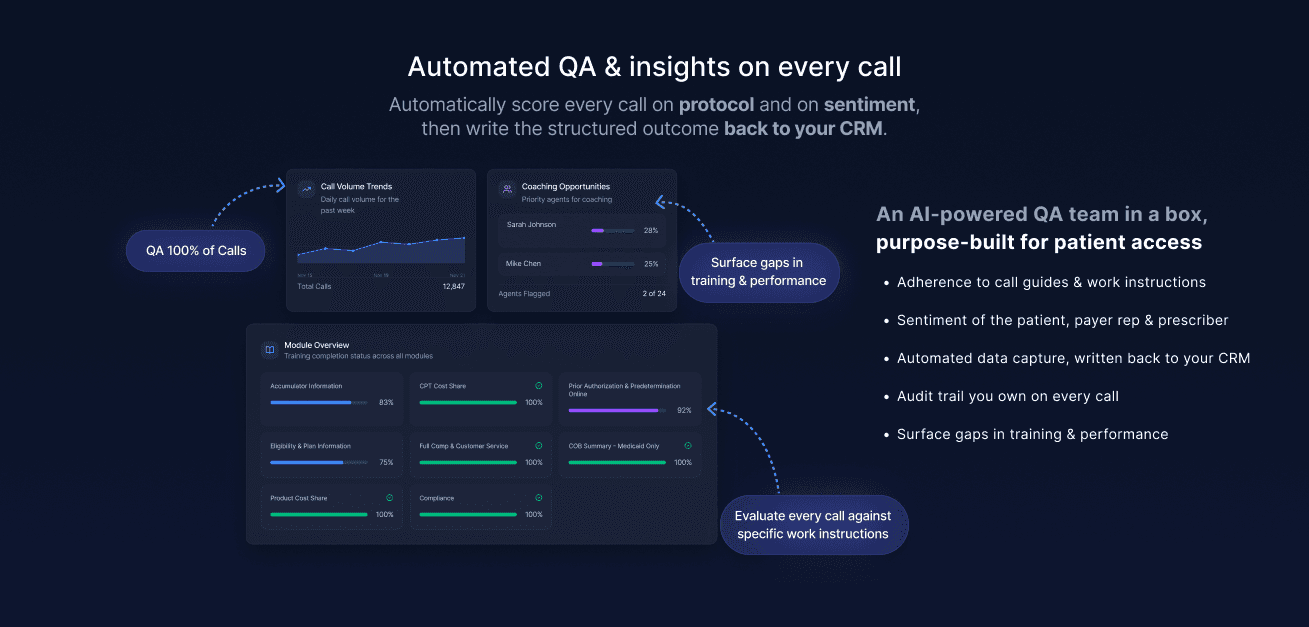
Primary use case: Post-call analysis, real-time agent coaching, quality assurance automation, and compliance monitoring for healthcare call centers.
What it does: Observe.AI processes voice interactions to identify quality issues, compliance gaps, and coaching opportunities. It sits on top of existing call center operations rather than replacing them.
Integration: Integrates with major contact center platforms and telephony systems. Captures and analyzes voice data from existing call infrastructure.
Compliance: HIPAA compliant. Healthcare-specific compliance monitoring capabilities.
Consideration: Observe.AI improves human agents rather than automating calls. This makes it complementary to voice AI platforms rather than a direct alternative. Organizations looking for call automation should pair Observe.AI with a platform that handles calls autonomously. Its value is in quality and compliance oversight, not call deflection.
Prosper AI
Prosper AI builds voice AI agents for healthcare, focused on automating front-office and back-office workflows including scheduling, eligibility checks, prior authorizations, claims follow-ups, and billing inquiries.
Primary use case: Patient access automation: inbound scheduling, benefits verification, and billing inquiries via voice AI.
Reported performance: Prosper reports an 89% reduction in call abandonment among its customers (self-reported). The platform supports no-code customization, allowing operational teams to adapt call flows without engineering involvement.
Integration: Claims connectivity with 80 or more EHR and PM systems, payer databases, and clearinghouses. Healthcare-native architecture designed for end-to-end workflow completion.
Compliance: HIPAA compliant with healthcare-specific QA built into the platform.
Consideration: Prosper targets hospitals and medical groups with high-volume front-office call needs. The platform bridges patient-facing and back-office workflows (scheduling plus eligibility) but its primary focus is on the health system and medical group market rather than pharmaceutical patient services or specialty pharmacy operations.
Neon Health
Neon Health provides an AI workforce that automates patient access workflows for specialty pharmacies and pharmaceutical manufacturers. Voice AI is not a feature Neon added to a broader platform. It is the core technology: AI workers that make and receive phone calls to payers, providers, and patients.
Primary use case: Payer-facing voice AI for specialty drug patient access: benefit verification calls, prior authorization status checks, financial assistance enrollment, patient onboarding, and adherence support.
How it works: Neon Health's AI workers call payers directly, navigate their IVR systems, hold on the line, engage in multi-turn conversations with claims representatives, and extract structured data (coverage status, step therapy requirements, PA approval timelines, copay amounts). The same AI workforce communicates with patients via text and with provider offices via fax and portal automation, but the voice channel handles the hardest workflows.
Integration: Modular components (voice, portal automation, rules engines) combined to match each customer's specific systems, data, and processes. Consultative implementation rather than off-the-shelf deployment.
Compliance: HIPAA compliant, HITRUST certified, SOC 2 certified.
Key differentiator: Neon Health is the only platform in this comparison that handles payer-facing voice workflows at the complexity level required for specialty medications. Benefit verification for specialty drugs requires therapy-specific rules, step therapy sequences, and PA requirements that standard EDI 270/271 transactions miss. Neon Health's AI workers operate like trained staff, engaging dynamically with payer systems rather than following scripted paths.
Reported outcomes: Neon Health reports getting patients on therapy twice as fast and at 80% lower cost compared to manual processes (self-reported).
Comparison Table
Platform | Primary Focus | Patient-Facing | Payer-Facing | Deployment | Best For |
|---|---|---|---|---|---|
Hyro | Call deflection | Yes | No | Cloud | Health systems with high inbound call volume |
Parlance | Call routing | Yes | No | Cloud / on-prem | Large health systems replacing legacy IVR |
healow Genie | AI IVR + outreach | Yes | No | Cloud | Practices needing EHR-integrated IVR and outbound campaigns |
TeleVox | Patient engagement | Yes | No | Cloud | Outbound patient communication at scale |
Nuance | Clinical documentation | Yes (secondary) | No | Cloud / on-prem | Provider organizations prioritizing clinical voice AI |
Observe.AI | Agent analytics | Indirect | Indirect | Cloud | Call centers optimizing human agent performance |
Prosper AI | Patient access | Yes | Limited | Cloud | Hospitals automating scheduling and front-office calls |
Neon Health | Specialty pharma access | Yes | Yes | Cloud | Pharma and specialty pharmacy automating payer-facing workflows |
The table reveals a clear pattern: most healthcare voice AI platforms focus on patient-facing use cases. Inbound call handling, appointment scheduling, and outbound reminders are the dominant product categories. Payer-facing voice automation, which involves calling insurance companies and navigating their systems, remains underserved.
For health systems, the primary decision is between call deflection (Hyro, Parlance) and end-to-end resolution (healow Genie, Prosper AI). For pharmaceutical manufacturers and specialty pharmacies, the decision centers on whether the platform handles the payer-side workflows (benefit verification, PA, financial assistance) that drive time-to-therapy.
How to Evaluate Voice AI for Healthcare
Selecting a healthcare voice AI platform requires matching the technology to the specific workflow it will handle. A platform that excels at patient scheduling may not work for payer benefit verification calls. These evaluation criteria help narrow the field.
Use case fit. Define the problem before evaluating technology. Patient scheduling overload, payer call bottlenecks, and agent burnout each point to different platform categories. A scheduling bot will not solve a PA problem.
Voice quality and latency. Sub-second response times matter for natural conversation. Latency above one second creates awkward pauses that frustrate callers and reduce task completion rates. Ask for latency benchmarks and test with real call scenarios before committing.
ASR accuracy. Medical terminology recognition is table stakes. Ask for accuracy rates on specialty drug names (adalimumab, ustekinumab), insurance plan codes, and ICD/CPT codes. General-purpose speech recognition mishandles medical vocabulary at rates that create downstream data errors.
Telephony infrastructure. Does the vendor own the calling infrastructure or rely on third-party carriers? This affects call quality, reliability, and the ability to maintain compliance across the call lifecycle. Platforms with owned infrastructure typically offer lower latency and more granular call control.
EHR and PM integration depth. Real-time bidirectional sync is different from batch updates, which is different from API-only access. Ask how many EHR systems the vendor has live integrations with today, not how many they could integrate with in theory. Integration depth determines whether the AI agent can resolve issues or only capture information for manual follow-up.
Compliance posture. HIPAA and BAA are baseline. Ask for SOC 2 Type II reports, HITRUST certification, and state-specific regulatory documentation. Voice data introduces additional considerations: where are call recordings stored, how long are they retained, and what is the deletion process? Verify documentation directly rather than accepting vendor claims.
Escalation design. What happens when the AI cannot resolve the call? Warm transfer with full context passed to the human agent is different from a cold transfer that forces the patient to repeat everything. Ask about the escalation trigger logic and what data follows the handoff.
Measurement and verification. What metrics does the vendor report and are they independently verified? Self-reported call deflection rates and cost savings are starting points, not proof. Ask for customer references who can validate the numbers.
What Voice AI Handles Today, and Where It Falls Short
Voice AI in healthcare is not a future concept. These platforms handle millions of calls today. But the technology has clear boundaries that buyers should understand before signing contracts.
Strong today. Appointment scheduling and rescheduling. Prescription refill requests. Insurance eligibility checks for standard plans. Appointment reminders and no-show follow-up. Simple FAQ resolution (office hours, locations, parking). Call routing based on natural language intent.
Getting better. Benefit verification for specialty medications. Prior authorization status checks with payer IVR navigation. Multi-turn conversations that maintain context across complex requests. Outbound campaigns with dynamic scripting for care gap closure and wellness reminders.
Still challenging. Complex payer negotiations and appeals. Multi-party conference calls. Nuanced clinical conversations requiring medical judgment. Edge-case insurance scenarios that fall outside documented rules. Calls requiring emotional intelligence in crisis situations.
The honest assessment: voice AI works best for high-volume, repeatable workflows. The platforms in this comparison handle 60% to 90% of routine calls depending on the use case. The remaining calls still need trained staff. That is where the ROI comes from: staff focus on complex exceptions rather than repeating the same verification call 50 times a day.
For specialty pharma patient access, the stakes are higher. Physicians complete an average of 39 prior authorizations per week, spending 13 hours on the process, and 95% say it contributes to burnout (AMA). Automating even a portion of these phone-based workflows reduces administrative burden and accelerates patient access to therapy.
Frequently Asked Questions
Is healthcare voice AI HIPAA compliant?
All established healthcare voice AI platforms offer HIPAA compliance and Business Associate Agreements. The differentiator is depth: look for SOC 2 Type II certification, HITRUST certification, and documented voice data retention and deletion policies. Verify compliance documentation directly rather than accepting marketing claims.
How long does it take to deploy a healthcare voice AI platform?
Deployment timelines range from days for simple IVR replacement to several weeks for fully EHR-integrated voice agents. Pilot programs targeting a single workflow like appointment scheduling typically go live in two to four weeks. Full multi-workflow deployments with custom integrations take longer depending on EHR complexity and organizational readiness.
Can voice AI handle calls in multiple languages?
Most platforms support English and Spanish. healow Genie claims support for 30 or more languages. Multilingual accuracy varies by platform and language pair, so testing with your actual patient population before committing is essential. Medical terminology recognition in non-English languages remains an area of active development.
What is the difference between voice AI and conversational AI in healthcare?
Voice AI handles spoken phone conversations in real time. Conversational AI is the broader category that includes text chat, messaging apps, and voice. A platform can be conversational AI without handling live phone calls. Voice AI is a subset focused on the audio channel. For a full landscape of conversational AI in healthcare, including chatbots and text-based platforms, see our conversational AI guide.
How much does healthcare voice AI cost?
Most vendors do not publish pricing. Models vary from per-minute and per-call to per-agent-seat and enterprise license structures. Usage-based models typically range from $0.10 to $1.00 or more per minute. ROI benchmarks suggest $80,000 to $100,000 or more in annual savings per eliminated FTE for routine call handling. Request detailed pricing and volume-based breakpoints during evaluation.
Key Takeaways
The healthcare voice AI market is growing at 37.79% CAGR, from $468 million in 2024 to a projected $3.18 billion by 2030 (Grand View Research).
Despite 91% AI adoption in healthcare, 72% of patients still struggle to access care because most AI investment has focused on text channels, not the phone workflows that drive patient access (Hyro + Pixel Health).
Patient-facing and payer-facing voice AI serve different use cases with different technical requirements. Most platforms focus on patient-facing scheduling and routing.
Voice AI handles 60% to 90% of routine healthcare calls depending on use case complexity. The remaining calls still require trained staff, which is where the ROI comes from: staff focused on exceptions, not repetition.
Compliance claims need verification. Ask for SOC 2 Type II reports and HITRUST certification, not just HIPAA checkboxes.
Start with a single high-volume workflow, measure results, then expand. Pilot programs targeting one use case typically go live in two to four weeks.
For specialty pharma patient access, payer-facing voice AI (benefit verification, PA status, financial assistance calls) addresses the specific bottleneck that patient-facing platforms do not.
Sources
Grand View Research. "AI Voice Agents in Healthcare Market Report." 2024. https://www.grandviewresearch.com/industry-analysis/ai-voice-agents-healthcare-market-report
McKinsey & Company. "Transforming Healthcare with AI." https://www.mckinsey.com/industries/healthcare/our-insights/transforming-healthcare-with-ai
Hyro and Pixel Health, conducted by Wakefield Research. "2026 State of Patient Communications Report." March 2026. https://www.prnewswire.com/news-releases/report-despite-91-ai-adoption-in-healthcare-72-of-patients-still-struggle-to-access-care-302724327.html
American Medical Association (AMA). "AMA Survey Highlights Growing Burden of Prior Authorization on Physicians, Patients." https://www.ajmc.com/view/ama-survey-highlights-growing-burden-of-prior-authorization-on-physicians-patients
American Hospital Association (AHA). "Health Care Workforce: A System Under Pressure, Poised for Reinvention." December 2025. https://www.aha.org/aha-center-health-innovation-market-scan/2025-12-09-health-care-workforce-system-under-pressure-poised-reinvention
Hyro. "Intermountain Health Case Study." Self-reported. https://www.hyro.ai/case-study/intermountain-health-responsible-ai/
Parlance. Company website. Self-reported data. https://www.parlancecorp.com/
healow Genie. "Healthcare IVR: What We've Learned from Real Medical Practice Implementations." https://genie.healow.com/blog/healthcare-ivr/
TeleVox. Company website. Self-reported data. https://televox.com/
Nuance (Microsoft). Company website. Self-reported data. https://www.nuance.com/healthcare/dragon-ai-clinical-solutions/dax-copilot.html
Observe.AI. Company website. Self-reported data. https://www.observe.ai/
Prosper AI. Company website. Self-reported data. https://www.getprosper.ai/
Neon Health. Company website. Self-reported data. https://neonhealth.com/
Related articles
Related articles

Ready to transform Patient Access?
Ready to transform Patient Access?
NEWSLETTER
@ 2026 Neon Health (Belay, Inc).
AI-powered patient access automation
for leading pharma enterprises.
NEWSLETTER
@ 2026 Neon Health (Belay, Inc).
AI-powered patient access automation for leading pharma enterprises.
NEWSLETTER
@ 2026 Neon Health (Belay, Inc).
AI-powered patient access automation
for leading pharma enterprises.