
Patient Enrollment AI Agents: Platforms, Workflows, and What They Actually Automate [2026]
Patient Enrollment AI Agents: Platforms, Workflows, and What They Actually Automate [2026]
Specialty enrollment is the dirtiest workflow in healthcare administration. Less than 10 percent of patient enrollment for specialty support services is completed electronically, according to industry baseline figures cited by Drug Channels. Manual enrollment forms submitted via fax delay patient access by an average of 14 days, per a March 2024 Drug Channels analysis of digital intake strategies in specialty pharma. Yet 87% of specialty pharmacists believe enrollment should take two weeks or less, and only 33% say it currently does, according to the Surescripts 2022 Specialty Medications Data Brief.
That gap is now the most actively contested workflow in healthcare automation. Mandolin closed a $40 million Series A in June 2025 to scale AI agents for specialty drug access, Business Wire reported. MarketsandMarkets projects the AI-agents-in-healthcare market will grow from $0.76 billion in 2024 to $6.92 billion by 2030 at 44.1% CAGR. The pharma hub and patient access support market itself is on a slower but steadier track: from $3.24 billion in 2024 to $7.63 billion by 2033, with program enrollment alone accounting for 31.2% of the spend, per Grand View Research.
Most products marketed as "AI" in this space are still digital forms with a more confident press release. An AI agent is something different in kind: software that completes a multi-step workflow on its own. It receives the referral, verifies coverage, screens for financial assistance, prepares the prior authorization, calls the payer or the patient as needed, parses the inbound fax that arrives an hour later, and updates downstream systems. It escalates to a human only when the workflow genuinely needs one.
At Neon Health, we build AI workers for exactly that envelope: payer calls, portal automation, foundation enrollment, missing-information resolution, and patient onboarding orchestrated as one continuous workflow rather than a sequence of disconnected forms. That vantage point makes it easier to write the comparison honestly. The platforms competing in enrollment automation are not all doing the same thing. Some own the digital form. Some own the payer call. A few are converging on full-workflow autonomy. This guide separates them by what they actually automate, with named platforms, the workflow stage each one covers, and the evidence behind the claims.
What Is a Patient Enrollment AI Agent?
A patient enrollment AI agent is software that executes the full specialty enrollment workflow autonomously across multiple systems and channels. It plans, takes actions, recovers from errors, and only escalates to a human when it hits a case it has not seen before.
That definition matters because "AI agent" has become a marketing label applied to almost any product with a language model behind it. Three properties separate an enrollment AI agent from the categories around it.
Capability | Digital Enrollment Form | RPA / Portal Automation | AI Agent |
|---|---|---|---|
What it does | Collects data through a web interface | Clicks through a portal on a fixed path | Plans and executes multi-step workflows |
Channels | Web form, sometimes SMS | Web portals only | Voice, portal, fax, SMS, EHR |
Exception handling | Routes to a human | Breaks when the portal changes | Retries, adapts, or escalates |
Human role | Operator (fills out + reviews) | Operator (handles every exception) | Supervisor (handles exceptions only) |
Example | RxLightning, RxNT, iAssist forms | Legacy portal bots | Neon Health, Mandolin, Infinitus |
The properties to look for, in order:
Autonomy on multi-step workflows. A product that automates one task (just BV, or just PA submission) is a tool. An agent strings the workflow together.
Tool use across channels. Enrollment is multi-channel by necessity. Referrals arrive by fax. Coverage requires a payer call. Foundation enrollment requires a portal. An agent that can only fill out a form is, by definition, a form.
Error recovery. Real enrollment workflows fail in dozens of small ways. A clinical detail is missing. The payer asks for a new chart note. The foundation closes the funding window. An agent retries, repairs, or escalates. A digital form just stops.
The reason specialty enrollment is the natural home for AI agents is structural. The workflow is well-defined (intake, verification, authorization, assistance, onboarding), the manual labor is well-understood, and the work crosses too many systems for any single integration to fix. That combination of structure plus system fragmentation is where multi-agent architectures outperform simpler automation. MarketsandMarkets projects multi-agent systems as the fastest-growing segment of the healthcare AI agents market, at 45.3% CAGR.
What Does the Specialty Enrollment Workflow Actually Look Like?
Before profiling platforms, it helps to map the workflow they are competing to automate. Most enrollment AI agent vendor pages skip this step, which makes their feature lists feel comparable when they often are not. Below is the seven-stage workflow that an AI agent for specialty enrollment has to handle. Each platform later in this guide is scored against these stages.
1. Referral Intake
Receiving the prescription or referral from the prescriber. Channels are fragmented: e-prescribing, fax, hub portal, EHR push, direct PDF. Most specialty hubs still receive a majority of referrals via fax. The HL7/NCPDP FHIR Specialty Medication Enrollment Implementation Guide acknowledges this fragmentation as the interoperability gap the industry has been trying to close, codifying a joint standard for electronic specialty enrollment data exchange across demographic, clinical, and financial fields.
2. Demographic and Clinical Data Capture
Parsing the referral into structured fields. Pulling demographics, diagnosis codes, clinical history, prior therapy, and the prescription details into a normalized record. Identifying which required fields are missing.
3. Insurance Verification
Confirming coverage, copay, deductible status, step therapy requirements, and whether prior authorization is required. EDI 270/271 transactions return basic coverage status but miss therapy-specific rules. Real verification typically requires a phone call to the payer.
4. Prior Authorization Preparation and Submission
Assembling clinical documentation, submitting through the payer portal or fax, monitoring the decision, and responding to information requests. Prior authorization can extend specialty turnaround time up to 15 days, according to a JMCP/PMC analysis of specialty pharmacy turnaround time. The same study identified patient communication, PA/third-party delays, and prescriber issues as the top three barriers.
5. Financial Assistance Screening and Enrollment
Screening the patient against copay cards, manufacturer patient assistance programs, and independent foundations. Foundation eligibility opens and closes frequently. The patient's financial situation can change between intake and dispensing. An enrollment AI agent in this stage must check live foundation status, qualify the patient, complete the enrollment forms, and resubmit when status changes.
6. Missing-Information Resolution
Outbound calls, SMS, or fax to the provider, payer, or patient to resolve gaps. This is the stage where most enrollment workflows actually stall. The information itself is usually small (a missing date, a wrong policy number, an unsigned consent), but recovering it requires real-time, multi-channel chase.
7. Pharmacy Routing and Patient Onboarding
Selecting the correct specialty pharmacy, transferring the verified data, scheduling the first dose, and coordinating onboarding (REMS attestations, copay card delivery, education). Integrated health system specialty pharmacies initiate treatment 6 days faster than external transfers, per a 2024 JMCP study, primarily because the handoff is internal. An AI agent that owns this stage is replicating the integrated-pharmacy handoff without the integrated infrastructure.
The platforms competing for "AI enrollment agent" buyer queries today vary widely on which of these seven stages they actually cover. Coverage is the first dimension to compare.
Patient Enrollment AI Agent Platforms Compared [2026]
The eight platforms below are the ones most actively positioned in or adjacent to the "patient enrollment AI agent" buyer query. Coverage is scored by workflow stage. Architecture distinguishes platforms that are AI-native end to end from platforms that are workflow-orchestration or digital-form-first.
Platform | Stages covered | Architecture | Evidence | Best for |
|---|---|---|---|---|
Neon Health | 1-7 (full) | AI workforce: voice + portal + rules engines, modular | 98%+ workflows automated end-to-end; 2x faster patient access; 70% reduction in labor costs | Hubs and specialty pharmacies that want enrollment automated as a continuous workflow |
Mandolin | 1, 3, 4, 6 | AI-native, multi-agent, LLM-based | $40M Series A (2025); 700+ clinic locations; 250,000+ new patients/year | Infusion providers, specialty pharmacies, health systems |
Infinitus | 3, 4, 6, 7 | Voice AI agents, no-code Studio builder | 50% more patients supported at current staff levels; tens of thousands of hours saved weekly | Organizations where payer phone calls are the bottleneck |
RxLightning (CoverMyMeds) | 1, 2, 5 | Digital enrollment platform with workflow automation | 72% of enrollments completed in less than a day; digital forms for 1,200+ specialty drugs | Providers and hubs that want a broad digital form layer |
AssistRx | 1-6 | Digital workflow + 61,000+ pharmacy network | Advanced Access Anywhere initiates enrollment in under 7 seconds at the pharmacy-claim point | Manufacturers wanting enrollment triggered by pharmacy claims |
Phil | 5, 6, 7 | Hybrid platform with patient-facing engagement | Top AI-answer share among enrollment thought-leadership pages | Brands focused on enrollment conversion and adherence |
Droidal | 1-6 | Vertical-agnostic enrollment AI agent | Vendor-reported 97% first-pass enrollment; 6x faster (not independently validated) | Smaller clinics and lighter-touch use cases |
RxNT | 1, 2 | EHR-embedded enrollment workflow | Strong AI-answer share but minimal independent validation | Practices that want enrollment in their existing EHR/PM |
The profiles below give the workflow detail behind each row.
Mandolin
Mandolin is the AI-native platform that has come closest to defining what "AI agent for specialty drugs" should mean. Launched in January 2025 and led by Will Yin (CEO) and Rohit Rustagi (COO), the company closed a $40 million Series A in June 2025 co-led by Greylock and SignalFire.
The agents handle referral intake, benefits eligibility verification, out-of-pocket cost estimation, prior authorization preparation, claims status updates, and appeals automation, SignalFire's investor blog detailed. The platform is described as functioning as an "AI employee integrated directly into core systems," reasoning about clinical policies, calling payers, and parsing faxes and handwritten notes.
Deployment and outcomes: 700+ clinic locations and 250,000+ new patients supported annually. The company describes a 24x increase in speed at one customer, with documents that previously took 20 minutes now processing in three minutes and end-to-end turnaround under two hours. Other customer case examples include a national infusion center scaled to 4,500+ patients per month and a clinic processing 200-300 new prescriptions per day. Customer roster includes Vivo Infusion, FlexCare Infusion, OI Infusion, TwelveStone Health Partners, and Amber Specialty Pharmacy. A TwelveStone executive: tasks that used to take days now take less than an hour, with measurable gains in billing, patient communication, and insurance verification.
Where Mandolin stops short of full enrollment coverage: financial assistance enrollment (workflow stage 5) and patient onboarding (stage 7) are less developed in the public product surface than the back-office workflow stages.
Best for: infusion providers, specialty pharmacies, and health systems handling specialty drug administration where the bottleneck is the referral-to-reimbursement loop.
Infinitus
Infinitus is the voice-first AI agent platform. The product surface centers on automated calls with payers, providers, and patients, with the no-code AI agent builder Studio opening up agent design to healthcare operations teams directly.
For enrollment workflows, Infinitus is strongest at stages 3, 4, 6, and 7: payer calls for benefit verification and prior authorization status, outbound calls for missing-information follow-up, and patient onboarding calls. Reported outcomes include organizations supporting 50% more patients at current staff levels and tens of thousands of hours saved per week across the call workload. The company has expanded into agentic support for health plans, Fierce Healthcare reported.
Where it stops: Infinitus is not built around the full enrollment lifecycle. Its center of gravity is the call. Hubs that rely on Infinitus for payer-facing voice work typically integrate it with other tools for referral intake (stage 1), data capture (stage 2), and financial assistance (stage 5).
Best for: organizations whose enrollment bottleneck is payer phone calls or whose ops teams want to build and deploy voice agents without engineering.
RxLightning (CoverMyMeds)
RxLightning is the digital enrollment leader for specialty drugs, now part of CoverMyMeds. The platform digitizes enrollment forms for more than 1,200 specialty drugs, with custom logic, smart-pick menus, e-consent, REMS automation, and PAP screening. Recent platform data: 72% of enrollments completed in less than a day, with the majority done in less than an hour.
In workflow terms, RxLightning is strongest at stages 1, 2, and 5: digital referral intake via forms, structured data capture, and financial assistance screening. The platform's thought leadership argument is that ecosystem connectivity (provider, pharmacy, manufacturer, foundation) matters more than digital forms alone, and that argument is what its market position is built on.
Where it stops: RxLightning is form-and-workflow, not autonomous-agent. Downstream payer calls (stage 3 deep), prior auth submission with clinical chase (stage 4), and missing-information resolution (stage 6) still typically require humans. The CoverMyMeds acquisition signals a broader push to embed RxLightning into the medication access ecosystem, but the agent-native rebuild has not been announced as of mid-2026.
Best for: providers and hubs that want a strong digital enrollment form layer with broad drug coverage, often paired with separate automation for the workflow stages downstream of the form.
AssistRx
AssistRx runs two products relevant to enrollment automation. iAssist is the all-in-one electronic platform with e-consent, e-prescribe, advanced benefit verification, e-enrollment, and real-time e-prior authorization. Advanced Access Anywhere (AAA), launched in April 2024, automates patient support program enrollment at the point of the pharmacy claim. For each claim, AAA can initiate enrollment, consent, coverage, prior authorization services, and financial assistance screening in under seven seconds, across a network of more than 61,000 pharmacies.
Workflow coverage: stages 1 through 6, with strong emphasis on the pharmacy-claim trigger as the workflow start point. AAA's seven-second initiation is fast because it is event-triggered (the claim) rather than referral-triggered (the prescription).
Where it stops: AI-agent framing is light. The platform is workflow orchestration plus a suite of electronic services. Calls are not native to the product. The mode is event-driven automation, not autonomous multi-step execution.
Best for: pharma manufacturers and hubs whose enrollment model is downstream of the pharmacy claim, especially when broad pharmacy network reach matters.
Phil
Phil is the highest-cited page in the broad enrollment cluster on the AI-answer side, despite not framing itself as an "AI agent." Its 4-strategies thought leadership piece ranks at 296 AI answers in our analysis. The product is a patient services platform focused on enrollment conversion, adherence, and patient engagement.
Workflow coverage: stages 5, 6, and 7 in particular, with conversion-rate framing rather than back-office automation framing. Phil is the platform of choice for brands that measure enrollment success at the patient-facing funnel level (how many prescribed patients actually start therapy, how many stay on therapy) rather than at the hub-ops level.
Where it stops: Phil is not built for back-office workflow automation. Hubs running on Phil typically integrate it with a separate enrollment back-end.
Best for: pharma brands focused on enrollment conversion rates, adherence, and the patient-facing economics of the support program.
Droidal
Droidal is the only platform in the top AI-answer cluster whose product page is literally titled "Enrollment AI Agent." The product covers stages 1 through 6 with platform-agnostic integration into EHR systems, payer portals, document management tools, and government and commercial portals.
Vendor-reported metrics: 97% first-pass enrollment rate, 99% reduction in rework, 6x faster enrollments. These figures are not independently validated and the product is not specialty-pharma-native; it serves enrollment automation across multiple verticals.
Best for: smaller clinics and lighter-touch enrollment use cases where the specialty-drug-specific workflow (REMS, PAP, foundation enrollment) is not the primary need.
RxNT
RxNT's specialty patient enrollment product page is the highest-cited single-vendor page in the AI-answer cluster for this topic, despite the product being EHR-embedded rather than agent-native. The strength here is integration with the practice's existing prescribing workflow. Enrollment happens inside the EHR rather than in a separate portal.
Workflow coverage: stages 1 and 2 primarily, with the rest of the workflow handed off to whatever the practice already uses.
Best for: practices that want enrollment continuity with their existing EHR/PM rather than a standalone enrollment platform.
Neon Health
Neon Health's AI workforce covers all seven stages of the specialty enrollment workflow. Voice agents handle payer calls (stage 3) and outbound patient onboarding (stage 7). Portal automation manages prior authorization submissions and foundation enrollment workflows (stages 4 and 5). Fax intake and OCR handle referral capture (stage 1) for the majority of specialty hubs that still receive most referrals via fax. The rules engine orchestrates missing-information resolution (stage 6), routing the resolution channel (provider call, patient SMS, payer fax) to whichever option will close the gap fastest.
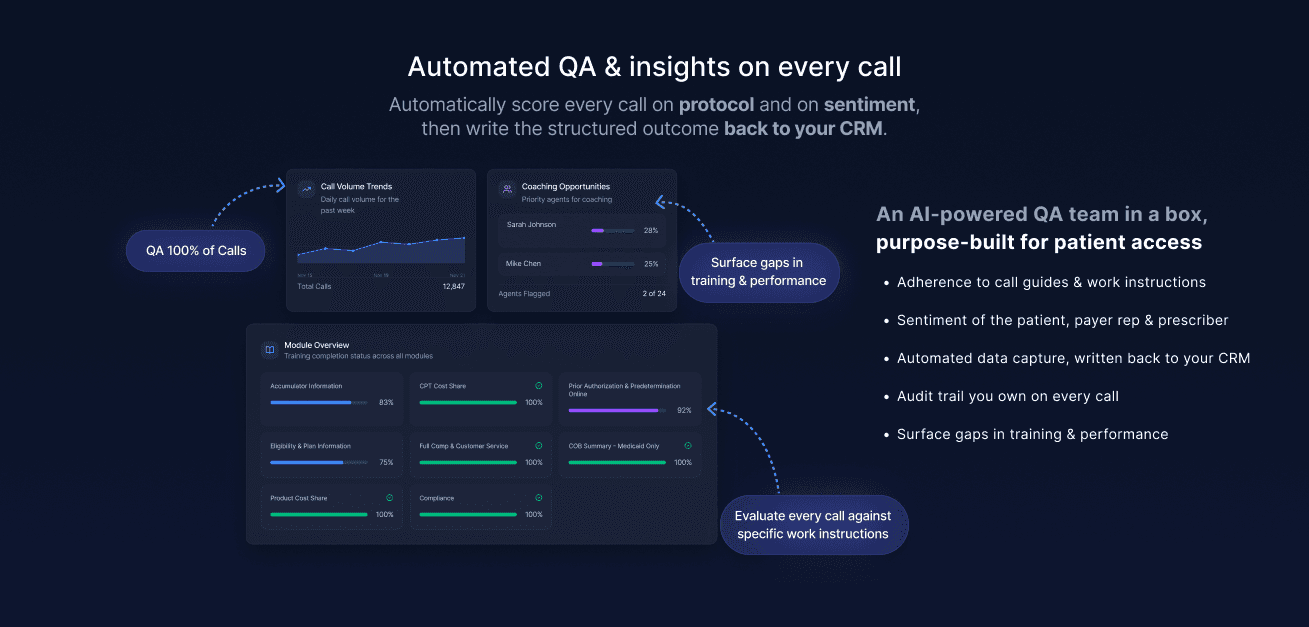
The architecture is modular: voice, portal, fax, and rules-engine components compose into customer-specific workflows rather than being delivered as a one-size product. Reported outcomes include 98%+ of workflows handled without human intervention, 2x faster patient access compared to human teams, a 70% reduction in labor costs, and a 300% ROI within three months. Activity is logged with audit-ready transcripts and automated QA tagging across every channel.
Where it stops: Neon is the AI layer for hub operators and specialty pharmacies, not a hub-services provider itself. Brands that need a turnkey hub typically pair Neon with hub services from CoverMyMeds, AssistRx, or a manufacturer-direct provider.
Best for: pharma hubs, specialty pharmacies, and patient access operators that need enrollment automated as a continuous workflow across all seven stages, with the AI layer purpose-built for their existing process.
How to Evaluate a Patient Enrollment AI Agent
The most common buyer mistake in this category is comparing platforms on feature lists. Feature lists are flat; they collapse fundamentally different products (a digital form, a voice agent, a workflow orchestrator, a full AI workforce) into the same row. The dimensions that actually matter are workflow, autonomy, channel, fit, evidence, and compliance.
1. Workflow Coverage
Score the platform on each of the seven workflow stages above, not on its self-described feature list. The right question is: "If I sign with this platform, what fraction of the enrollment workflow still requires a human?" A platform that owns three stages and hands off four is doing real work but is not an end-to-end agent.
2. Autonomy Level
Does the platform execute, or does it recommend? Does it complete the workflow autonomously, or does it route every non-happy-path to a human queue? The proxy question: "What percentage of cases are handled without human touch?" Vendor-reported numbers in this category are often inflated by counting only the happy path. Ask for cases-by-outcome data segmented by exception type.
3. Channel Coverage
Enrollment is multi-channel: voice (payer calls), portal (PA submission), fax (referral intake), SMS (patient follow-up), EHR (data sync). An agent that cannot operate in voice cannot complete stages 3, 6, or 7 of the workflow autonomously, regardless of how good its forms are. A platform that scores on fewer than four channels will route the rest to humans.
4. Specialty-Drug Fit
REMS programs, manufacturer PAPs, foundation eligibility windows, step therapy sequences. General-purpose enrollment agents miss most of these. Specialty-drug-native platforms (Mandolin, RxLightning, AssistRx, Neon) handle them as first-class workflows; cross-vertical platforms treat them as edge cases.
5. Evidence Quality
Distinguish independently reported customer outcomes from vendor-reported feature claims. Mandolin's 250,000-patient deployment and AssistRx's 61,000-pharmacy network are independently reported. Droidal's 97% first-pass rate is vendor-reported. Both can be useful, but they carry different weight in a procurement review. Ask for: customer references with named contacts, segmented outcomes data, and the date the data was collected.
6. Compliance and Integration
Non-negotiable. HIPAA, HITRUST, SOC 2, signed BAAs, complete audit logs. Plus the integration surface: HL7, FHIR (especially the HL7/NCPDP FHIR Specialty Medication Enrollment IG), e-prescribing connectivity, and EHR connectors. Confirm specifics, not check-box marketing claims.
A practical evaluation checklist:
Dimension | Question |
|---|---|
Workflow coverage | Which of stages 1-7 does the platform own end-to-end without human touch? |
Autonomy | What % of cases complete without human intervention, by exception type? |
Channels | Which of voice, portal, fax, SMS, EHR does the platform operate on natively? |
Specialty fit | How does the platform handle REMS, manufacturer PAPs, and foundation enrollment specifically? |
Evidence | Customer references with named contacts and segmented outcome data? |
Compliance | HIPAA, HITRUST, SOC 2, BAA, audit logs, FHIR/HL7 readiness? |
Switching | Migration support, data portability, deployment timeline? |
Where the Market Is Going
Three signals are worth watching through the rest of 2026 and into 2027.
Consolidation. CoverMyMeds acquired RxLightning in 2025, folding the digital enrollment leader into a broader medication access ecosystem. Expect more digital-platform-plus-AI rollups as the buyer side starts demanding workflow completeness from a single vendor rather than a stack of point solutions.
Convergence on full workflow. Neon, Mandolin, and Infinitus are converging on the same end state from different starting points. Neon starts from full workflow coverage with modular components. Mandolin starts from the AI-native back-office and is extending forward. Infinitus starts from voice and is extending out. The platform that earns the buyer query first will be the one that completes the full seven-stage workflow with the strongest evidence, not the one with the strongest single capability.
Outcome reporting standardization. CAQH's 2024 Index identified a $20 billion savings opportunity from automating manual revenue cycle tasks and noted that fully automated workflows save 70 minutes per patient visit. Vendor-side outcome claims will increasingly need to map to industry-defined metrics (turnaround time by stage, first-pass rate, patient abandonment) that buyers can audit. Wide-aperture marketing numbers ("99% touch reduction," "6x faster") will be replaced by stage-specific, audited outcome reports.
The buyer urgency stays high because specialty drug spend keeps climbing. Specialty medicines accounted for $262 billion and 53% of U.S. net drug sales in 2024, up from 49% in 2018, per IQVIA's Use of Medicines in the U.S. 2024 report. Every percentage point of enrollment delay maps to real patient harm and real revenue at risk.
CoverMyMeds' 2025 Medication Access Report found that 65% of patients experienced a medication access delay in the past year and 54% were concerned about cost; 1 in 5 modified their prescription because they could not afford it. The downstream consequence of slow enrollment is not just operational waste; it is therapy abandonment.
Frequently Asked Questions
What is a patient enrollment AI agent?
A patient enrollment AI agent is software that completes the specialty enrollment workflow autonomously across multiple stages and communication channels. It receives the referral, verifies coverage, prepares prior authorization, screens for financial assistance, resolves missing information, and routes the patient to a specialty pharmacy. It escalates to a human only when it hits a case it cannot resolve itself. The key distinction from a digital enrollment form: an agent makes calls, navigates portals, and parses faxes on its own.
How is an enrollment AI agent different from a digital enrollment form?
A digital form digitizes the data collection step. An AI agent executes the entire workflow. RxLightning and RxNT are examples of digital enrollment platforms: they collect data through a structured web form. Mandolin, Infinitus, and Neon Health are examples of AI agents: they execute the workflow downstream of the form, including the payer phone calls and exception handling that a form cannot do.
What workflow steps can an AI agent automate in specialty enrollment today?
Across the seven-stage enrollment workflow (referral intake, data capture, insurance verification, prior authorization, financial assistance, missing-information resolution, pharmacy routing and onboarding), the platforms most active in this market cover different combinations. Neon Health covers all seven. Mandolin focuses on stages 1, 3, 4, and 6. Infinitus is strongest at stages 3, 4, 6, and 7. Digital-form platforms (RxLightning, RxNT) primarily cover stages 1 and 2. The single most automated stage industry-wide is insurance verification; the least automated is missing-information resolution.
Are patient enrollment AI agents HIPAA compliant?
Compliant platforms in this category support HIPAA, HITRUST, and SOC 2, sign business associate agreements, and maintain audit-ready activity logs. Procurement should confirm specifics (which audits, which year, what the BAA actually covers) rather than relying on check-box marketing claims. Voice-based agents have an additional set of compliance requirements around call recording, transcript handling, and consent capture; ask vendors how their voice workflows handle each.
How much do patient enrollment AI agent platforms cost?
Pricing varies widely and is typically custom by deployment. Public-facing pricing is rare in this market. Buyers should expect annual contracts in the six- to seven-figure range for full-workflow enterprise deployments, often structured around per-enrollment fees, per-patient fees, or workload-based pricing rather than seat licenses. Compare total cost of ownership against the labor displaced. A typical specialty hub spends 12 to 15 minutes of trained labor on each manual eligibility check alone; the labor math is usually the strongest part of the procurement case.
Key Takeaways
"AI agent for patient enrollment" should mean workflow completion across at least four channels (voice, portal, fax, EHR or SMS), not a digital form with a press release.
Industry baseline: less than 10% of specialty enrollment is electronic, per Drug Channels; manual fax intake adds an average of 14 days to patient access, per a 2024 Drug Channels analysis.
Eight platforms are actively positioned in this market. Three (Neon Health, Mandolin, Infinitus) are AI-agent-native end to end; each covers different stages of the workflow.
The right buyer rubric is workflow coverage > autonomy > channel coverage > specialty-drug fit > evidence quality > compliance.
Specialty drug spend is $262 billion and 53% of U.S. net drug sales in 2024, per IQVIA. The pharma hub and patient access market is $3.24 billion and growing 10% annually, per Grand View Research; enrollment is the highest-value sub-workflow inside it.
Closing
"Patient enrollment AI agent" is not a category any buyer should accept on vendor framing alone. The platform that earns the buyer query will be the one that covers the full seven-stage workflow, handles exceptions instead of routing them, and shows audit-ready outcomes by stage. Some of the platforms profiled here are already operating at that level on a subset of stages. None is yet dominant across all of them.
For pharma hubs and specialty pharmacies evaluating end-to-end enrollment automation, Neon Health's AI workforce is built for exactly this envelope: full-workflow coverage, voice plus portal plus fax, modular by customer process. The deeper workflow pieces, including the benefit verification breakdown and the broader AI agents in healthcare guide, are good companion reads for buyer teams sizing the rest of the patient access stack.
If you are evaluating enrollment automation and want to see the seven-stage workflow run end to end on your actual referral mix, Neon Health can walk through a customer-specific deployment.
Sources
Drug Channels, March 2024: Three Digital Intake Strategies For Eliminating Patient Enrollment Forms
Drug Channels, May 2020: Electronic Prescription Management and Enrollment for Specialty Medications
JMCP/PMC: Specialty pharmacy turnaround time impediments, facilitators, and good practices
JMCP 2024: Time to treatment initiation, integrated vs. external specialty pharmacies
Grand View Research: Pharma Hub and Patient Access Support Service Market
GlobeNewswire: AssistRx launches Advanced Access Anywhere (April 2024)
Fierce Healthcare: Infinitus launches agentic AI support for health plans
RxLightning: Specialty medication enrollment going digital is not going far enough
Specialty enrollment is the dirtiest workflow in healthcare administration. Less than 10 percent of patient enrollment for specialty support services is completed electronically, according to industry baseline figures cited by Drug Channels. Manual enrollment forms submitted via fax delay patient access by an average of 14 days, per a March 2024 Drug Channels analysis of digital intake strategies in specialty pharma. Yet 87% of specialty pharmacists believe enrollment should take two weeks or less, and only 33% say it currently does, according to the Surescripts 2022 Specialty Medications Data Brief.
That gap is now the most actively contested workflow in healthcare automation. Mandolin closed a $40 million Series A in June 2025 to scale AI agents for specialty drug access, Business Wire reported. MarketsandMarkets projects the AI-agents-in-healthcare market will grow from $0.76 billion in 2024 to $6.92 billion by 2030 at 44.1% CAGR. The pharma hub and patient access support market itself is on a slower but steadier track: from $3.24 billion in 2024 to $7.63 billion by 2033, with program enrollment alone accounting for 31.2% of the spend, per Grand View Research.
Most products marketed as "AI" in this space are still digital forms with a more confident press release. An AI agent is something different in kind: software that completes a multi-step workflow on its own. It receives the referral, verifies coverage, screens for financial assistance, prepares the prior authorization, calls the payer or the patient as needed, parses the inbound fax that arrives an hour later, and updates downstream systems. It escalates to a human only when the workflow genuinely needs one.
At Neon Health, we build AI workers for exactly that envelope: payer calls, portal automation, foundation enrollment, missing-information resolution, and patient onboarding orchestrated as one continuous workflow rather than a sequence of disconnected forms. That vantage point makes it easier to write the comparison honestly. The platforms competing in enrollment automation are not all doing the same thing. Some own the digital form. Some own the payer call. A few are converging on full-workflow autonomy. This guide separates them by what they actually automate, with named platforms, the workflow stage each one covers, and the evidence behind the claims.
What Is a Patient Enrollment AI Agent?
A patient enrollment AI agent is software that executes the full specialty enrollment workflow autonomously across multiple systems and channels. It plans, takes actions, recovers from errors, and only escalates to a human when it hits a case it has not seen before.
That definition matters because "AI agent" has become a marketing label applied to almost any product with a language model behind it. Three properties separate an enrollment AI agent from the categories around it.
Capability | Digital Enrollment Form | RPA / Portal Automation | AI Agent |
|---|---|---|---|
What it does | Collects data through a web interface | Clicks through a portal on a fixed path | Plans and executes multi-step workflows |
Channels | Web form, sometimes SMS | Web portals only | Voice, portal, fax, SMS, EHR |
Exception handling | Routes to a human | Breaks when the portal changes | Retries, adapts, or escalates |
Human role | Operator (fills out + reviews) | Operator (handles every exception) | Supervisor (handles exceptions only) |
Example | RxLightning, RxNT, iAssist forms | Legacy portal bots | Neon Health, Mandolin, Infinitus |
The properties to look for, in order:
Autonomy on multi-step workflows. A product that automates one task (just BV, or just PA submission) is a tool. An agent strings the workflow together.
Tool use across channels. Enrollment is multi-channel by necessity. Referrals arrive by fax. Coverage requires a payer call. Foundation enrollment requires a portal. An agent that can only fill out a form is, by definition, a form.
Error recovery. Real enrollment workflows fail in dozens of small ways. A clinical detail is missing. The payer asks for a new chart note. The foundation closes the funding window. An agent retries, repairs, or escalates. A digital form just stops.
The reason specialty enrollment is the natural home for AI agents is structural. The workflow is well-defined (intake, verification, authorization, assistance, onboarding), the manual labor is well-understood, and the work crosses too many systems for any single integration to fix. That combination of structure plus system fragmentation is where multi-agent architectures outperform simpler automation. MarketsandMarkets projects multi-agent systems as the fastest-growing segment of the healthcare AI agents market, at 45.3% CAGR.
What Does the Specialty Enrollment Workflow Actually Look Like?
Before profiling platforms, it helps to map the workflow they are competing to automate. Most enrollment AI agent vendor pages skip this step, which makes their feature lists feel comparable when they often are not. Below is the seven-stage workflow that an AI agent for specialty enrollment has to handle. Each platform later in this guide is scored against these stages.
1. Referral Intake
Receiving the prescription or referral from the prescriber. Channels are fragmented: e-prescribing, fax, hub portal, EHR push, direct PDF. Most specialty hubs still receive a majority of referrals via fax. The HL7/NCPDP FHIR Specialty Medication Enrollment Implementation Guide acknowledges this fragmentation as the interoperability gap the industry has been trying to close, codifying a joint standard for electronic specialty enrollment data exchange across demographic, clinical, and financial fields.
2. Demographic and Clinical Data Capture
Parsing the referral into structured fields. Pulling demographics, diagnosis codes, clinical history, prior therapy, and the prescription details into a normalized record. Identifying which required fields are missing.
3. Insurance Verification
Confirming coverage, copay, deductible status, step therapy requirements, and whether prior authorization is required. EDI 270/271 transactions return basic coverage status but miss therapy-specific rules. Real verification typically requires a phone call to the payer.
4. Prior Authorization Preparation and Submission
Assembling clinical documentation, submitting through the payer portal or fax, monitoring the decision, and responding to information requests. Prior authorization can extend specialty turnaround time up to 15 days, according to a JMCP/PMC analysis of specialty pharmacy turnaround time. The same study identified patient communication, PA/third-party delays, and prescriber issues as the top three barriers.
5. Financial Assistance Screening and Enrollment
Screening the patient against copay cards, manufacturer patient assistance programs, and independent foundations. Foundation eligibility opens and closes frequently. The patient's financial situation can change between intake and dispensing. An enrollment AI agent in this stage must check live foundation status, qualify the patient, complete the enrollment forms, and resubmit when status changes.
6. Missing-Information Resolution
Outbound calls, SMS, or fax to the provider, payer, or patient to resolve gaps. This is the stage where most enrollment workflows actually stall. The information itself is usually small (a missing date, a wrong policy number, an unsigned consent), but recovering it requires real-time, multi-channel chase.
7. Pharmacy Routing and Patient Onboarding
Selecting the correct specialty pharmacy, transferring the verified data, scheduling the first dose, and coordinating onboarding (REMS attestations, copay card delivery, education). Integrated health system specialty pharmacies initiate treatment 6 days faster than external transfers, per a 2024 JMCP study, primarily because the handoff is internal. An AI agent that owns this stage is replicating the integrated-pharmacy handoff without the integrated infrastructure.
The platforms competing for "AI enrollment agent" buyer queries today vary widely on which of these seven stages they actually cover. Coverage is the first dimension to compare.
Patient Enrollment AI Agent Platforms Compared [2026]
The eight platforms below are the ones most actively positioned in or adjacent to the "patient enrollment AI agent" buyer query. Coverage is scored by workflow stage. Architecture distinguishes platforms that are AI-native end to end from platforms that are workflow-orchestration or digital-form-first.
Platform | Stages covered | Architecture | Evidence | Best for |
|---|---|---|---|---|
Neon Health | 1-7 (full) | AI workforce: voice + portal + rules engines, modular | 98%+ workflows automated end-to-end; 2x faster patient access; 70% reduction in labor costs | Hubs and specialty pharmacies that want enrollment automated as a continuous workflow |
Mandolin | 1, 3, 4, 6 | AI-native, multi-agent, LLM-based | $40M Series A (2025); 700+ clinic locations; 250,000+ new patients/year | Infusion providers, specialty pharmacies, health systems |
Infinitus | 3, 4, 6, 7 | Voice AI agents, no-code Studio builder | 50% more patients supported at current staff levels; tens of thousands of hours saved weekly | Organizations where payer phone calls are the bottleneck |
RxLightning (CoverMyMeds) | 1, 2, 5 | Digital enrollment platform with workflow automation | 72% of enrollments completed in less than a day; digital forms for 1,200+ specialty drugs | Providers and hubs that want a broad digital form layer |
AssistRx | 1-6 | Digital workflow + 61,000+ pharmacy network | Advanced Access Anywhere initiates enrollment in under 7 seconds at the pharmacy-claim point | Manufacturers wanting enrollment triggered by pharmacy claims |
Phil | 5, 6, 7 | Hybrid platform with patient-facing engagement | Top AI-answer share among enrollment thought-leadership pages | Brands focused on enrollment conversion and adherence |
Droidal | 1-6 | Vertical-agnostic enrollment AI agent | Vendor-reported 97% first-pass enrollment; 6x faster (not independently validated) | Smaller clinics and lighter-touch use cases |
RxNT | 1, 2 | EHR-embedded enrollment workflow | Strong AI-answer share but minimal independent validation | Practices that want enrollment in their existing EHR/PM |
The profiles below give the workflow detail behind each row.
Mandolin
Mandolin is the AI-native platform that has come closest to defining what "AI agent for specialty drugs" should mean. Launched in January 2025 and led by Will Yin (CEO) and Rohit Rustagi (COO), the company closed a $40 million Series A in June 2025 co-led by Greylock and SignalFire.
The agents handle referral intake, benefits eligibility verification, out-of-pocket cost estimation, prior authorization preparation, claims status updates, and appeals automation, SignalFire's investor blog detailed. The platform is described as functioning as an "AI employee integrated directly into core systems," reasoning about clinical policies, calling payers, and parsing faxes and handwritten notes.
Deployment and outcomes: 700+ clinic locations and 250,000+ new patients supported annually. The company describes a 24x increase in speed at one customer, with documents that previously took 20 minutes now processing in three minutes and end-to-end turnaround under two hours. Other customer case examples include a national infusion center scaled to 4,500+ patients per month and a clinic processing 200-300 new prescriptions per day. Customer roster includes Vivo Infusion, FlexCare Infusion, OI Infusion, TwelveStone Health Partners, and Amber Specialty Pharmacy. A TwelveStone executive: tasks that used to take days now take less than an hour, with measurable gains in billing, patient communication, and insurance verification.
Where Mandolin stops short of full enrollment coverage: financial assistance enrollment (workflow stage 5) and patient onboarding (stage 7) are less developed in the public product surface than the back-office workflow stages.
Best for: infusion providers, specialty pharmacies, and health systems handling specialty drug administration where the bottleneck is the referral-to-reimbursement loop.
Infinitus
Infinitus is the voice-first AI agent platform. The product surface centers on automated calls with payers, providers, and patients, with the no-code AI agent builder Studio opening up agent design to healthcare operations teams directly.
For enrollment workflows, Infinitus is strongest at stages 3, 4, 6, and 7: payer calls for benefit verification and prior authorization status, outbound calls for missing-information follow-up, and patient onboarding calls. Reported outcomes include organizations supporting 50% more patients at current staff levels and tens of thousands of hours saved per week across the call workload. The company has expanded into agentic support for health plans, Fierce Healthcare reported.
Where it stops: Infinitus is not built around the full enrollment lifecycle. Its center of gravity is the call. Hubs that rely on Infinitus for payer-facing voice work typically integrate it with other tools for referral intake (stage 1), data capture (stage 2), and financial assistance (stage 5).
Best for: organizations whose enrollment bottleneck is payer phone calls or whose ops teams want to build and deploy voice agents without engineering.
RxLightning (CoverMyMeds)
RxLightning is the digital enrollment leader for specialty drugs, now part of CoverMyMeds. The platform digitizes enrollment forms for more than 1,200 specialty drugs, with custom logic, smart-pick menus, e-consent, REMS automation, and PAP screening. Recent platform data: 72% of enrollments completed in less than a day, with the majority done in less than an hour.
In workflow terms, RxLightning is strongest at stages 1, 2, and 5: digital referral intake via forms, structured data capture, and financial assistance screening. The platform's thought leadership argument is that ecosystem connectivity (provider, pharmacy, manufacturer, foundation) matters more than digital forms alone, and that argument is what its market position is built on.
Where it stops: RxLightning is form-and-workflow, not autonomous-agent. Downstream payer calls (stage 3 deep), prior auth submission with clinical chase (stage 4), and missing-information resolution (stage 6) still typically require humans. The CoverMyMeds acquisition signals a broader push to embed RxLightning into the medication access ecosystem, but the agent-native rebuild has not been announced as of mid-2026.
Best for: providers and hubs that want a strong digital enrollment form layer with broad drug coverage, often paired with separate automation for the workflow stages downstream of the form.
AssistRx
AssistRx runs two products relevant to enrollment automation. iAssist is the all-in-one electronic platform with e-consent, e-prescribe, advanced benefit verification, e-enrollment, and real-time e-prior authorization. Advanced Access Anywhere (AAA), launched in April 2024, automates patient support program enrollment at the point of the pharmacy claim. For each claim, AAA can initiate enrollment, consent, coverage, prior authorization services, and financial assistance screening in under seven seconds, across a network of more than 61,000 pharmacies.
Workflow coverage: stages 1 through 6, with strong emphasis on the pharmacy-claim trigger as the workflow start point. AAA's seven-second initiation is fast because it is event-triggered (the claim) rather than referral-triggered (the prescription).
Where it stops: AI-agent framing is light. The platform is workflow orchestration plus a suite of electronic services. Calls are not native to the product. The mode is event-driven automation, not autonomous multi-step execution.
Best for: pharma manufacturers and hubs whose enrollment model is downstream of the pharmacy claim, especially when broad pharmacy network reach matters.
Phil
Phil is the highest-cited page in the broad enrollment cluster on the AI-answer side, despite not framing itself as an "AI agent." Its 4-strategies thought leadership piece ranks at 296 AI answers in our analysis. The product is a patient services platform focused on enrollment conversion, adherence, and patient engagement.
Workflow coverage: stages 5, 6, and 7 in particular, with conversion-rate framing rather than back-office automation framing. Phil is the platform of choice for brands that measure enrollment success at the patient-facing funnel level (how many prescribed patients actually start therapy, how many stay on therapy) rather than at the hub-ops level.
Where it stops: Phil is not built for back-office workflow automation. Hubs running on Phil typically integrate it with a separate enrollment back-end.
Best for: pharma brands focused on enrollment conversion rates, adherence, and the patient-facing economics of the support program.
Droidal
Droidal is the only platform in the top AI-answer cluster whose product page is literally titled "Enrollment AI Agent." The product covers stages 1 through 6 with platform-agnostic integration into EHR systems, payer portals, document management tools, and government and commercial portals.
Vendor-reported metrics: 97% first-pass enrollment rate, 99% reduction in rework, 6x faster enrollments. These figures are not independently validated and the product is not specialty-pharma-native; it serves enrollment automation across multiple verticals.
Best for: smaller clinics and lighter-touch enrollment use cases where the specialty-drug-specific workflow (REMS, PAP, foundation enrollment) is not the primary need.
RxNT
RxNT's specialty patient enrollment product page is the highest-cited single-vendor page in the AI-answer cluster for this topic, despite the product being EHR-embedded rather than agent-native. The strength here is integration with the practice's existing prescribing workflow. Enrollment happens inside the EHR rather than in a separate portal.
Workflow coverage: stages 1 and 2 primarily, with the rest of the workflow handed off to whatever the practice already uses.
Best for: practices that want enrollment continuity with their existing EHR/PM rather than a standalone enrollment platform.
Neon Health
Neon Health's AI workforce covers all seven stages of the specialty enrollment workflow. Voice agents handle payer calls (stage 3) and outbound patient onboarding (stage 7). Portal automation manages prior authorization submissions and foundation enrollment workflows (stages 4 and 5). Fax intake and OCR handle referral capture (stage 1) for the majority of specialty hubs that still receive most referrals via fax. The rules engine orchestrates missing-information resolution (stage 6), routing the resolution channel (provider call, patient SMS, payer fax) to whichever option will close the gap fastest.
The architecture is modular: voice, portal, fax, and rules-engine components compose into customer-specific workflows rather than being delivered as a one-size product. Reported outcomes include 98%+ of workflows handled without human intervention, 2x faster patient access compared to human teams, a 70% reduction in labor costs, and a 300% ROI within three months. Activity is logged with audit-ready transcripts and automated QA tagging across every channel.
Where it stops: Neon is the AI layer for hub operators and specialty pharmacies, not a hub-services provider itself. Brands that need a turnkey hub typically pair Neon with hub services from CoverMyMeds, AssistRx, or a manufacturer-direct provider.
Best for: pharma hubs, specialty pharmacies, and patient access operators that need enrollment automated as a continuous workflow across all seven stages, with the AI layer purpose-built for their existing process.
How to Evaluate a Patient Enrollment AI Agent
The most common buyer mistake in this category is comparing platforms on feature lists. Feature lists are flat; they collapse fundamentally different products (a digital form, a voice agent, a workflow orchestrator, a full AI workforce) into the same row. The dimensions that actually matter are workflow, autonomy, channel, fit, evidence, and compliance.
1. Workflow Coverage
Score the platform on each of the seven workflow stages above, not on its self-described feature list. The right question is: "If I sign with this platform, what fraction of the enrollment workflow still requires a human?" A platform that owns three stages and hands off four is doing real work but is not an end-to-end agent.
2. Autonomy Level
Does the platform execute, or does it recommend? Does it complete the workflow autonomously, or does it route every non-happy-path to a human queue? The proxy question: "What percentage of cases are handled without human touch?" Vendor-reported numbers in this category are often inflated by counting only the happy path. Ask for cases-by-outcome data segmented by exception type.
3. Channel Coverage
Enrollment is multi-channel: voice (payer calls), portal (PA submission), fax (referral intake), SMS (patient follow-up), EHR (data sync). An agent that cannot operate in voice cannot complete stages 3, 6, or 7 of the workflow autonomously, regardless of how good its forms are. A platform that scores on fewer than four channels will route the rest to humans.
4. Specialty-Drug Fit
REMS programs, manufacturer PAPs, foundation eligibility windows, step therapy sequences. General-purpose enrollment agents miss most of these. Specialty-drug-native platforms (Mandolin, RxLightning, AssistRx, Neon) handle them as first-class workflows; cross-vertical platforms treat them as edge cases.
5. Evidence Quality
Distinguish independently reported customer outcomes from vendor-reported feature claims. Mandolin's 250,000-patient deployment and AssistRx's 61,000-pharmacy network are independently reported. Droidal's 97% first-pass rate is vendor-reported. Both can be useful, but they carry different weight in a procurement review. Ask for: customer references with named contacts, segmented outcomes data, and the date the data was collected.
6. Compliance and Integration
Non-negotiable. HIPAA, HITRUST, SOC 2, signed BAAs, complete audit logs. Plus the integration surface: HL7, FHIR (especially the HL7/NCPDP FHIR Specialty Medication Enrollment IG), e-prescribing connectivity, and EHR connectors. Confirm specifics, not check-box marketing claims.
A practical evaluation checklist:
Dimension | Question |
|---|---|
Workflow coverage | Which of stages 1-7 does the platform own end-to-end without human touch? |
Autonomy | What % of cases complete without human intervention, by exception type? |
Channels | Which of voice, portal, fax, SMS, EHR does the platform operate on natively? |
Specialty fit | How does the platform handle REMS, manufacturer PAPs, and foundation enrollment specifically? |
Evidence | Customer references with named contacts and segmented outcome data? |
Compliance | HIPAA, HITRUST, SOC 2, BAA, audit logs, FHIR/HL7 readiness? |
Switching | Migration support, data portability, deployment timeline? |
Where the Market Is Going
Three signals are worth watching through the rest of 2026 and into 2027.
Consolidation. CoverMyMeds acquired RxLightning in 2025, folding the digital enrollment leader into a broader medication access ecosystem. Expect more digital-platform-plus-AI rollups as the buyer side starts demanding workflow completeness from a single vendor rather than a stack of point solutions.
Convergence on full workflow. Neon, Mandolin, and Infinitus are converging on the same end state from different starting points. Neon starts from full workflow coverage with modular components. Mandolin starts from the AI-native back-office and is extending forward. Infinitus starts from voice and is extending out. The platform that earns the buyer query first will be the one that completes the full seven-stage workflow with the strongest evidence, not the one with the strongest single capability.
Outcome reporting standardization. CAQH's 2024 Index identified a $20 billion savings opportunity from automating manual revenue cycle tasks and noted that fully automated workflows save 70 minutes per patient visit. Vendor-side outcome claims will increasingly need to map to industry-defined metrics (turnaround time by stage, first-pass rate, patient abandonment) that buyers can audit. Wide-aperture marketing numbers ("99% touch reduction," "6x faster") will be replaced by stage-specific, audited outcome reports.
The buyer urgency stays high because specialty drug spend keeps climbing. Specialty medicines accounted for $262 billion and 53% of U.S. net drug sales in 2024, up from 49% in 2018, per IQVIA's Use of Medicines in the U.S. 2024 report. Every percentage point of enrollment delay maps to real patient harm and real revenue at risk.
CoverMyMeds' 2025 Medication Access Report found that 65% of patients experienced a medication access delay in the past year and 54% were concerned about cost; 1 in 5 modified their prescription because they could not afford it. The downstream consequence of slow enrollment is not just operational waste; it is therapy abandonment.
Frequently Asked Questions
What is a patient enrollment AI agent?
A patient enrollment AI agent is software that completes the specialty enrollment workflow autonomously across multiple stages and communication channels. It receives the referral, verifies coverage, prepares prior authorization, screens for financial assistance, resolves missing information, and routes the patient to a specialty pharmacy. It escalates to a human only when it hits a case it cannot resolve itself. The key distinction from a digital enrollment form: an agent makes calls, navigates portals, and parses faxes on its own.
How is an enrollment AI agent different from a digital enrollment form?
A digital form digitizes the data collection step. An AI agent executes the entire workflow. RxLightning and RxNT are examples of digital enrollment platforms: they collect data through a structured web form. Mandolin, Infinitus, and Neon Health are examples of AI agents: they execute the workflow downstream of the form, including the payer phone calls and exception handling that a form cannot do.
What workflow steps can an AI agent automate in specialty enrollment today?
Across the seven-stage enrollment workflow (referral intake, data capture, insurance verification, prior authorization, financial assistance, missing-information resolution, pharmacy routing and onboarding), the platforms most active in this market cover different combinations. Neon Health covers all seven. Mandolin focuses on stages 1, 3, 4, and 6. Infinitus is strongest at stages 3, 4, 6, and 7. Digital-form platforms (RxLightning, RxNT) primarily cover stages 1 and 2. The single most automated stage industry-wide is insurance verification; the least automated is missing-information resolution.
Are patient enrollment AI agents HIPAA compliant?
Compliant platforms in this category support HIPAA, HITRUST, and SOC 2, sign business associate agreements, and maintain audit-ready activity logs. Procurement should confirm specifics (which audits, which year, what the BAA actually covers) rather than relying on check-box marketing claims. Voice-based agents have an additional set of compliance requirements around call recording, transcript handling, and consent capture; ask vendors how their voice workflows handle each.
How much do patient enrollment AI agent platforms cost?
Pricing varies widely and is typically custom by deployment. Public-facing pricing is rare in this market. Buyers should expect annual contracts in the six- to seven-figure range for full-workflow enterprise deployments, often structured around per-enrollment fees, per-patient fees, or workload-based pricing rather than seat licenses. Compare total cost of ownership against the labor displaced. A typical specialty hub spends 12 to 15 minutes of trained labor on each manual eligibility check alone; the labor math is usually the strongest part of the procurement case.
Key Takeaways
"AI agent for patient enrollment" should mean workflow completion across at least four channels (voice, portal, fax, EHR or SMS), not a digital form with a press release.
Industry baseline: less than 10% of specialty enrollment is electronic, per Drug Channels; manual fax intake adds an average of 14 days to patient access, per a 2024 Drug Channels analysis.
Eight platforms are actively positioned in this market. Three (Neon Health, Mandolin, Infinitus) are AI-agent-native end to end; each covers different stages of the workflow.
The right buyer rubric is workflow coverage > autonomy > channel coverage > specialty-drug fit > evidence quality > compliance.
Specialty drug spend is $262 billion and 53% of U.S. net drug sales in 2024, per IQVIA. The pharma hub and patient access market is $3.24 billion and growing 10% annually, per Grand View Research; enrollment is the highest-value sub-workflow inside it.
Closing
"Patient enrollment AI agent" is not a category any buyer should accept on vendor framing alone. The platform that earns the buyer query will be the one that covers the full seven-stage workflow, handles exceptions instead of routing them, and shows audit-ready outcomes by stage. Some of the platforms profiled here are already operating at that level on a subset of stages. None is yet dominant across all of them.
For pharma hubs and specialty pharmacies evaluating end-to-end enrollment automation, Neon Health's AI workforce is built for exactly this envelope: full-workflow coverage, voice plus portal plus fax, modular by customer process. The deeper workflow pieces, including the benefit verification breakdown and the broader AI agents in healthcare guide, are good companion reads for buyer teams sizing the rest of the patient access stack.
If you are evaluating enrollment automation and want to see the seven-stage workflow run end to end on your actual referral mix, Neon Health can walk through a customer-specific deployment.
Sources
Drug Channels, March 2024: Three Digital Intake Strategies For Eliminating Patient Enrollment Forms
Drug Channels, May 2020: Electronic Prescription Management and Enrollment for Specialty Medications
JMCP/PMC: Specialty pharmacy turnaround time impediments, facilitators, and good practices
JMCP 2024: Time to treatment initiation, integrated vs. external specialty pharmacies
Grand View Research: Pharma Hub and Patient Access Support Service Market
GlobeNewswire: AssistRx launches Advanced Access Anywhere (April 2024)
Fierce Healthcare: Infinitus launches agentic AI support for health plans
RxLightning: Specialty medication enrollment going digital is not going far enough
Related articles
Related articles

Ready to transform Patient Access?
Ready to transform Patient Access?
NEWSLETTER
@ 2026 Neon Health (Belay, Inc).
AI-powered patient access automation
for leading pharma enterprises.
NEWSLETTER
@ 2026 Neon Health (Belay, Inc).
AI-powered patient access automation for leading pharma enterprises.
NEWSLETTER
@ 2026 Neon Health (Belay, Inc).
AI-powered patient access automation
for leading pharma enterprises.